
Why is Jupiter so big?
The gap between the second largest planet and Jupiter

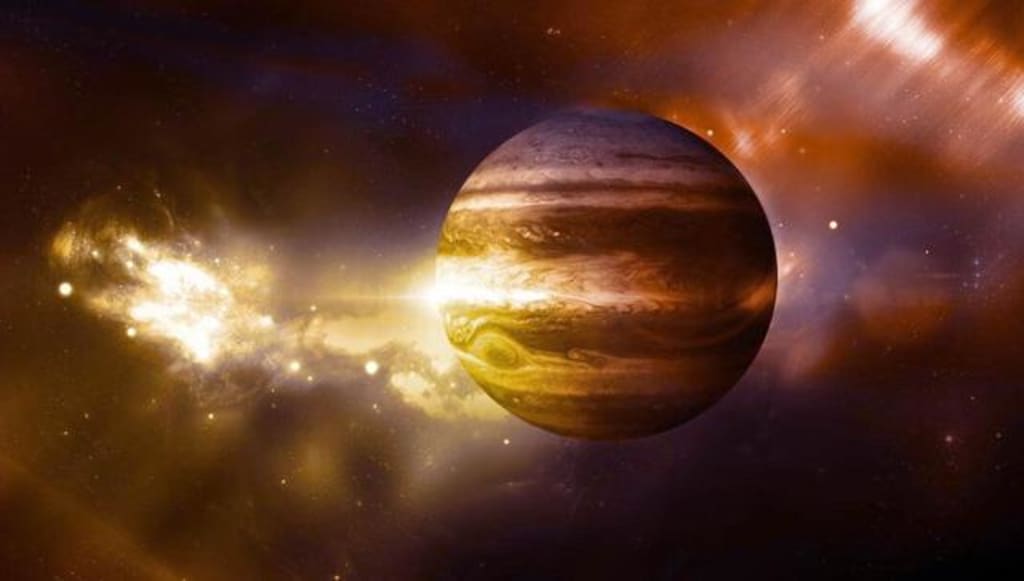
Jupiter and Saturn are the first and second largest planets in the solar system respectively, with Jupiter's average diameter being about 139,822 km and Saturn's average diameter being about 116,464 km. In terms of volume, Jupiter is not much bigger than Saturn, but in terms of mass, Saturn is far less than Jupiter, as Saturn's mass is about 5.6834 x 10^26 kg, while Jupiter's mass is about 1.8982 x 10^27 kg.
The difference between the second largest planet in the solar system and Jupiter is so great, not to mention the other planets the mass of Jupiter is more than twice the sum of the mass of the other planets in the solar system, it can be said to be "proud of the stars", so the question arises, why is Jupiter so big? The answer is: because at the beginning of the formation of the solar system, it picked up a big bargain.
There are a huge number of stars in the observable universe, among which there are "old" ones, "young" ones, and of course, those at the beginning of their life. If we observe enough stars, we can collect stars in all stages.
In the past, scientists have observed a large number of stars at the beginning of their lives, and analysis has shown that all of these stars evolved from primordial nebulae without exception.
In simple terms, the primordial nebula collapses under the influence of gravity, and in the process, the material in the nebula will continue to gather towards its gravitational center and eventually form a shining star, after which the remnants of the nebula will orbit around the new star and accrete with each other, thus forming a multitude of objects around the new star.
So there is every reason to believe that our solar system also formed from a primordial nebula. This is the prevailing view in the scientific community, and scientists believe that our solar system was born about 4.57 billion years ago from a primordial nebula called the "solar nebula" that evolved after a gravitational collapse.
The formation of the Sun and its planets can be divided into four steps: 1) the "solar nebula" began to collapse; 2) the Sun formed at the center of the nebula; 3) the remnants of the nebula formed a disk-like structure around the Sun called the "protoplanetary disk"; 4) the "protoplanetary disk" was formed in the middle of the Sun. The material in the "protoplanetary disk" continues to accrete with each other, eventually forming the eight planets we see today.
According to common sense, the closer the "protoplanetary disk" to the Sun, the more dense the material in the region, so the closer to the Sun, Mercury, Venus, Earth, and Mars should be larger than Jupiter, but we all know that the actual situation in the solar system is not the case, why? It is explainable.
From the diagram of the three phases of water, we can see that in the absence of pressure or low pressure, water can not exist in liquid form, in fact, for other substances, this law also applies. Since there is no environment with stable pressure in the protoplanetary disk, almost all matter in the disk can only exist in gaseous and solid forms.
Ideally, the solid matter would snowball by colliding with each other and accreting, and when its mass reaches a certain level, its gravitational force would be sufficient to attract nearby gas, which would then increase further.
However, in regions closer to the Sun, this "ideal situation" does not exist, because the Sun, on the one hand, causes many volatile substances (such as water, ammonia, methane, carbon monoxide, carbon dioxide, etc.) to exist only in gaseous form due to its heat, and on the other hand, the stellar wind released by the Sun will, the stellar winds released by the Sun will continue to drive the gas outward from the "protoplanetary disk".
This results in relatively little solid matter and a continuous outward escape of gaseous matter so that only rocky planets of relatively small size and mass form in this region.
As the distance from the Sun increases, the temperature decreases, and when the distance increases to a certain point, the volatile material condenses into a solid, which becomes easy to accrete.
We can refer to the distance at which volatiles can condense into solid particles as the "freeze line". "According to scientists' estimates, at the beginning of the solar system, the "freeze line" ranged from about 2.7 to 5 astronomical units from the Sun.
It is conceivable that if a planet formed right at the outer edge of the "freeze line", it would undoubtedly be a great bargain because it would have access to a lot of solid matter here and would grow rapidly.
Yes, you guessed it, Jupiter got such a great advantage. According to scientists, 3 million years after the formation of the Sun, the mass of Jupiter at the outer edge of the "freeze line" increased enough to bind hydrogen and helium, and after that, Jupiter began to absorb a lot of material (mainly hydrogen and helium) that escaped from the inner part of the solar system. After that, Jupiter began to absorb a lot of material (mainly hydrogen and helium) that had escaped from the inner part of the solar system and grew rapidly into a huge planet.
Of course, Jupiter could not absorb all the material that escaped from the inner solar system, so Saturn, Uranus, and Neptune, which are located on the outer side of Jupiter, also got a share in varying degrees, although they did not absorb as much material as Jupiter, but enough to grow into giant planets much larger than Earth.
About the Creator
Robert Jack
One of the secrets of emotional stability for adults is to keep the expectations of others to a minimum.
Keep reading
More stories from Robert Jack and writers in Earth and other communities.
Denmark and Greenland Prepare for US Talks as Trump Says Territory’s PM Has a ‘Big Problem’
Denmark and Greenland are preparing for crucial talks with the United States amid renewed diplomatic tension, after former US President Donald Trump claimed that Greenland’s prime minister has a “big problem.” The remarks, reported as part of ongoing European political coverage, have drawn attention to the fragile balance between diplomacy, sovereignty, and strategic interests in the Arctic. As delegations ready themselves for discussions in Washington, the episode underscores how Greenland has once again become a focal point in global geopolitics.
By Aarif Lasharia day ago in Earth


Comments
There are no comments for this story
Be the first to respond and start the conversation.