
When Trees Walk: The Enchantment—and Truth—Behind Socratea exorrhiza
Deep in the Amazon, a palm tree seems to defy nature itself—creeping across the forest floor like a living riddle, half legend, half science.

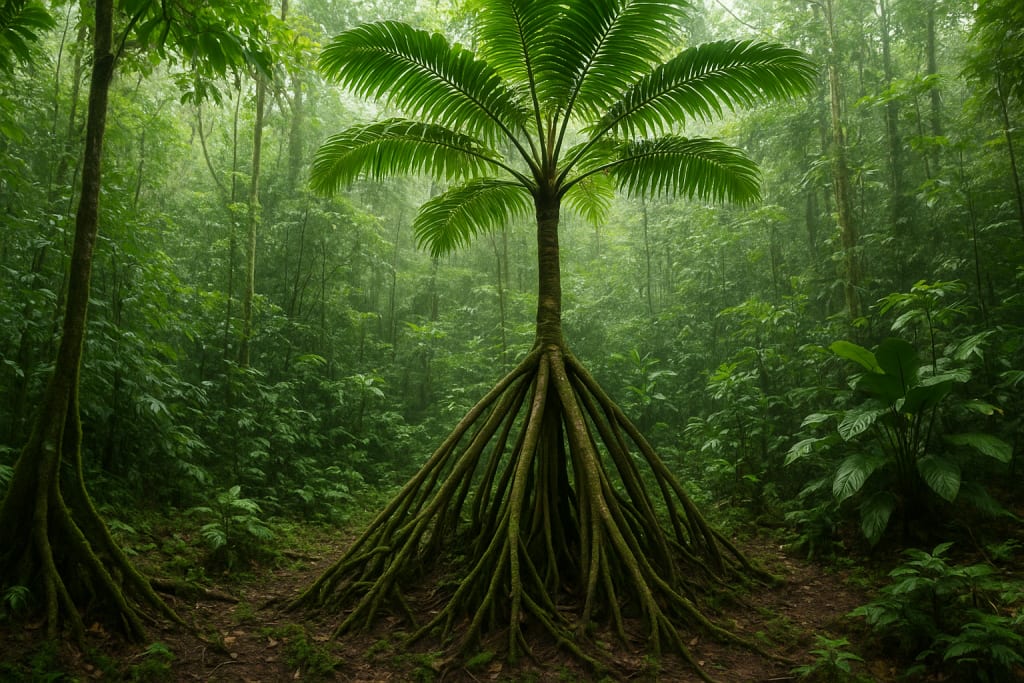
When the rubber boom swept through the Amazon in the late 19th century, foreign travelers carried home wild tales of the rainforest. Most were met with skepticism, but few stirred as much disbelief as the story of a tree that could walk. Explorers spoke of tall palms that, when the ground beneath them shifted or grew too dark, slowly migrated toward new soil and brighter light. According to local lore, they did so under the veil of night, their roots inching forward like legs in a ghostly march.
Indigenous guides pointed to towering trees with stilt-like roots radiating outward from their trunks, swearing that each cluster had not stood in the same place a decade before. “By the time your grandchildren return,” one guide told a missionary, “that tree will be over there.” The man pointed thirty feet away. For those unaccustomed to the mysteries of the rainforest, the claim sounded like pure fantasy.
And yet, to this day, the Socratea exorrhiza—known simply as the walking palm—remains a botanical enigma that bridges myth and science.
Anatomy of a legend
The walking palm’s appearance alone is enough to inspire stories. Instead of a single sturdy base, its trunk rests on dozens of long, spidery roots that sprawl downward in all directions, elevating it above the forest floor. In the dim light of the understory, it seems less like a tree and more like a tripod set in motion.
Local tribes long believed these roots allowed the tree to “step” away from danger: shifting riverbanks, falling debris, or the suffocating shade of taller neighbors. Some myths even claimed the palms moved to escape people, uprooting themselves at night so that hunters awoke to find the forest rearranged.
Science behind the mystery
Scientists have studied the palm for decades, and the truth is both less dramatic and no less fascinating. The tree does not pull up its roots and march across the jungle like a giant insect. Instead, its growth pattern creates the illusion of motion.
New roots sprout in the direction of better light or more stable soil, while older roots on the opposite side wither away. Over years, this gradual renewal can shift the trunk’s position by several feet. To a human observer it might look motionless, but to the rainforest, where centuries shape the landscape, such a drift is meaningful.
This adaptation is not mere curiosity—it may be a survival strategy in a world where shade, floods, and competition are constant threats. The palm’s peculiar design helps it endure where other trees would collapse.
Echoes in culture
Beyond biology, the walking palm has become a symbol in Amazonian folklore. Among the Shuar and other indigenous peoples, the tree embodies patience and resilience, teaching that even the smallest, slowest changes can alter fate. It is said to be a restless spirit of the forest, always seeking a better place to stand.
Travelers who visit the Amazon often encounter guides who retell these stories, weaving science with myth to enchant their audiences. Some describe the palm as “the only tree with free will.” Whether tourists believe it or not, they rarely forget the image of a tree that chooses its own path.
The rainforest in motion
The walking palm is more than a curiosity; it is a metaphor for the rainforest itself. The Amazon is never still. Rivers shift their courses, vines twist around trunks, animals migrate in search of food, and even the trees appear to move.
The slow journey of the palm mirrors the slow collapse and renewal of the forest. Every step it takes—measured not in hours but in decades—reminds us that life in the Amazon is about constant adjustment.
An uncertain future
Yet the future of the walking palm, like that of the rainforest around it, is uncertain. Logging, mining, and the spread of agriculture continue to strip away vast swaths of jungle. Climate change alters rainfall patterns, threatening the delicate balance that species like Socratea exorrhiza depend upon.
In this light, the palm’s myth of movement takes on a new poignancy. It may survive storms and shifting soil, but it cannot simply “walk away” from bulldozers or fire. Its legendary adaptability is no match for human destruction.
Between wonder and doubt
So, does the walking palm really walk? The honest answer is: not in the way legend suggests. It does not wander the jungle like a ghostly nomad. But through slow, persistent growth, it changes its place in the forest, inch by inch, year by year.
And perhaps that is why the myth endures. Because whether in science or in story, the walking palm whispers the same lesson: survival is not about standing still—it is about moving, however slowly, toward the light.
References
1. Nature and Culture International. (2024). The “Walking” Palm Tree. [Online]. Available at: https://www.natureandculture.org/directory/walking-palm-trees/
2. Radford, B. (2012). Can ‘Walking Palm Trees’ Really Walk?, Live Science. [Online]. Available at: https://www.livescience.com/33663-walking-tree-socratea-exorrhiza.html
3. Radford, B. (2009). The Myth of the Walking Tree, Skeptical Inquirer, November–December. [Online PDF]. Available at: https://skepticalinquirer.org/wp-content/uploads/sites/29/2009/11/p23.pdf
4. Cassella, C. (2023). A Persistent Rumor Suggests This Tree Can Walk Around, But Is It True?, ScienceAlert. [Online]. Available at: https://www.sciencealert.com/a-persistent-rumor-suggests-this-tree-can-walk-around-but-is-it-true
About the Creator
Jiri Solc
I’m a graduate of two faculties at the same university, husband to one woman, and father of two sons. I live a quiet life now, in contrast to a once thrilling past. I wrestle with my thoughts and inner demons. I’m bored—so I write.
United States Lawn Mowers Market Size and Forecast 2025–2033
The United States Lawn Mowers Market is expected to reach US$ 15.91 billion by 2033, rising from US$ 9.64 billion in 2024, registering a CAGR of 5.73% during 2025–2033. This strong growth trajectory reflects changing lifestyles, increased spending on home improvement, and rapid technological innovation across outdoor equipment. From battery-powered walk-behind models to autonomous robotic mowers guided by GPS and artificial intelligence, the industry is undergoing a structural shift toward efficiency, sustainability, and user convenience.
By Renub Research7 days ago in Earth
Judge Trump: Courtroom Battles and Public Questions Surrounding Donald Trump
Judge Trump: Courtroom Battles and Public Questions Surrounding Donald Trump Donald Trump’s name has been repeatedly linked with judges, courts, and major legal decisions over the past several years. As a former president and a high-profile political figure, Trump has faced intense legal scrutiny, making judges central figures in news coverage and public debate. The phrase “Judge Trump” has come to reflect public curiosity about the judges who oversee Trump-related cases, their rulings, and how these legal battles may affect his political future. Understanding this topic requires looking at the legal landscape, the role of the judiciary, and the most common questions people ask. Judge Trump: Courtroom Battles and Public Questions Surrounding Donald Trump
By America today 7 days ago in Earth
Miss Persephone's Manual to a Seemingly Ordinary Life
Miss Persephone was found at the dining table, her blue eyes swollen, her tears arriving and retreating like the tides of the ocean. Earlier that day, her family had visited her in the retirement home where she had lived for eight years. It was her eightieth birthday.
By Imola Tóth2 days ago in Fiction


Comments
There are no comments for this story
Be the first to respond and start the conversation.