
When the Sky Turned Silent
A story of vanishing birdsong, climate grief, and the quiet fight for hope

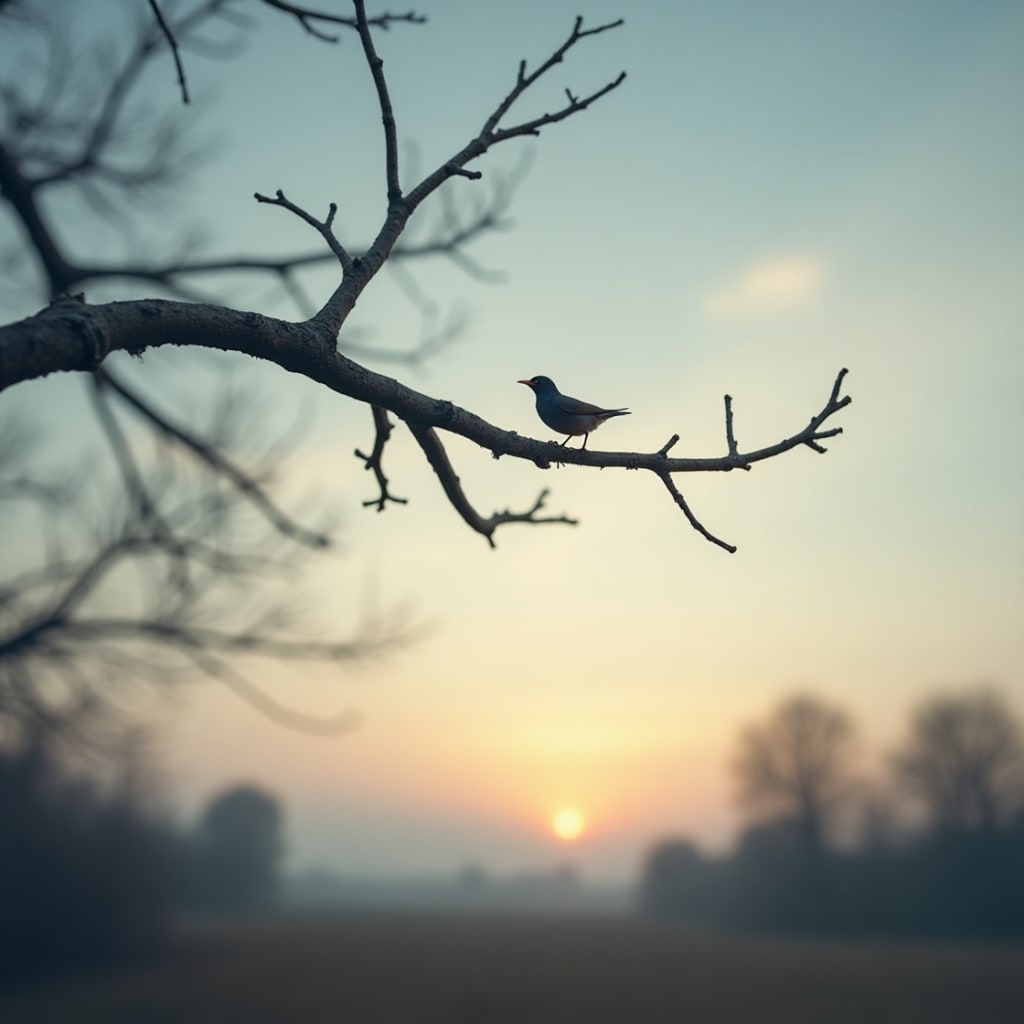
There was a time when mornings came with music.
Not from machines or playlists, but from the feathered choir that gathered outside my window. They sang without reason, without schedule. Warblers, thrushes, sparrows—they were the alarm clocks of the Earth, reminding us that the world was still turning, still breathing.
And then one spring, they didn’t come back.
The trees still blossomed. The wind still whispered through the leaves. But the melodies were missing—like a song you once loved but can no longer remember. The silence was not immediate. It crept in slowly, like fog curling around the ankles. Fewer chirps in the morning. Less flutter in the branches. An emptiness you couldn’t name at first… but felt.
I didn’t notice until it was gone.
That’s the tragedy of silence—it’s loudest when it replaces something precious.
I began to walk the fields I used to visit with my father. He taught me the names of birds the way some teach prayers: reverently. “That's a skylark,” he’d say, pointing skyward. “And that whistle? That’s the song of a robin defending its place in the world.”
I used to think the sky belonged to the clouds.
Now I know it belonged to the wings that filled it.
That spring, the sky turned silent.
Not because the birds chose to leave—but because we gave them no reason to stay. Their homes had been shredded by machinery. Their food poisoned by our hunger for convenience. The warmth they relied on came too soon, too fast, confusing the rhythm their ancestors trusted for generations.
We called it climate change.
They called it the end.
I started documenting what remained. A few doves. A hawk, high and restless. One stubborn blackbird in the evening. I downloaded apps, joined forums, learned how to recognize birds by call and by absence. But mostly, I mourned.
Not just for the birds.
For us.
Because when the sky turns silent, something in us goes quiet too. A knowing, a connection, a soft thread that tied us to the world in ways we never fully understood.
My niece, only six, once asked me why I was listening so hard to “nothing.”
I told her I was listening for what used to be there.
She frowned. “Can we bring it back?”
I wanted to say yes. I wanted to give her hope instead of heartbreak.
But hope, I’ve learned, is not something you hand to someone like a gift. It’s something you plant—like a seed—and water every day.
So I said, “Maybe. If enough of us remember.”
We started small.
She made feeders out of juice boxes. I replanted native shrubs in our backyard. We banned pesticides from the garden, even if it meant weeds won a few rounds. We put out water dishes. We joined a community group that did bird counts, picked up litter from wetlands, and wrote letters to local politicians.
Some days, it felt pointless. Like throwing pebbles into a tsunami.
But then came the morning I heard a single, high whistle.
Not a memory. Not a recording.
A real bird, singing.
My niece ran out barefoot, eyes wide. “Did you hear that?”
I nodded. “It’s a start.”
And maybe that’s all healing ever is—starts.
Small sounds after long silences.
Tiny wings beating against impossible odds.
The sky hasn’t returned to its former symphony.
But now, the silence is no longer absolute.
There are days when I still ache with grief. When I remember forests I once wandered in that are now fields of stumps. When I hear chain saws and bulldozers louder than any songbird. When the headlines remind me of species declared extinct this week.
But then I see my niece carefully refilling the birdbath.
Or watch a young couple planting trees in a schoolyard.
Or read a report about local birds returning to habitats once ruined.
And I realize: the sky may have turned silent…
But it doesn’t have to stay that way.
We were the reason they vanished.
Maybe—just maybe—we can be the reason they return.
Closing Line:
And so, we listen—not just for the birds, but for the echo of our responsibility, waiting to be answered with action.
About the Creator
Keep reading
More stories from hazrat ali and writers in Earth and other communities.
Eyes of the King: Lessons from the Savannah
Eyes of the King: Lessons from the Savannah The vast savannah stretched endlessly beneath the golden sun, a canvas painted with whispers of ancient tales and primal truths. Here, where the grass swayed in waves and the wind carried stories, lived the king—majestic, fierce, and watchful. The lion, with eyes sharp as the edge of dawn, ruled not just with strength but with a wisdom written deep into the land itself.
By hazrat ali6 months ago in Humans
The Reality of the Illusion of Time
Recently, as I strolled along the short stretch to my strength training session, I aimlessly took in the row of tatty shops and shabby buildings along the route and passed an off-street, in which one of my sisters used to live, around thirteen years ago.
By Chantal Christie Weiss3 days ago in Earth
Why Putin Went Quiet When Challenged by Trump Over Venezuela
When U.S. forces captured Venezuelan President Nicolás Maduro in early January 2026, the world was stunned. Venezuela has long been a Russian ally, yet Russian President Vladimir Putin remained almost completely silent when challenged directly by U.S. President Donald Trump. Why would a leader so often outspoken on the world stage hold back in such a dramatic moment? Let’s unpack the story and explore what it means for global politics. A Bold Move That Shocked the World On January 3, U.S. forces executed a daring operation in Venezuela, taking Maduro into custody in New York to face charges including drug trafficking and narco‑terrorism. The operation was framed by the U.S. as a step to enforce justice, but critics saw it as an extraordinary overreach of power. Venezuela is no ordinary country for Russia. Since the days of Hugo Chávez, Moscow has cultivated close ties with Caracas, offering military support, energy deals, and diplomatic backing on the global stage. Past actions included Russian bombers visiting Venezuela and high-profile defense agreements. Given this history, many expected a fiery response from Putin. Yet, the Kremlin remained calm, issuing measured statements rather than sharp threats. Why Silence Was Strategic Experts suggest there are several reasons for Putin’s muted reaction, each revealing the careful calculation behind the Kremlin’s foreign policy. 1. Focus on the War in Ukraine Russia’s primary priority remains Ukraine. Engaged in a high-stakes military and diplomatic battle, Putin cannot afford distractions or new confrontations far from home. Escalating tensions with the United States over Venezuela could jeopardize Moscow’s position in Europe. A New York Times report highlighted that Russia is “subordinating all other interests to the war in Ukraine,” suggesting that even a high-profile ally like Venezuela takes a back seat to Moscow’s strategic goals. 2. Limited Military Options While Russia’s alliance with Venezuela is longstanding, much of the support has been symbolic rather than operational. Defense systems and military cooperation exist on paper, but Russia lacks the immediate ability to counter a U.S. operation thousands of miles away. Putin may have recognized that responding aggressively would be both ineffective and costly, potentially risking military and economic consequences that Moscow cannot afford. 3. Maintaining Diplomatic Channels with Washington With Donald Trump back in the White House since 2025, there has been cautious optimism in Moscow about recalibrating U.S.–Russia relations. Avoiding a dramatic confrontation over Venezuela keeps diplomatic channels open, allowing Russia to negotiate on other high-priority issues like Ukraine and sanctions relief. In other words, silence can be a calculated strategy, signaling restraint rather than weakness. 4. Russia’s Global Influence Is Waning The Maduro episode also highlights a broader geopolitical reality: Russia’s global reach has limits. Since the 2022 invasion of Ukraine, Moscow’s influence in regions like the Middle East and parts of the former Soviet Union has weakened. Venezuela remains one of its few high-profile allies outside Europe, but even there, Russia’s power is largely symbolic. By not escalating, Putin is acknowledging a practical truth: Russia cannot be everywhere at once, and some battles are not worth fighting. 5. Choosing Battles Wisely Some analysts emphasize that Putin’s quiet response is more about strategic prioritization than capitulation. In a world dominated by nuclear powers and volatile global politics, direct confrontation with the United States over Venezuela could spiral into a far larger crisis. By staying silent, the Kremlin may be signaling that it picks its battles carefully, focusing resources on Ukraine, where the stakes are highest. What This Means for the World Putin’s silence sends several messages: Russia is currently stretched, economically and militarily. Moscow is prioritizing Ukraine over symbolic allies. Strategic restraint is sometimes more powerful than public confrontation. The limits of Russian influence are becoming more visible to the world. This episode reflects a new reality in geopolitics: power is as much about choosing when not to act as when to assert force. The Bigger Picture The capture of Maduro is a defining moment not just for Venezuela, but for global politics. It shows the United States asserting power in a way not seen for decades, while Russia’s quiet reaction underscores its current limits and priorities. For observers, Putin’s silence is a lesson in modern geopolitics: even the most assertive leaders exercise restraint when stakes are high and risks are global. In the end, the Maduro affair reminds us that in today’s world, the loudest response is not always the most effective one — sometimes, quiet calculation speaks volumes. Sources and Further Reading The US capture of Maduro reveals Russia’s weakness – Atlantic Council ‘It sends a horrible signal’: US politicians react to capture of Nicolás Maduro – The Guardian Russia slams 'neocolonial threats' against Venezuela – Reuters
By Muhammad Hassan7 days ago in Earth
The Devil's Cut
“Comrade, finally you’re awake.” The voice was smooth, sensual. A flickering incandescent bar was all that lit the white, sterile room. All Vladimir remembered was everything going black. He tried to move his arms and found them strapped to the gurney.
By Matthew J. Fromm3 days ago in Fiction



Comments
There are no comments for this story
Be the first to respond and start the conversation.