
When the Air Turns Hostile: Reflecting on an Extreme Cold Watch
A personal look at how frigid warnings reshape not just our routines, but our understanding of vulnerability, community, and control in a changing climate.


It’s strange how silence feels different in the cold. During an extreme cold watch, the air seems to stop moving, and even the smallest sound—footsteps, a car starting—takes on a sharper edge. I’ve lived through New York winters all my life, but it wasn’t until last week that I realized how menacing stillness can be. When the temperature dropped below ten degrees, and the wind made it feel worse than memory could calculate, I suddenly understood the phrase “life-threatening cold.” It wasn’t drama—it was data made flesh.
The local alerts came first, repeating on the radio and phone notifications that we were entering a stretch of “dangerously low wind chills.” Phrases like “frostbite within minutes” and “limit outdoor exposure” felt absurdly formal for something that, once outside, required no elaboration. The kind of cold where your eyelashes freeze together is humbling; it takes your body hostage and leaves your mind catching up, realizing belatedly how small humans are when nature decides to turn unfriendly.
Growing up, I used to romanticize winter. I thought of it as clean, picturesque, and somehow moral—cold as purity, snow as renewal. But standing on the porch that morning, hearing the frozen cracking of tree limbs under the kind of air that punishes movement, I felt no poetry. Just fragility. Every sound—the groan of my heating pipes, the rattle of the siding—announced its own struggle to endure. It made me strangely aware of how much our homes do to shelter us from the violence of the natural world.
There’s something psychologically unnerving about an extreme cold watch, too. It’s not an immediate disaster; it’s a state of waiting. The alert says conditions may reach dangerous levels, which means you’re suspended between preparedness and helplessness. Do you stock up on supplies as if you’re about to weather a snowstorm? Or do you go to work, trusting the heater and the forecast models to behave? That tension mirrors our broader climate anxiety. We live in a permanent state of “watch”—aware of what’s coming but seldom sure when it will break over us.
I thought about my grandparents, who grew up in a farmhouse with a wood stove. For them, a stretch of subzero weather was exhausting but not existential. They understood the patterns of the land. Now, our dependence is almost entirely shifted to invisible systems—pipelines, electric grids, global supply lines that must all hold for survival to feel routine. When the power flickers in a modern winter, it’s not just an inconvenience; it’s a reminder of how thin the line of stability has become.
When meteorologists issue an extreme cold watch, they’re speaking in degrees and wind speeds, but what they’re really forecasting is vulnerability. For the homeless, for the elderly living alone, for those who can’t afford adequate heating, that “watch” is a warning that survival will come down to community response. I thought of a neighbor I barely know who uses a wheelchair; that night, I knocked on her door, asking if she needed groceries before the storm hit. She smiled, surprised. I think both of us realized that weather alerts don’t just test infrastructure—they test empathy.
That week, everything slowed down. People canceled appointments without apology. Conversations in the grocery store briefly replaced the usual impatience with shared caution: “Stay warm out there,” said with new sincerity. There’s something honest about a cold so sharp that it forces people into a universal rhythm of care. You can’t negotiate with air temperature. You adapt, or you suffer. There’s no illusion of control, and maybe that’s why it brings out a kind of reluctant solidarity.
Personally, I spent most of that weekend inside, watching my breath fog near the kitchen window and listening to the radiator clank like an aging heart. The only trips outside were to feed the birds, whose frantic movements made them seem like tiny, desperate survivors of the same indifferent physics the rest of us faced. I used to think that kind of empathy—toward animals, toward strangers—was sentimental. Now I see it differently. It’s clarity.
The experience left me thinking about what happens after the alerts end. Warmth returns, routines resume, and we act as though it were an isolated event. But I’ve noticed that these “extreme watches” are more frequent now, more erratic. Cold snaps that once came like clockwork now arrive unpredictably, dragging wind patterns that make meteorologists revise their models midweek. You start to suspect that we’ve crossed from weather into consequence.
The phrase extreme cold watch sounds bureaucratic, but what it really demands is a reckoning: how quickly nature humbles precision. For years, I trusted that progress—smart thermostats, energy grids, city alerts—would make weather more manageable. But the older I get, the more I sense that every alert, every storm, every freeze is a quiet reminder: adaptation isn’t mastery. The planet never stops reminding us who’s the host and who’s the guest.
When the watch lifted and temperatures rose just enough for breath to stop stinging, I walked outside at dusk. The street looked almost forgiving again, but I felt changed. Not because of fear, but awareness. Winter had made its point without needing drama—just silence, and air cold enough to demand respect. I pulled my scarf a little tighter, looked at the faint frost still hanging on the branches, and thought about how every extreme condition has a story to tell—if we’re willing to listen from inside the warmth we so easily take for granted.
About the Creator
Trend Vantage
Covering the latest trends across business, tech, and culture. From finance to futuristic innovations, delivering insights that keep you ahead of the curve. Stay tuned for what’s next!
Keep reading
More stories from Trend Vantage and writers in Earth and other communities.
Eagles: The Majestic Predators of the Sky
Eagles are among the most revered and awe-inspiring birds of prey in the animal kingdom. Known for their impressive size, keen eyesight, powerful talons, and regal presence, eagles have captured human imagination for centuries. They symbolize strength, freedom, and courage across various cultures and are often featured in heraldry, national emblems, and folklore.
By Trend Vantage5 months ago in Earth
Trump’s Greenland Threats Push Europe Toward Divorcing America
When you think of Greenland, the first things that probably come to mind are icebergs, polar bears, and maybe some adventurous explorers. But lately, Greenland has become the center of a major diplomatic drama — one that’s forcing Europe to question its long-standing relationship with the United States. And the spark? Donald Trump’s threats over Greenland. The Controversy: Trump’s Unusual Move Back in January 2026, Trump shocked the world again, not with an election campaign but with a bold — and many would say bizarre — plan to acquire Greenland. But he didn’t stop at just “expressing interest.” He threatened eight European nations with tariffs — starting at 10% and potentially climbing to 25% — unless Denmark agreed to sell Greenland to the U.S. Yes, you read that right: tariffs on allies to buy a remote Arctic island. For Europe, this was more than shocking — it felt like a betrayal from a partner they’ve relied on for decades. Europe’s Response: Outrage and Solidarity European leaders didn’t hold back. Germany, France, Norway, the UK, and others banded together to condemn Trump’s approach. The message was clear: Europe won’t be blackmailed. Even usually cautious leaders spoke up. Norway’s Prime Minister bluntly said, “Threats have no place among allies.” Meanwhile, European Commission President Ursula von der Leyen emphasized that tariffs between allies “have no place” and could undermine decades of cooperation. This isn’t just a political disagreement. Europe sees this as a test of trust, sovereignty, and alliance reliability. Why Greenland Matters At first glance, Greenland might seem like just a frozen island. But strategically, it’s a big deal: Location: Greenland sits between North America and Europe, controlling key air and sea routes. Military Importance: It hosts radar and U.S. military infrastructure critical to early-warning systems. Resources: Beneath the ice lie minerals and rare earth elements that the world desperately needs. For Europe, Greenland is also about principle. The island belongs to Denmark and the Greenlandic people, not Washington. Europe’s support for Denmark shows a broader commitment to respecting sovereignty — a principle that Trump’s threats directly challenged. The Bigger Picture: A Crisis of Trust Greenland may just be the tip of the iceberg. For years, European nations have felt frustrated by U.S. policies that seemed unpredictable — whether it’s climate agreements, trade deals, or security commitments. Trump’s Greenland threats amplified these frustrations. Suddenly, Europe is questioning something fundamental: Can the U.S. be trusted as a long-term partner? Some European leaders have even started talking about a kind of “divorce” from the U.S. — not literally leaving NATO, but rethinking how dependent they should be on America for security and strategic decisions. Europe’s Path Toward Strategic Independence This Greenland drama is accelerating discussions about European strategic autonomy. Basically, Europe is asking: Should we be able to protect our own interests without always relying on the U.S.? The EU has long talked about building stronger defense capabilities and investing more in its own military, but progress has been slow. Greenland might just be the wake-up call that finally pushes Europe to act. What’s Next? So, what happens from here? Europe isn’t just going to sit quietly. Leaders are looking at: Economic counter-measures like tariffs on U.S. goods Strengthening European defense and security collaboration Reasserting Europe’s role on the global stage, with less reliance on Washington Even if Europe doesn’t fully “divorce” America, Greenland is changing the terms of the transatlantic partnership. Europe will now demand more respect, clearer rules, and recognition of its sovereignty — and they’re not afraid to make that clear. Why This Matters to All of Us You might wonder why this matters if you’re not in Europe or the U.S. Greenland may seem remote, but this story is about alliances, trust, and how global power is shifting. The way Europe responds could reshape the world order, affect trade, military cooperation, and even the global economy. And for anyone following U.S.-European relations, it’s a reminder that sometimes the smallest places — even a frozen island — can have huge global consequences. Bottom line: Trump’s Greenland threats aren’t just a bizarre footnote in history. They’re a wake-up call for Europe, forcing the continent to rethink its ties with America and consider a future where it can act independently — strategically, economically, and politically. Greenland, icy as it is, might just melt the old rules of alliance forever.
By Muhammad Hassan3 days ago in Earth
Australia Organic Fertilizer Market Size and Forecast 2025–2033
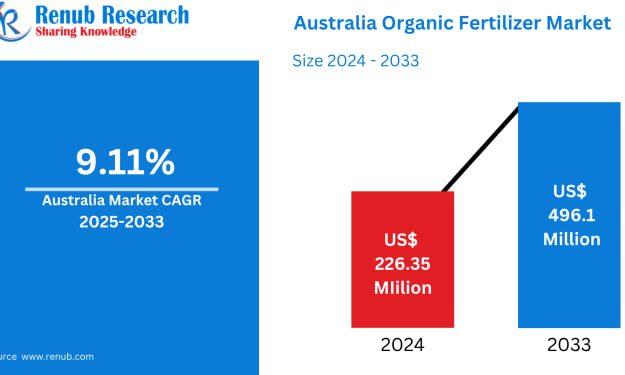
Australia Organic Fertilizer Market Outlook The Australia Organic Fertilizer Market is entering a strong growth phase as sustainability becomes a core priority for farmers, consumers, and policymakers alike. According to Renub Research, the market is expected to reach US$ 496.1 million by 2033, rising from US$ 226.35 million in 2024, expanding at a CAGR of 9.11% from 2025 to 2033.
By jaiklin Fanandishabout 5 hours ago in Earth


Comments
There are no comments for this story
Be the first to respond and start the conversation.