
Australia Organic Fertilizer Market Size and Forecast 2025–2033
Sustainable Farming Takes Root as Australia’s Organic Fertilizer Market Grows at 9.11% CAGR

Australia Organic Fertilizer Market Outlook
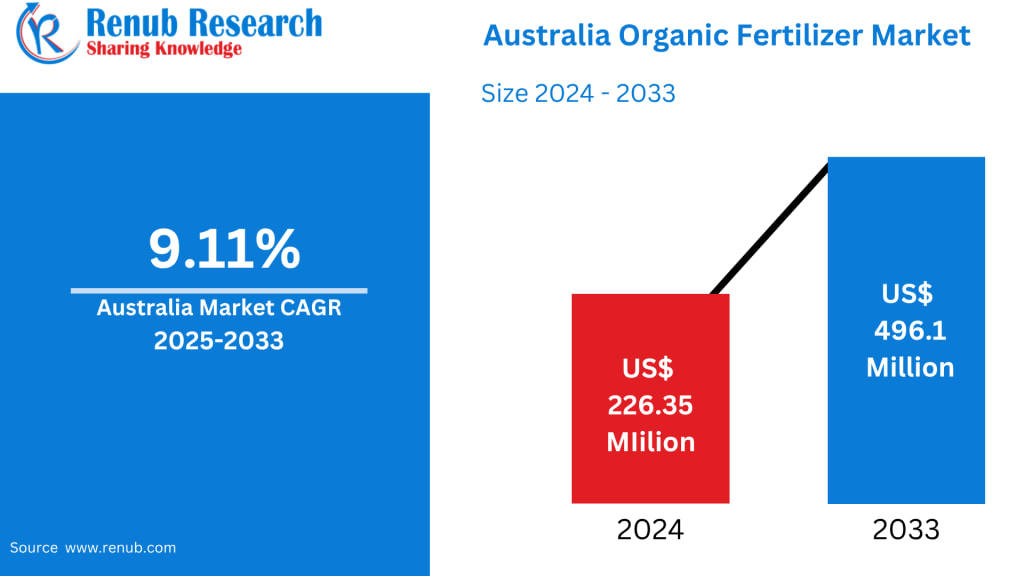
The Australia Organic Fertilizer Market is entering a strong growth phase as sustainability becomes a core priority for farmers, consumers, and policymakers alike. According to Renub Research, the market is expected to reach US$ 496.1 million by 2033, rising from US$ 226.35 million in 2024, expanding at a CAGR of 9.11% from 2025 to 2033.
This impressive growth reflects a fundamental shift in Australian agriculture. Farmers are increasingly moving away from chemical-intensive farming systems toward eco-friendly, regenerative, and soil-restoring practices. Organic fertilizers—derived from plant, animal, and natural mineral sources—are emerging as a critical solution to meet rising food demand while protecting soil health, biodiversity, and water resources.
With growing consumer demand for organic food, government-backed climate-smart farming initiatives, and advancements in bio-based fertilizer technologies, organic fertilizers are no longer a niche input but a mainstream agricultural necessity in Australia.
What Are Organic Fertilizers and Why They Matter
Organic fertilizers are produced from natural materials such as manure, compost, crop residues, seaweed, bone meal, and beneficial microorganisms. Unlike synthetic fertilizers, they release nutrients slowly, improve soil structure, enhance microbial activity, and increase long-term fertility.
In Australia’s climate—where droughts, soil erosion, and nutrient depletion are persistent challenges—organic fertilizers play a vital role in building resilient agricultural systems. They not only nourish crops but also restore soil carbon, improve moisture retention, and reduce dependency on imported chemical fertilizers.
Key Growth Drivers of the Australia Organic Fertilizer Market
1. Rising Consumer Demand for Organic Produce
Health-conscious consumers are driving the organic revolution. Australian households are increasingly choosing foods that are chemical-free, pesticide-free, and sustainably produced, leading to a surge in organic farming across fruits, vegetables, grains, and pulses.
As awareness grows around the link between food quality and chronic diseases, demand for organic produce continues to rise. According to national health data, cardiovascular diseases remain a leading health concern in Australia, strengthening consumer preference for healthier food choices. This trend directly boosts the use of organic fertilizers, as organic certification requires natural soil inputs.
Farmers are responding to this demand by transitioning to organic and regenerative farming systems—making organic fertilizers a core input rather than an alternative option.
2. Strong Government Support for Sustainable Agriculture
Government policies and funding programs are playing a decisive role in accelerating the organic fertilizer market. Australia’s commitment to climate-smart agriculture has resulted in substantial investments in soil health, carbon farming, and sustainable input use.
One notable initiative is the Climate-Smart Agriculture Program under the Natural Heritage Trust, which allocated US$ 302.1 million in 2023–2024. This includes a US$ 45 million Partnerships and Innovation Grant (2024–2028) to develop climate-resilient farming tools and practices. These programs actively promote organic fertilizers as a sustainable alternative to synthetic inputs.
As environmental regulations tighten and carbon reduction becomes mandatory across sectors, organic fertilizers are expected to see accelerated adoption across Australian farms.
3. Expansion of Organic Retail and Distribution Channels
Large supermarket chains like Woolworths and Coles have significantly expanded their organic food ranges, making organic products more accessible to mainstream consumers. At the same time, farmers’ markets and specialty organic stores are growing across urban and regional Australia.
This retail expansion creates a direct demand pull for organic farming inputs, including fertilizers. With reliable offtake channels and premium pricing, farmers are more willing to invest in organic fertilizers, strengthening market growth.
4. Advancements in Bio-Based and Microbial Fertilizers
Technological innovation is transforming organic fertilizers from traditional compost into high-performance bio-inputs. New formulations using microorganisms, nitrogen-fixing bacteria, phosphate-solubilizing bacteria, and biostimulants are improving crop yields while maintaining soil health.
These innovations make organic fertilizers competitive with synthetic alternatives, especially for high-value crops such as fruits, vegetables, and wine grapes. Improved efficiency and consistency are encouraging larger commercial farms to adopt organic fertilizers at scale.
Challenges Facing the Australia Organic Fertilizer Market
High Production Costs
Organic fertilizer production remains more expensive than chemical alternatives due to labor-intensive processes, longer production cycles, and quality control requirements. Raw materials such as manure, crop residues, and compost can also fluctuate in availability, driving up costs.
For cost-sensitive farmers—especially in commodity crops—this price difference can slow adoption, particularly when short-term returns are prioritized over long-term soil health.
Supply Chain and Logistics Issues
The supply chain for organic fertilizers is highly dependent on regional availability of organic raw materials. Seasonal variations, transportation challenges, and limited processing infrastructure can disrupt supply.
In remote agricultural regions, logistics costs can be high, limiting consistent access to organic fertilizers. Addressing these bottlenecks through local production facilities and digital supply-chain platforms remains essential for market expansion.
Recent Developments in the Australia Organic Fertilizer Industry
October 2024:
The Queensland government announced winners under the Regional Economic Futures Fund (REFF) and Backing Business in the Bush Fund (BBBF) fertilizer initiatives. Funding ranged from US$ 50,000 to US$ 12.75 million, supporting projects aimed at expanding organic fertilizer production.
Mort & Co. received funding to build new granulators and automated batching systems to boost organic fertilizer output near Dalby.
DataFarming secured funding to develop digital infrastructure linking farmers directly with fertilizer producers, improving transparency and supply efficiency.
October 2024:
Good Fruit & Vegetables magazine featured Flamingro, a certified organic chitin-based biostimulant that demonstrated a 26% increase in root mass during trials. Its launch in Australia marks a major step forward in bio-based fertilizer adoption, especially in viticulture and horticulture.
These developments highlight how innovation, investment, and collaboration are reshaping Australia’s organic fertilizer ecosystem.
Australia Organic Fertilizer Market Segmentation Analysis
By Source
Plant-Based
Animal-Based
Synthetic-Based
Plant-based and animal-based fertilizers dominate the market, driven by compost, manure, and crop residue recycling. These align closely with circular economy principles.
By Mode of Application
Seed Treatment
Soil Treatment
Root Dripping
Soil treatment remains the most widely used method, especially for large-scale cereal and grain cultivation. However, root dripping is gaining traction in high-value horticulture and greenhouse farming.
By Product Type
Microorganism
Azospirillum
Cyanobacteria
Phosphate-Solubilizing Bacteria
Azolla
Aulosira
Rhizobium
Azotobacter
Other
Microbial fertilizers are the fastest-growing segment, as they enhance nutrient availability and soil microbiome health.
By Organic Residues
Farm Yard Manure
Crop Residue
Green Manure
Other Products
Farmyard manure remains the backbone of organic fertilizer production, while crop residue recycling is increasing due to waste reduction policies.
By Crop Type
Cereals & Grains
Oilseeds & Pulses
Fruits & Vegetables
Others
Fruits and vegetables represent the highest adoption rate due to premium pricing of organic produce and consumer demand for chemical-free food.
By Form
Dry
Liquid
Dry organic fertilizers dominate due to ease of storage and transport, but liquid formulations are growing rapidly in precision farming systems.
Competitive Landscape and Key Players
The Australia organic fertilizer market features a mix of global innovators and regional manufacturers focusing on microbial technology, sustainable sourcing, and farmer education.
Key players analyzed from four viewpoints—company overview, key persons, recent strategies, and sales analysis—include:
National Fertilizers
Madras Fertilizers
Seek Biotechnology Co. Ltd
Coromandel International
Nagarjuna Fertilizers and Chemicals Ltd
T. Stanes & Company Limited
Novozymes
KRIBHCO
These companies are investing in bio-innovation, localized production, and digital platforms to strengthen their presence in the Australian market.
Future Outlook: A Green Transformation of Australian Agriculture
The next decade will be transformative for Australian agriculture. As sustainability shifts from preference to policy, organic fertilizers will become essential inputs for climate-resilient farming systems. With strong market growth, technological innovation, and institutional support, the organic fertilizer market is set to double in value by 2033.
The convergence of consumer demand, government backing, retail expansion, and soil health awareness positions organic fertilizers as a cornerstone of Australia’s green agricultural economy.
Final Thoughts
The Australia Organic Fertilizer Market is no longer driven by ideology alone—it is powered by economics, innovation, and necessity. With a projected market size of US$ 496.1 million by 2033, organic fertilizers are reshaping the way Australian food is grown.
As farmers, consumers, and policymakers align toward a shared sustainability vision, organic fertilizers will play a central role in ensuring healthy soils, healthy crops, and a healthy future for Australia’s agricultural sector.
About the Creator
jaiklin Fanandish
Jaiklin Fanandish, a passionate storyteller with 10 years of experience, crafts engaging narratives that blend creativity, emotion, and imagination to inspire and connect with readers worldwide.
Keep reading
More stories from jaiklin Fanandish and writers in Earth and other communities.
Global Calcium Carbonate Market Size & Forecast 2025–2033
Introduction: A Quiet Giant of Global Industry Calcium carbonate may not be a headline-grabbing material, but it is one of the most indispensable compounds in modern industrial life. Found naturally in limestone, marble, and chalk, this humble mineral underpins everything from the buildings we live in to the paper we write on and the plastics we use every day. Its low cost, wide availability, and remarkable versatility have made it a cornerstone raw material across multiple industries worldwide.
By jaiklin Fanandish3 days ago in Earth
Light Builder Waste Skip Bins: Convenient Solutions for Small Projects
Whether you’re renovating your home, cleaning out a small construction site, or completing a DIY project, managing light building waste efficiently is essential. Light builder waste skip bins provide an easy, safe, and environmentally friendly way to dispose of debris without hassle. In this blog, we’ll explore the benefits of light builder waste skip bins, how to choose the right size, and tips for using them effectively.
By Sydney Skip Binsabout 6 hours ago in Earth
Homeowners Don’t Want to Move: The Big Deal About Shrinking Backyards
In neighborhoods across the country, a subtle but growing trend is taking root: homeowners aren’t moving, and it’s not just because of the housing market. Many are staying put because their backyards—once spaces for relaxation, gardening, and family fun—are shrinking, either physically due to new development or symbolically as life priorities shift. What may seem like a minor detail—an ordinary backyard—is, for many, a defining feature of home life. Losing it can change how people live, play, and even feel about their communities. This shift has consequences for families, urban planning, and even the way cities are designed. It also sheds light on why homeowners are willing to compromise on size, style, or even location rather than give up their outdoor space. Why Backyards Matter More Than Ever Backyards are more than just patches of grass. They are extensions of our living space, providing: Personal outdoor retreats for reading, gardening, or hosting friends. Safe spaces for children and pets to play. Social hubs for barbecues, birthdays, and neighborhood gatherings. Mental and physical health benefits, including fresh air, sunlight, and exercise. For families who have invested years into landscaping, planting trees, or building decks and patios, the backyard is an emotional asset. Moving to a new home often means losing these personal touches—and many homeowners aren’t willing to take that step. “Backyards are part of our identity,” says Laura Jennings, a landscape designer in suburban Chicago. “People have memories tied to them—first steps, garden harvests, family barbecues. That’s why so many homeowners are staying put, even if it’s tempting to relocate for a bigger house or a better neighborhood.” The Trend of Shrinking Yards Urban densification and suburban development have slowly eaten into traditional backyard space. In many cities, large lots are being replaced with townhomes, duplexes, or small-lot single-family homes. Even in suburban neighborhoods, new constructions often prioritize indoor square footage over outdoor space. The shrinking backyard trend has several effects: Less room for recreation: Families may struggle to fit a swing set, pool, or garden into a smaller yard. Increased desire to stay put: Homeowners prefer maintaining a familiar outdoor space rather than trading it for a slightly larger indoor area. Higher emotional attachment: As yards become more limited, the significance of every tree, patch of grass, or vegetable garden grows. For many, the choice isn’t just about square footage—it’s about quality of life. Homeowners Are Making Trade-Offs As a result, more homeowners are staying in place longer, even if it means: Skipping a bigger kitchen or extra bedroom. Living in a less “trendy” neighborhood. Paying more in maintenance or property taxes to keep a cherished yard intact. Some have embraced innovative backyard solutions to maximize smaller spaces: Vertical gardens and container planting. Multi-functional patios that serve as dining, lounging, and play areas. Creative landscaping, including raised beds, pergolas, and tiny ponds. These adaptations allow homeowners to maintain the sense of space and enjoyment they’ve built over years without relocating. Emotional and Social Dimensions Beyond practical reasons, the backyard has a symbolic meaning. It represents: Continuity and stability: Homeowners see staying put as preserving a lifestyle. Family history: Many yards hold stories—graduations, summer afternoons, first bike rides. Community connection: Long-term residents know neighbors, local schools, and nearby amenities. Moving often means giving up these ties. A survey by the National Association of Home Builders found that over 60% of homeowners aged 35–55 preferred staying in their current homes, citing yard size and outdoor enjoyment as key factors. For these individuals, giving up a backyard is not a small inconvenience—it’s a major life decision. The Impact on Neighborhoods and Cities The trend of staying put also affects broader urban and suburban planning. Fewer homeowners moving means: Less turnover in neighborhoods, which can reduce housing market fluidity. Pressure on developers to include quality outdoor space in new builds. Greater demand for parks and community green spaces, as private yards shrink. Urban planners and developers are noticing the importance of outdoor space in retention and satisfaction metrics. Homes with usable yards, green roofs, or communal gardens often have higher value and attract long-term residents. The Future of Backyard Living As city lots shrink and suburban sprawl continues, homeowners are adapting: Smaller, highly curated gardens instead of sprawling lawns. Multi-functional backyards designed for work, play, and entertainment. Investment in outdoor amenities such as fire pits, decks, or small pools. Some communities are exploring shared backyard concepts, like community gardens and pocket parks, to supplement shrinking private spaces. While these aren’t a complete replacement for personal yards, they provide social and environmental benefits and may encourage homeowners to stay in their homes longer. Conclusion: More Than Grass and Trees Shrinking backyards might seem like a minor design issue, but for homeowners, it’s deeply tied to lifestyle, family life, and personal identity. The reluctance to move is not just a reaction to the housing market; it reflects an emotional, social, and practical connection to outdoor space that indoor square footage alone can’t replace. As urban density grows and lot sizes shrink, the importance of backyards will continue to shape homeowner decisions, neighborhood design, and community dynamics. Families are showing that a yard is not just grass and trees—it’s a place of memory, freedom, and connection. In a world where real estate trends often prioritize indoor luxury, the backyard remains a powerful symbol of home, anchoring families to the places they love—and keeping many from moving at all
By Muhammad Hassan3 days ago in Earth
Smart phones, Humans and Aliens.
WARNING. I will be tapping into one of your favorite creative tensions: The absurdity of humans worshipping their glowing rectangles as if they were tiny oracles. There’s something deliciously poetic about that contradiction, and it lends itself beautifully to an instructive proviso.
By Novel Allen6 days ago in Poets


Comments
There are no comments for this story
Be the first to respond and start the conversation.