
When Glaciers Roamed Mars
Uncovering Mars’ Icy Past: How Subglacial Melting Shaped the Arabia Terra Region

When Glaciers Roamed Mars
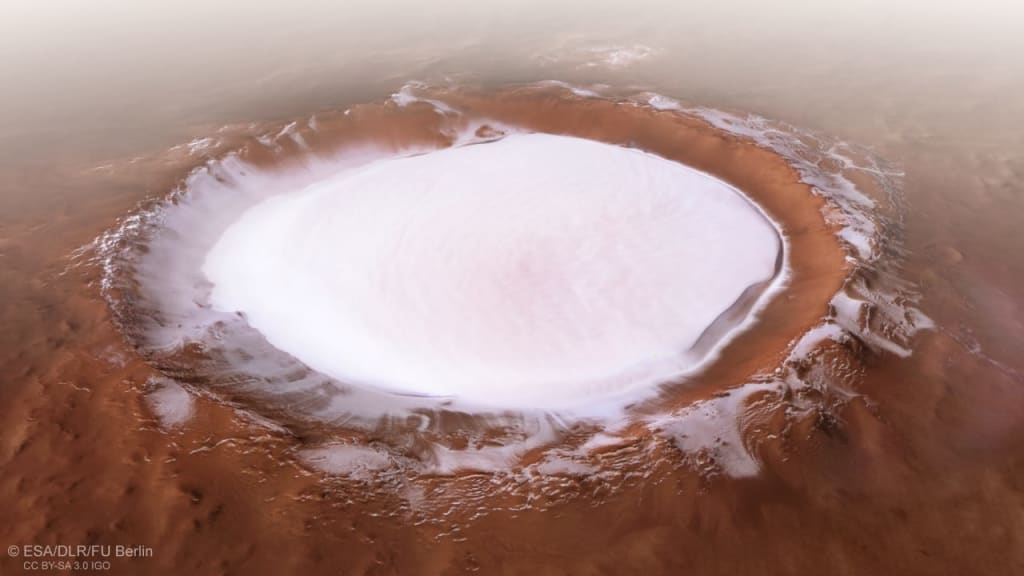
Mars often perceived as a cold and barren wasteland holds a rich history of climatic shifts that hint at a once warmer and wetter planet. While today the Martian landscape is dominated by dry rocky terrain scientists have long theorized that vast amounts of water once flowed across its surface. Evidence from river valleys lake beds and ice deposits suggests that glaciers and water bodies played a crucial role in shaping the Red Planet's topography. Recent research conducted by the Planetary Science Institute (PSI) sheds new light on the existence of subglacial melting in Mars’ northern Arabia Terra region, particularly in and around a mid sized crater and the adjacent Heart Lake System.
The Role of Glaciers in Martian History
Glaciers on Mars have fascinated scientists for decades as they provide vital clues about the planet’s geological past. Unlike Earth where water is abundant in its liquid form Mars’ water is mostly locked in polar ice caps subsurface glaciers and permafrost. The existence of these ice deposits suggests that Mars underwent significant climate changes in its past. The PSI study focuses on how subglacial melting might have influenced Mars’ geology specifically through the gradual retreat of glaciers which left behind distinct landforms and evidence of past meltwater flow.
The Heart Lake System and Evidence of Subglacial Melting
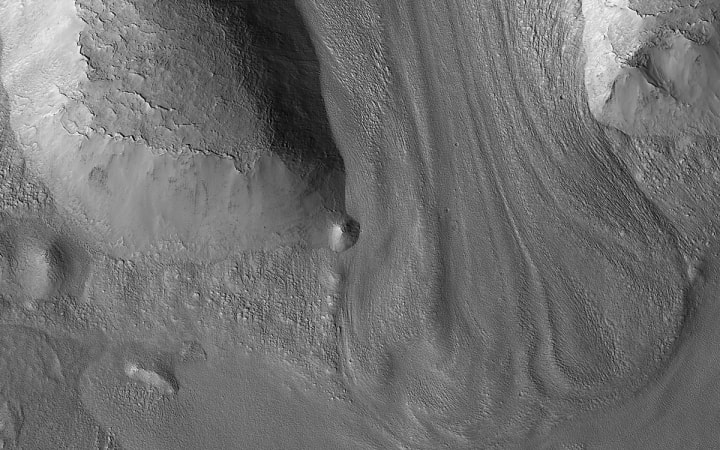
The Heart Lake System located near a mid-sized crater in Arabia Terra exhibits features consistent with those found in glacial landscapes on Earth. According to the PSI team a receding regional glacier likely created the depression known as the Heart Lake System. The melting of glacial ice beneath the surface led to the formation of shallow channels and a proglacial lake a body of water formed in front of a retreating glacier. This process deposited smaller glacial remnants within the crater further supporting the hypothesis that subglacial melting contributed to the geological evolution of this region. Scientists have used multiple lines of evidence to reach these conclusions including high resolution imaging from orbiters and spectral analysis. The channels in the region resemble those found on Earth in areas where glacial ice has melted from below, carving out networks of waterways. These findings indicate that even in Mars’ cold past localized melting events may have occurred due to geothermal heat or fluctuations in the planet’s climate.
Implications for Martian Climate and Potential Habitability
The discovery of past subglacial melting is significant for understanding Mars' climatic history. It suggests that Mars may have experienced intermittent warm periods allowing liquid water to persist beneath its glaciers. This not only shaped the planet’s geography but also raises intriguing questions about the possibility of past microbial life. On Earth subglacial lakes such as those found in Antarctica are known to harbor extremophiles organisms capable of surviving in extreme conditions. If similar environments once existed on Mars they could have provided a refuge for microbial life. Moreover the study of Martian glaciers has implications for future exploration. Understanding the location and behavior of ice deposits is crucial for future manned missions to Mars. If astronauts can access subsurface ice it could serve as a vital resource for drinking water and fuel production. NASA and other space agencies are already investigating ways to extract and utilize Martian ice to support long term human presence on the planet. The recent study by the Planetary Science Institute adds another piece to the puzzle of Mars' hydrological history. The presence of subglacial melting in the Arabia Terra region suggests that Mars once had dynamic climate conditions that allowed for episodic liquid water flow. This discovery reinforces the idea that Mars’ surface has been shaped by complex geological and hydrological processes some of which may still be active in certain regions. As exploration of the Red Planet continues further studies of Martian glaciers and ice deposits could provide crucial insights into the planet’s past climate its potential for life and its suitability for future
SEO KEYWORD:
Mars glaciers, Martian ice deposits, Subglacial melting on MarS, Water on Mars, Arabia Terra region, Heart Lake System Mars, Martian climate history, Mars geological formations, Mars exploration, Potential life on Mars, Glacial activity on Mars, Martian water sources, Mars hydrology, NASA Mars discoveries, Mars colonization resources.
About the Creator
Adnan Rasheed
Author & Creator | Writing News , Science Fiction, and Worldwide Update| Digital Product Designer | Sharing life-changing strategies for success.
Keep reading
More stories from Adnan Rasheed and writers in Earth and other communities.
Earth’s Oceans Weren’t Always Blue Scientists Say
Earth’s Oceans Weren’t Always Blue Scientists Say When we picture Earth from space we often think of it as the Blue Planet because of its vast glistening oceans. However scientists say that Earth’s oceans weren’t always the deep blue we see today. Instead their color has changed over millions of years due to varying environmental conditions the presence of microorganisms and shifts in the Earth's atmosphere. Understanding these changes gives us a fascinating glimpse into our planet’s history and evolution.
By Adnan Rasheed11 months ago in Earth
Industrial Deployment of Biochar in Modern Metal Smelting Systems
Biochar is increasingly examined as a functional carbonaceous material in high-temperature metallurgical operations. Traditionally dominated by fossil-derived coke and coal, metal smelting processes are under pressure to decarbonize while maintaining reductive efficiency and structural reliability. Biochar, when properly engineered, presents a technically viable supplementary reductant in the production of steel, silicon, and ferroalloy. Its application, however, requires stringent control of physicochemical properties and integration within existing furnace infrastructure.
By Wayne Shen3 days ago in Earth


Comments
There are no comments for this story
Be the first to respond and start the conversation.