
whats the edge of the universe
Edge of the universe

The universe, as vast and mysterious as it is, has a boundary known as the cosmological event horizon—the ultimate edge beyond which we can never travel. This edge lies an astonishing 16 billion light-years away from Earth, and due to the fundamental laws of physics, it remains forever beyond our reach. Unlike earthly boundaries or even the edges of our solar system, this cosmic limit is not a tangible wall but a consequence of the universe’s expansion and the universal speed limit discovered by Albert Einstein.
According to Einstein’s theory of relativity, nothing can travel faster than the speed of light. This speed limit, approximately 299,792 kilometers per second, governs the movement of all matter and energy in the cosmos. At first glance, this might suggest that we could theoretically approach any point in the universe given enough time. However, the universe itself behaves in a way that defies this intuition. While no object can locally exceed the speed of light, the fabric of space-time—the very structure of the universe—is expanding. Imagine a sponge soaked in water: as the sponge expands, every point within it moves away from every other point. Similarly, in the universe, every point in space is receding from others as space itself stretches.
The expansion of the universe is not uniform in the sense of simple motion; instead, the farther away a point is, the faster it appears to be moving away from us. This phenomenon means that at extremely large distances, galaxies and other cosmic structures recede from Earth faster than light itself. Even if a spacecraft could travel at the speed of light—which is impossible according to Einstein’s laws—it would never be able to reach these objects. No matter how fast we move toward them, the space in between keeps expanding faster than we can traverse. This is why the cosmological event horizon exists: it represents the limit of our observable universe, a boundary determined not by our technology but by the fundamental properties of space and time.
The concept of the cosmological event horizon has profound implications for our understanding of the universe. Beyond this horizon, events and objects are permanently inaccessible. We cannot receive signals from them, and they cannot interact with us in any way. This means that a significant portion of the universe is, in principle, forever hidden from human observation. Even as telescopes grow more powerful and our computational models more advanced, there will always be a portion of the cosmos that lies beyond the event horizon, untouched and unknowable.
Interestingly, while the universe obeys Einstein’s cosmic speed limit, the expansion of space itself is not constrained by this limit. Space can—and does—expand faster than light, carrying galaxies with it. This subtle distinction between motion through space and expansion of space is key to understanding why the event horizon exists. It is a reminder that the universe is not merely a static collection of stars and galaxies but a dynamic, ever-growing structure, stretching outward at an accelerating pace.
The edge of the universe, therefore, is not a boundary in the traditional sense but a cosmic horizon—a physical limit imposed by the interplay of relativity, the speed of light, and the universe’s expansion. It challenges our intuition about distance, speed, and reach. No spacecraft, no signal, and no human endeavor can cross it. Yet, this unreachable boundary inspires awe and curiosity. It compels scientists, philosophers, and dreamers alike to contemplate the scale, structure, and ultimate fate of the cosmos.
In essence, the cosmological event horizon is a reminder of both the immensity of the universe and the limitations of human reach. It represents the farthest edge we can ever hope to observe, a boundary dictated not by human technology but by the fundamental rules of nature. As we gaze into the depths of the night sky, we are witnessing only a fraction of reality—a mere bubble of existence enclosed within a horizon shaped by space itself. The universe beyond continues its silent expansion, stretching into the infinite unknown, a testament to the enduring mystery and grandeur of the cosmos.
About the Creator
Keep reading
More stories from Blessing Ngozi and writers in Earth and other communities.
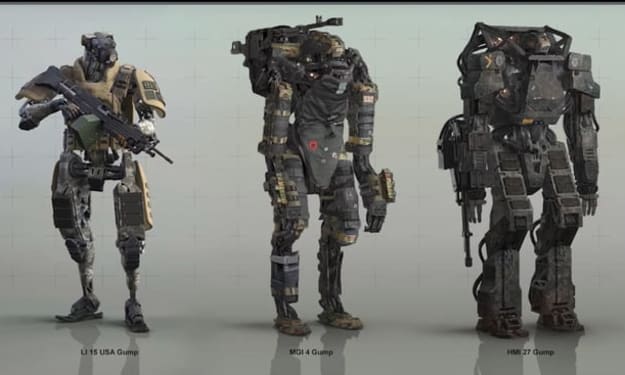
Robotic Soilders
In the not-so-distant future, the nature of warfare may be transformed beyond recognition. Human soldiers, long the backbone of military forces, could eventually be replaced on the front lines by robotic warriors powered by advanced artificial intelligence. These autonomous machines promise a level of efficiency and endurance far beyond human capability. Unlike human troops, they would never grow fatigued, never succumb to fear, and never question the orders they are given. Equipped with cutting-edge weaponry, night vision systems, and instant battlefield communication, AI-driven soldiers could carry out complex operations with precision and speed that no human army could match.
By Blessing Ngozi5 months ago in Earth
Birds with Wild Hairdos
Cockatoos are known for their expressive crests, which they raise or lower depending on their mood. The crests can be white, yellow, or pink. These charismatic birds are native to the Australian continent, the islands of the Indo-Australian archipelago, and parts of New Guinea. There are 21 different species of cockatoo, varying in size from the diminutive Galah to the imposing Sulphur-crested Cockatoo. Most cockatoo species are highly social birds, forming strong pair bonds that often last a lifetime. Cockatoos are primarily herbivores, with a diet consisting of seeds, nuts, fruits, roots, and occasionally insects and larvae.
By Rasma Raisters2 days ago in Earth
Regenerative Agriculture's Quiet Revolution
by Futoshi Tachino Regenerative agriculture — a holistic approach to farming that restores soil health, biodiversity, and resilience — has rapidly gained traction in recent years. This shift remains largely underappreciated by the public; in a 2024 survey, around 43% of U.S. consumers had never heard of regenerative agriculture (and another 28% had only minimal awareness) [4]. Despite this low profile, tangible developments in regenerative farming are delivering robust results. Farmers are proving that it’s possible to maintain high yields with fewer chemical inputs, improve profitability, and enhance ecological outcomes — all at once. This article explores the evidence-backed progress of regenerative agriculture across regions, the policies and technologies driving its adoption, and why this overlooked sustainability success story deserves greater recognition.
By Futoshi Tachino8 days ago in Earth



Comments
There are no comments for this story
Be the first to respond and start the conversation.