
What would happen if the Sun exploded tomorrow?
When the Sun Goes Boom: Exploring the Spectacular Explosion of Our Mighty Star

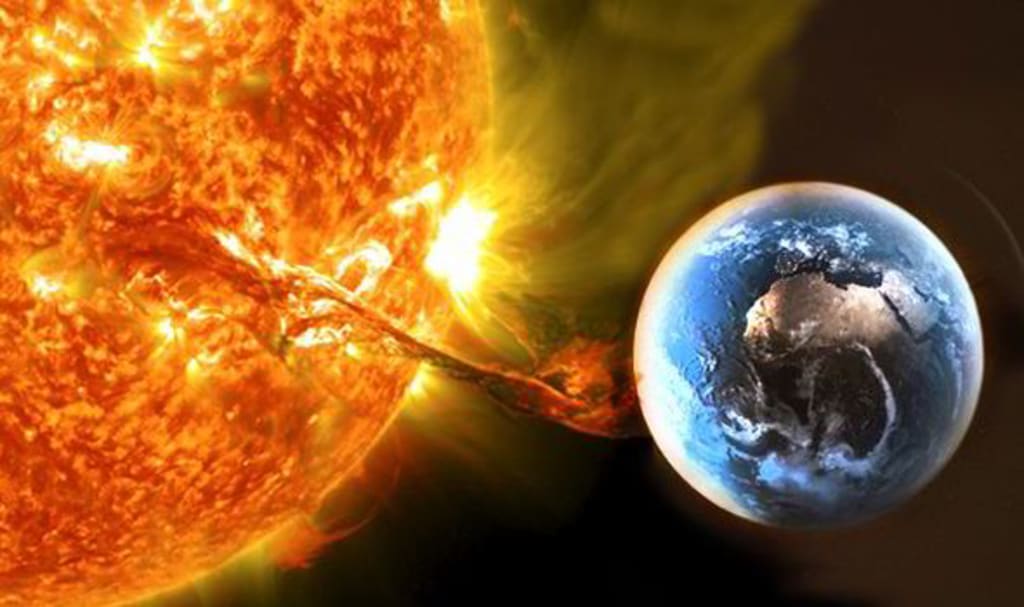
The Sun, that celestial furnace at the heart of our solar system, holds within it a secret. A ticking time bomb, ready to unleash its explosive might. While it has illuminated our world for over 10 billion years, its luminous reign is expected to dwindle within the next 5 billion years.
As the Sun's fiery life cycle nears its end, it will transform into a majestic red giant, its radiance stretching across the cosmos. But this grand spectacle is just a prelude to its final act. The Sun will then shrink, fading into a humble white dwarf—a dying star destined to cool over billions of years.
Alas, fear not, for we mortals shall have long departed this realm before such cosmic events unfold. Yet, let us indulge our imaginations and contemplate the cataclysmic scenario of witnessing the Sun's magnificent detonation. If we were to observe this solar explosion, one might envision a spectacle of epic proportions, akin to the grandest fireworks display in the universe.
However, in truth, we would likely be denied such a visual feast. The Sun resides a staggering 150 million kilometers away from Earth, and even light takes a leisurely 8 minutes to reach us. Though this distance may seem vast, in the cosmic ballet of supernovae, we are but a speck of dust, incapable of eluding the Sun's explosive demise.
To ensure Earth's complete safety from the supernova's wrath, we would need to find refuge at least 50 to 100 light years away. Alas, the odds are not in our favor. If the Sun were to explode tomorrow, the ensuing shockwave would not possess the strength to annihilate our entire planet. Yet, the half facing the Sun would succumb to an instantaneous boiling demise, while the fortunate other half would experience scorching temperatures, 15 times hotter than our Sun's current surface.
Moreover, deprived of the Sun's gravitational embrace, Earth would forsake its orbital dance and commence a wayward drift into the void of space. Amidst this celestial chaos, the remaining inhabitants would desperately struggle for survival. Perhaps, by some cosmic fortune, our planet might chance upon a new stellar companion, whose radiance could parallel the Sun's nourishing light and warmth. However, by the time this celestial courtship transpired, we would have long departed this mortal coil.
If, by some unfathomable miracle, we possessed prior knowledge of the Sun's impending explosion, we could strive to secure ourselves an additional millennium of existence. Of course, such a feat would necessitate prodigious resources and unfathomable endurance. We might be forced to retreat beneath the very ground we tread, into a vast network of fortified bunkers—our subterranean sanctuaries, sustaining the flickering flame of civilization.
In the wake of the explosion, temperatures on the Earth's surface would plummet within a week, descending to a bone-chilling -18 degrees Celsius. In a year's time, the mercury would plummet even further, reaching a frigid -73 degrees Celsius. At this juncture, the oceans would relinquish their liquid form, surrendering to the icy grip of frost.
Fast forward a thousand years, and Earth's atmosphere would freeze and crumble, exposing any remnants of life to cosmic radiation and meteoric bombardment. Hopefully, by that distant epoch, we would have traversed the vast expanse of space, seeking a new abode—a sanctuary untainted by the icy grip of celestial demise.
Amidst the desolation and uncertainty, let us not forget the silver lining. The Sun's explosion, when it eventually occurs, will not transpire overnight. Rather, it will embark upon a protracted, interstellar swan song spanning billions of years. As the Sun grows hotter and brighter, its expansive reach will birth new stars and planets, cascading its remnants into the cosmic tapestry.
In this celestial dance of creation, who knows what wonders may arise? Perhaps, new forms of life will emerge, inhabiting a rejuvenated Earth. Can you fathom the existence of a neo-humanoid species, shaped by the crucible of a reborn planet? The future of our galaxy, billions of years hence, eludes our wildest dreams. And within this vast expanse, we struggle to envision a solar system bereft of the great golden anchor that has steadfastly held us together.
But remember, dear wanderer, that the cosmos is an ever-changing tapestry. One day, in the distant future, the Sun will relinquish its brilliance, making way for a new luminary to take its place. And if, by some miracle, our descendants endure to witness this cosmic ballet, where might they call home? Could you imagine their birthplace, a magnificent space station amidst the infinite expanse—a testament to humanity's unyielding spirit and indomitable will? Only time shall reveal the secrets that lie beyond our earthly horizon.
About the Creator
Shraddha Gupta
A skilled content and article writer. With a flair for storytelling and meticulous research, I create captivating pieces that leave a lasting impression. Prepare to be spellbound by my concise yet impactful writing style.
Keep reading
More stories from Shraddha Gupta and writers in Earth and other communities.
The Lucid Canvas: Unveiling the Boundless Possibilities of Dreamscapes
Introduction: Have you ever experienced the sheer wonder of being fully aware that you are dreaming, as if stepping into a parallel universe where the possibilities are limitless? This extraordinary phenomenon is known as lucid dreaming. While most of us are accustomed to the chaotic and unpredictable nature of dreams, lucid dreaming offers a captivating realm where dreamers can actively participate, control their surroundings, and even shape their own narratives. In this article, we delve into the intriguing world of lucid dreaming, exploring its origins, potential benefits, and techniques for inducing these extraordinary experiences. Prepare to embark on an adventure beyond the boundaries of your imagination!
By Shraddha Gupta3 years ago in Motivation
Without Democracy, Donald Trump’s Venezuelan Oil Quest Will Fail
Donald Trump’s renewed interest in Venezuelan oil may seem, on the surface, like a hard-nosed geopolitical calculation. Venezuela holds the world’s largest proven oil reserves, and amid global energy uncertainty, access to those resources is undeniably tempting. But history, economics, and politics all point to the same conclusion: without democratic reform in Venezuela, any attempt by a Trump-led US administration to secure reliable Venezuelan oil will ultimately fail.
By Aarif Lashari6 days ago in Earth
So You Decided To Become a Nurse Practitioner:
So you decided to become an "Advanced Practice" nurse. Congratulations!... is what I would say if this was a good idea. Grad school? In this economy? What were you thinking? Likely it was something along the lines of either 1) “I've seen these other chucklefucks do it— Why can't I?” or even 2) “I've got a nice career, I should shake it up. I miss feeling like I have no clue what I'm doing.”
By Sandor Szabo3 days ago in Fiction




Comments
There are no comments for this story
Be the first to respond and start the conversation.