
What’s the Best Route for Peaking Mt Kilimanjaro?
Pick Your Choice

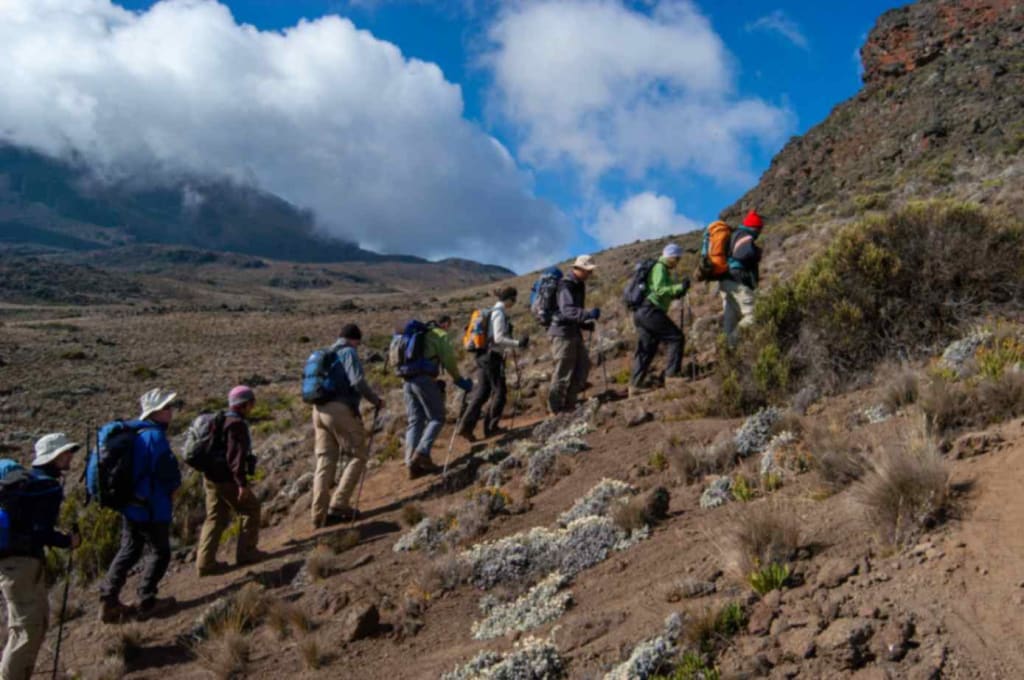
So, you've decided to climb Mt Kilimanjaro, Africa's highest peak. That's only the beginning. You must decide which of the seven approved climbing routes you'll use.
We break it down for you, telling you what every route offers, so you can make an informed choice.
Climbing Mount Kilimanjaro, or touching the Roof of Africa, is no mean achievement. Not only is Kilimanjaro Africa's highest peak, but it's also the world's highest freestanding mountain, so scaling it gives a sense of accomplishment.
However, despite standing at 5,895 meters (19,341 feet) above sea level, Kilimanjaro can be scaled without specialized climbing gear. You need to enjoy a certain level of fitness of course, and to acclimatize, but under the direction and support of experienced guides and porters, as a passionate mountain climber, you will make it.
Kilimanjaro has three summits - Shira, standing at 3,962 meters (13,000 feet), Mawenzi at 5,149 meters (16,893 feet), and Kibo, the highest, which rises to 5,895 meters (19,341 feet). Shira is an extinct volcano; the others are dormant.
Climbing routes
The Tanzania National Parks (TANAPA), has approved seven climbing routes. These are Marangu, Shira, Rongai, Machame, Lemosho, Northern Circuit, and Umbwe.
Only the Marangu route offers accommodation cabins. For the other routes, you need to bring tents for camping.
The Rongai route approaches Mt Kilimanjaro from the north. The Lemosho and Shira routes approach from the west, while the rest approach from the south.
So, which route should you use? It all depends on what you want to achieve, your level of mountain climbing expertise, the amount of time you want to spend, and your budget, among other things.
Do you, for instance, want to use the most scenic route? Then Lemosho is your pick. Machame and Northern Circuit also offer picturesque vistas. If you want to avoid crowds, choose the Rongai or Northern Circuit routes.
Below are details of what every route offers:
1. Marangu
The Marangu route is the oldest of the Kilimanjaro routes and is known for being the easiest. The paths have a gentle slope so are easy to manage. The trek normally takes five to six days and covers 72 kilometers.
However, the short climbing time does not give your body adequate time to acclimatize and the route is rated at 65% for success in reaching the summit. The ascent and descent use the same route so you see less of the mountain.
2. Shira
If you opt for this route, you register at Londorosi Gate and are then driven up some 3,500 meters to a point close to your first campsite. This means you risk gaining altitude too fast for your body to acclimatize. For this reason, it's best to do a pre-acclimatization trek.
This route's climb takes seven to eight days and covers 56 kilometers. The difficulty level is medium and the success rate is high.
3. Rongai
This is the only route that approaches the mountain from the drier northern side. It offers contrasting views of the mountain and some wildlife. You might even spot some wildlife in neighboring Kenya's Amboseli National Park.
The Rongai route is the second longest after the Northern Circuit. It covers 73 kilometers in six to seven days and enjoys a medium summit success rate.
4. Machame
The Machame route has a rich array of topography. For this reason, it's very popular and has many campsites along the way. Its popularity is its undoing as it can become crowded during peak times.
The climb takes six to eight days over 62 kilometers. The route enjoys a high summit success rate, especially for those who take seven to eight days, which allows time for acclimatization. The route is moderately difficult.
5. Lemosho
The Lemosho route is regarded as the most scenic of the Kilimanjaro paths. It also records low crowds and a high success rate.
Lemosho offers you the unique experience of trekking across the Shira Plateau, one of the biggest high-altitude plateaus worldwide. The hike up the mountain on this route, tagged as moderately difficult, takes eight days over a distance of 70 kilometers.
6. The Northern Circuit Route
This is the longest and toughest of the Kilimanjaro routes. It winds around the northern side of the mountain, but it's the ideal route if you want to see more of the Kilimanjaro landscape.
You trek across the splendid Shira Plateau and enjoy splendid glimpses of Uhuru Peak and Kibo Summit.
Many climbers avoid this long route so if you choose it, you will enjoy peace and quiet in the campsites. The trek covers 98 kilometers and takes nine to 10 days, thus giving you enough time for acclimatization. The route records the highest summit success rate of all the tracks.
7. Umbwe
At 53 kilometers, the Umbwe route is the shortest and steepest of the Kilimanjaro tracks. Only about 600 people use this trail a year.
The trek takes 5 to 6 days, not allowing enough time for acclimatization. As such, it records a very low summit success rate.
Pre-acclimatization is highly recommended if you decide to use the Umbwe route.
Final thoughts
Kilimanjaro is accessible all year round. However, some routes might be difficult to tackle during the rainy season. So, the best time to climb Kilimanjaro is during the dry months of December to March and June to October.
About the Creator
Wanjiru Ciira
I'm a story-teller with an interest in the human condition. I write on relationships, health, aging, parenting, travel, and fiction. I've a background in journalism - feature-writing, reporting, and investigative journalism.
Keep reading
More stories from Wanjiru Ciira and writers in Earth and other communities.
Dive into These 7 Exciting Activities around Mount Kenya
The Mount Kenya area is a true safari country. The region straddles the equator but hosts icy glaciers, alpine forests, savannah grassland, and woodland, among other features. It’s also home to an array of wildlife.
By Wanjiru Ciira11 months ago in Earth
Australia Metal Recycling Market: A Sustainable Growth Story Amid Circular Economy Shifts
The Australia metal recycling market is rapidly emerging as a key pillar in the nation’s transition toward a circular economy and sustainable industrial framework. Valued at USD 5.27 billion in 2025, this sector is forecast to expand to USD 7.35 billion by 2034, growing at a compound annual growth rate (CAGR) of 3.78% between 2026 and 2034.
By Rashi Sharma7 days ago in Earth
‘Green Arabia’: Saudi Arabia’s Vast Deserts Were Once Rivers, Lakes, and Grasslands, Studies Show
Saudi Arabia’s iconic deserts, with their endless dunes and arid expanses, are often seen as the epitome of extreme dryness. However, recent studies reveal a surprising chapter in the region’s geological and ecological history: vast parts of what is now the Arabian Desert were once verdant landscapes, complete with rivers, lakes, and flourishing grasslands. This discovery not only challenges our understanding of the region’s past but also offers insights into climate change, human migration, and the evolution of ecosystems in one of the world’s harshest environments.
By Fiazahmedbrohi 3 days ago in Earth


Comments
There are no comments for this story
Be the first to respond and start the conversation.