

What’s Inside CERN?
If you’ve ever gazed at the night sky and wondered about the secrets hidden in the tiniest particles of the universe, you’ve already stepped—mentally, at least—into the world of CERN. Nestled near Geneva, Switzerland, this sprawling scientific wonderland is officially known as the European Organization for Nuclear Research. To most people, however, it’s simply “CERN,” a place where scientists smash particles together to unlock the most profound mysteries of existence.
When I first read about CERN, I imagined it as a high-tech playground for the world’s most brilliant minds. The truth? It’s even more fascinating than that. Picture a massive underground network of tunnels, advanced detectors the size of buildings, and data centers buzzing with information from billions of particle collisions per second. That’s just a typical Tuesday at CERN.
A Global Collaboration of Minds
CERN isn’t just a European project—it’s a global one. Scientists, engineers, and technicians from over 100 nationalities come here to work on experiments so complex that they require decades of preparation. English and French are the main working languages, but the true “language” of CERN is science.
The organization was founded in 1954, at a time when the world was still healing from war. It symbolized a new era of peaceful scientific cooperation. Since then, it has evolved into the largest and most respected particle physics laboratory on Earth.
The Star Attraction: The Large Hadron Collider (LHC)
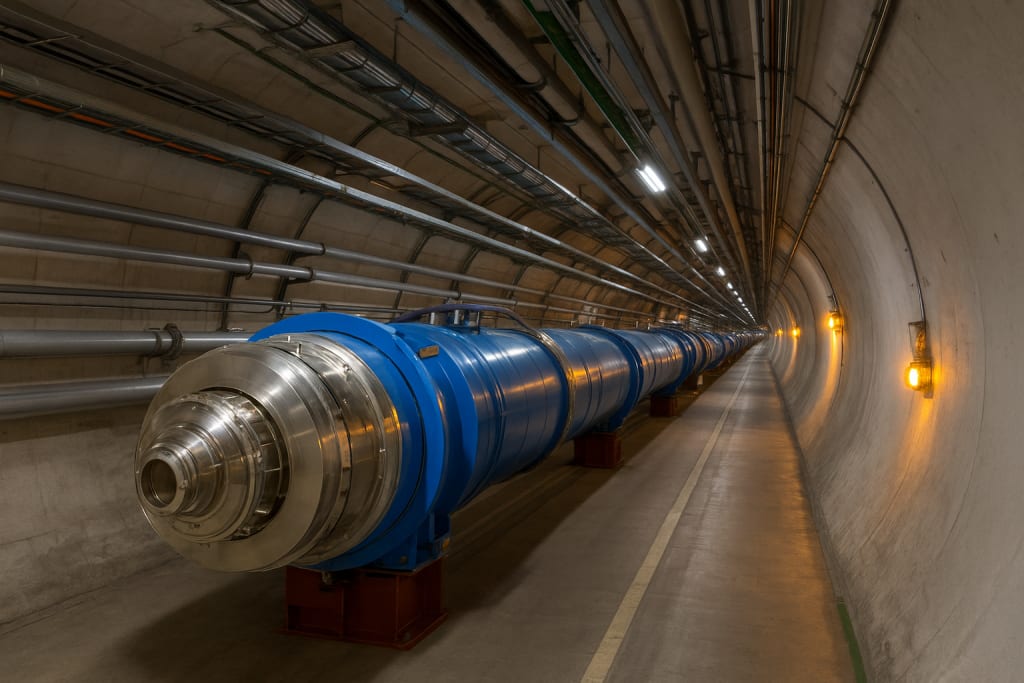
The Large Hadron Collider, or LHC, is CERN’s crown jewel. Imagine a circular tunnel 27 kilometers (17 miles) long buried about 100 meters underground, straddling the border between Switzerland and France. Inside, beams of protons are accelerated to near the speed of light and smashed together. The resulting collisions recreate conditions that existed just moments after the Big Bang.
It’s thanks to the LHC that the Higgs boson—often nicknamed the “God particle”—was discovered in 2012. This particle helps explain why other particles have mass, a finding that earned the Nobel Prize in Physics in 2013.
More Than Just One Collider
While the LHC is the headline act, CERN operates a whole chain of accelerators and experiments. These include:
The Super Proton Synchrotron (SPS): A key link in the accelerator chain, feeding particles into the LHC.
The Proton Synchrotron (PS): Operating since 1959, it’s been upgraded many times to meet modern needs.
The Antiproton Decelerator (AD): Where scientists study antimatter—yes, the stuff that sounds like science fiction but is very real.
ISOLDE (Isotope Separator On-Line): Specializes in studying radioactive isotopes for applications in medicine and nuclear physics.
Detectors the Size of Buildings
When protons collide inside the LHC, they produce showers of subatomic particles. Detecting and recording these events requires machines that are almost as impressive as the accelerator itself. Four main detectors take center stage:
ATLAS: A general-purpose detector, and one of the two that discovered the Higgs boson.
CMS (Compact Muon Solenoid): Similar goals to ATLAS but with a different design, offering complementary data.
ALICE: Specializes in studying quark-gluon plasma, a state of matter that existed in the early universe.
LHCb: Focuses on understanding why the universe is made mostly of matter and not antimatter.
What’s Actually Inside CERN?
Walking through CERN is like stepping into the future. Above ground, you’ll see office buildings, meeting rooms, and visitor centers. Below ground, however, lies a network of tunnels, magnets, and cryogenic systems cooled to colder than outer space.
Inside CERN, you’ll find:
Superconducting magnets to bend and focus the beams.
Vacuum chambers where the particle beams travel.
Control rooms where scientists monitor experiments 24/7.
Massive computing centers capable of processing petabytes of data each year.
And perhaps the most valuable resource of all—people. Scientists from all over the globe, sharing ideas and pushing the boundaries of human knowledge.
Projects Beyond Particle Physics
CERN isn’t just about smashing particles. The facility has had a huge impact on technology and everyday life. Did you know the World Wide Web was invented at CERN in 1989 by Tim Berners-Lee? It was created as a way for scientists to share information more easily.
Other projects include advancements in medical imaging, radiation therapy for cancer treatment, and even studies into sustainable energy sources. The spin-offs from CERN’s research often benefit society in unexpected ways.
The Future of CERN
CERN’s scientists are already planning the Future Circular Collider (FCC)—a potential successor to the LHC that could be up to 100 kilometers in circumference. This next-generation machine aims to explore physics beyond the Standard Model and answer questions that the LHC can’t.
Meanwhile, upgrades to the current LHC (turning it into the “High-Luminosity LHC”) will allow it to collect even more precise data in the coming years.
A Personal Reflection
Standing outside CERN’s main entrance, I felt a strange mix of awe and humility. This isn’t just a building or a machine—it’s a testament to what humanity can achieve when curiosity leads the way. Inside, thousands of people are working together not for profit, not for politics, but for understanding. And in a world often divided, that’s nothing short of inspiring.
Why CERN Matters
CERN is a bridge between the known and the unknown. Its work helps us understand the building blocks of reality, the origins of the universe, and the laws that govern everything from galaxies to grains of sand. Even if you never visit in person, the discoveries made here ripple outward into the world, touching your life in ways you might not even realize.
Sources
“The Large Hadron Collider: Unlocking the Secrets of the Universe”
“CERN: Facts and Figures”
“The Higgs Boson and Beyond”
“From the Web to the World: CERN’s Legacy in Technology”
About the Creator
Mohamed hgazy
Fiction and science writer focused on physics and astronomy. Exploring the human experience through imagination, curiosity, and the language of the cosmos.
Keep reading
More stories from Mohamed hgazy and writers in Earth and other communities.
How Ancient Rocks Reveal the Presence of Water on Mars
Introduction: A Handful of Pebbles, a World of Questions Sometimes, the smallest details tell the biggest stories. On Earth, smooth, rounded pebbles are a familiar sight along riverbanks and beaches — silent witnesses to the power of flowing water over time. In 2012, something remarkable happened millions of kilometers away: NASA’s Curiosity rover, exploring the dusty surface of Mars, stumbled upon clusters of similar pebbles. These weren’t just any rocks. They were water-worn conglomerates, the kind that form when streams and rivers tumble and polish stones for countless years.
By Mohamed hgazy7 months ago in Earth
No Word Comes Near Enough
The English language has its limits. I learned this when I became a student of the Bible and looked up the Greek and Hebrew definitions behind the Scriptures I loved. Some languages have so much more depth and power than the one I use to convey my thoughts. But, even so, I don't think any word could ever come close to describing this void and pain I am journeying through. I don't know how to swim through its murky waters.
By Shirley Belk7 days ago in Poets



Comments
There are no comments for this story
Be the first to respond and start the conversation.