
What Made These Perfectly Shaped Hills? | Weird Places
Unearthing the secrets of Earth's most symmetrical natural wonders

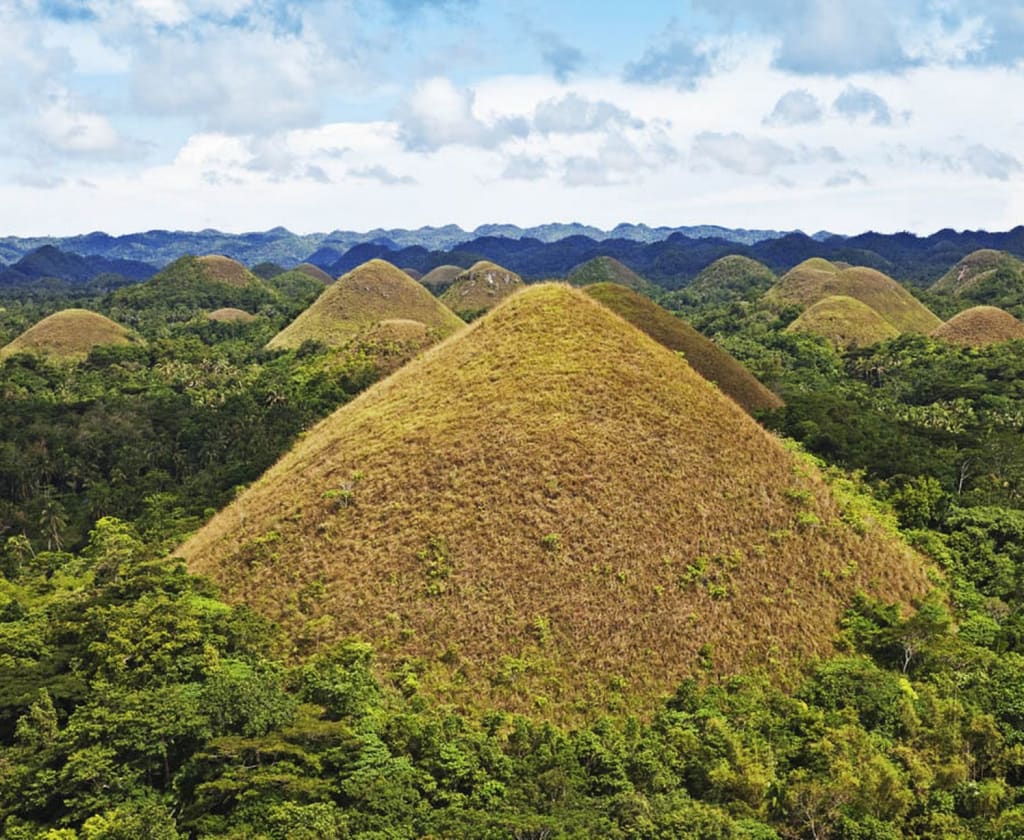
You’d be forgiven for thinking you’re looking at a picture of precisely formed chocolate truffles, that is until you notice the trees at their base.
These are the Chocolate Hills of Bohol, an island in the central Philippines.
It’s one of the most striking karst landscapes in the world, which means it formed from the erosion of limestone.
That’s not that unusual on its own.
15 to 20% of Earth’s surface has limestone beneath it.
But what sets the Chocolate Hills apart is their weirdly perfect symmetry.
And also that I want to eat them.
And while their formation has baffled residents and geologists alike, the secret of the hills might be surprisingly simple.
[SciShow Intro] Bohol is home to one thousand, one hundred seventy-six Chocolate Hills.
They’re not all identical – most are 30 to 50 meters, while the largest is 120 meters tall.
And they don’t always look like chocolate.
The name comes from the brown color the grasses turn during the dry season, from February to April each year.
Again, don’t eat grass The rest of the time they’re a lush green, thanks to the tremendous amount of rain brought by the monsoons.
Their striking appearance and symmetry have given rise to many local legends about how they formed.
One tells the story of two giants fighting, hurling humongous handfuls of mud at each other.
The mud balls that fell to the ground became the hills.
Another, less violent version, says the hills are the tears of a giant, mourning the loss of his human lover.
And these hills have inspired equally wide ranging theories among geologists.
From each hill being a small volcano coated in chalk, to the domes being formed by ancient sea currents.
In fact, if you read about the Chocolate Hills online youre probably gonna see still find a bunch of these ideas, but scientists now know the evidence doesn’t support them.
You’re telling me that there’s incorrect information On the internet?
The truth is these unique formations are an example of a very common geological process: the erosion of limestone.
Most of the islands of the Philippines are formed from the remnants of an ancient mountain range.
This gives the area a base of relatively tough metamorphic rocks like gneiss and schist.
60 million years ago, these mountains had long since eroded down, and this base of hard rock formed the bottom of a shallow sea.
And then coral reef started to grow in this sea, and slowly layer upon layer built up.
And these generations of coral were all made of calcium carbonate.
And you can find remnants of this ancient reef today.
The Chocolate Hills have fossils of coral, mollusks, algae, and plankton.
Eventually, the movement of tectonic plates pushed the seafloor down and nearby islands up.
Erosion of these islands buried the reef under layers of sediments like shale and it lithified, turning into solid limestone.
7 million years ago, more tectonic forces pushed all these layers up to the surface and erosion began, grinding the shale down to expose the limestone beneath.
Limestone erodes in a unique way, in a process known as karstification.
That is the tendency for limestone to erode into these dramatic features.
Not to be confused with carcinization, The process through which different animals With shells tend to evolve into crab-like forms Though interestingly, crab shells are made of calcium carbonate So there is a bit of a link Karstification begins with carbon dioxide in the atmosphere dissolving in rainwater and forming carbonic acid.
Limestone is slightly soluble, so this acidic water dissolves a little bit of it, forming a small crack.
But that small crack gives more acidic water a path to flow through, so the crack slowly widens.
Mechanical erosion also plays a role.
Pieces break off and grind the surrounding limestone down as they are washed away.
Eventually this gives you sinkholes, caves, and landscapes like the Chocolate Hills.
The hills are an example of conical karst, when those small cracks widen into deep gorges between the hills.
This mostly occurs near the tropics, and there are plenty of other dramatic examples, like in Guilin, China.
But what sets the Chocolate Hills apart is their remarkable symmetry.
Geologists still are not completely sure why this is, but they do think it has something to do with the weather.
The dominant weather pattern in the Philippines is the seasonal monsoon.
This brings ton of water, up to 3000 millimeters per year.
That’s three meters To put that in perspective, Seattle gets about a third of that.
And humidity on Bohol is pretty much always over 80%.
That means karstification is happening evenly and constantly on every exposed bit of limestone.
What’s special about the monsoon is that it’s seasonal.
The winds switch direction over the course of the year.
In fall and winter, they blow to the northeast.
Then, they do a 180 and blow to the southwest from spring to summer.
So the forces from the two directions roughly balance each other out, leaving perfectly conical hills.
There also isn’t a lot of soil on top of the limestone, in many spots less than 10 centimeters.
That means the hills can’t support plants bigger than grasses and small shrubs, so the topography isn’t hidden beneath a dense forest.
But these small plants do still play a role in the erosion.
The roots give off CO2 in the soil, once again creating carbonic acid to wear away at the limestone beneath.
This means the hills are eroding fast, but there is nearly a kilometer of limestone to get through so they aren’t going to vanish anytime soon.
That is, unless humans speed up the process.
The Chocolate Hills were designated a national geological monument in 1988, and a park area was established in the 1990s.
But despite this protection they still face threats of quarrying, mining the limestone to use it as construction material.
And it’s not simply a matter of saying quarrying is bad.
There is a delicate balance to strike between protecting the environment and allowing for local economic opportunities.
Protecting and monitoring karst is important, though.
These areas are prone to hazards like sinkholes and landslides and 75% of the population of Bohol lives on top of Karst.
And even if you don’t have limestone directly beneath your feet, all that flowing water also creates aquifers, which supply groundwater.
So studying karst isn’t just about how pretty landscapes formed.
It matters for keeping people safe and ensuring access to water.
Though we really do like the pretty.
The Chocolate Hills are an example of how ancient ecosystems, tectonic plates, and weather patterns all come together to make something that seems impossibly… perfect.
[ outro ]
About the Creator
Keep reading
More stories from taylor lindani and writers in Earth and other communities.
Major Scientific Milestones of 2017
The year 2017 was an extraordinary period for scientific progress. Researchers across the world achieved remarkable breakthroughs in space exploration, medicine, technology, and environmental science. These discoveries not only expanded human knowledge but also opened new possibilities for the future. From observing gravitational waves to advances in gene editing and artificial intelligence, 2017 demonstrated the powerful role science plays in shaping modern society.
By Irshad Abbasi 5 days ago in Earth



Comments
There are no comments for this story
Be the first to respond and start the conversation.