
What is the special significance of -273.15°C?
Why is the minimum temperature of the universe limited to -273.15°C?

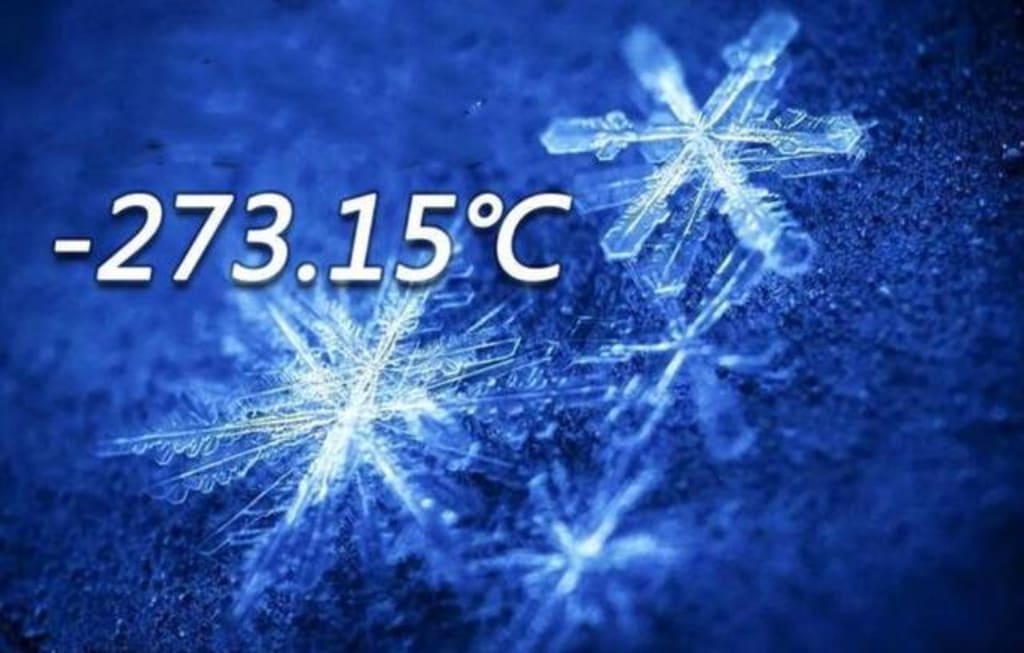
toThereisIf someone asks, what is the lowest temperature in the universe? I believe we can all answer: -273.15℃, but if pressed, what is the special meaning of this -273.15℃ with zero and whole? Why is the minimum temperature of the universe limited to -273.15℃? Some people may not be able to answer, but it's okay to answer, let's talk about this knowledge below.
Temperature is a physical quantity used to indicate the degree of hot and cold objects, want to discuss temperature, first of all, we have to define a unit of measurement for temperature, how to define it?
We know that the freezing point and boiling point of water is fixed at 1 standard atmosphere, which can be used as a very good reference.
So in 1742, the Swedish physicist Anders Celsius proposed that at 1 standard atmosphere, the temperature of boiling water can be recorded as 0 degrees, while the temperature of ice water can be recorded as 100 degrees, which can be divided into 100 equal parts, and each first part is 1 degree, and this is our common unit of temperature measurement --This is the origin of our common unit of temperature measurement - the degree Celsius (℃).
(Anders Regius)
See here you must ask, this is not the opposite, is not the temperature of ice water 0 degrees, the temperature of boiling water 100 degrees? There is no reversal, Regius proposed this definition at that time, to avoid negative numbers when measuring the temperature because it is below the freezing point of water.
Later people found this definition very inconvenient, after all, intuitively speaking, the larger the value, the higher the temperature should be, on the other hand, higher than the boiling water temperature also exists, the negative number is still inevitable, so people simply reversed this definition, and has been used to this day.
As early as the 16th century, the famous physicist Galileo discovered the phenomenon of thermal expansion and contraction of gases, and with the definition of "Celsius" and the technology of accurate temperature measurement, people can study the effect of temperature on the volume of gases in greater depth.
In 1787, Jacques Charles, a French physicist, conducted experiments on a variety of gases and showed that, at constant pressure, the increase in volume for each 1°C increase in temperature was always a fixed value, about 1 in 273 of the volume at 0°C.
(Jacques Charles)
This means that assuming that the volume of a mass of gas at a temperature of 0°C is 1 cubic meter, then when the temperature is raised to 1°C, its volume increases by approximately 0.00366 cubic meters (1 in 273 of its volume at 0°C), that is, 1.00366 cubic meters, and when it is raised to 2°C, its volume increases again by 0.00366 cubic meters, that is 1.00732 cubic meters, and the next is also accumulated in this way so that when the temperature is raised to 100°C, for example, the volume of this mass of gas increases to 1.366 cubic meters.
In 1802, the British physicist Gay-Lussac proposed the "Charles' law" (also known as "Gay-Lussac's law"), which states that the volume of an ideal gas at constant pressure is proportional to its temperature This law states that the volume of an ideal gas at constant pressure is proportional to its temperature and that the "1 in 273" measured by Jacques Charles is taken as the coefficient of volume expansion of the gas at constant pressure.
(Guy Lussac)
By the middle of the 19th century, human measurement techniques had advanced so much that scientists were able to increase the accuracy of this coefficient of expansion to 273.15 parts per million in the laboratory.
Imagine that for every 1°C increase in the temperature of a gas at constant pressure, the increase in volume is always 1 in 273.15 of its volume at 0°C. For every 1°C decrease in the temperature of this gas, the decrease in volume is also 1 in 273.15 of its volume at 0°C.
A simple calculation shows that for gas with an initial temperature of 0°C, the volume of the gas will be zero when the temperature is reduced to -273.15°C (provided that the pressure is constant). A gas with zero volume cannot exist, and this means that -273.15°C is impossible to reach.
Thus, the special significance of -273.15°C, a temperature value with zero and whole, lies in the fact that it is the theoretical lower limit of the temperature of the universe calculated by scientists through theory and experiment.
(Lord Kelvin)
In 1848, Lord Kelvin, known as the "father of thermodynamics", proposed a purely theoretical temperature scale independent of the properties of the measured substance in his paper "On an absolute temperature scale". This "absolute temperature scale" sets the theoretical lower temperature limit, i.e., -273.15°C, as "absolute zero" and uses Celsius as its unit increment.
Yes, this temperature scale is also later thermodynamic, its unit is K (Kelvin), according to the definition, 1K temperature change is equal to 1 ℃, but the two are calculated from a different starting point, the two can be simply "K = ℃ + 273.15" to convert, for example, 1 ℃, is equivalent to 274.15K.
In the following time, as science progressed, it became clear that the nature of temperature in the universe is the intensity of the thermal motion of microscopic particles inside the object, so the temperature corresponding to "absolute zero" is of course "the intensity of the thermal motion of microscopic particles inside the object is zero ".
In plain English, if all the microscopic particles inside an object are completely stationary, then the temperature of this object is "absolute zero", that is, -273.15℃. This does not happen, because, in our universe, there are no microscopic particles that are completely stationary.
On the other hand, according to the "uncertainty principle" of quantum mechanics, the position and momentum of elementary particles in the universe cannot be determined precisely at the same time, and if an object reaches -273.15°C, it means that the position and momentum of elementary particles can be determined precisely at the same time, which is a violation of quantum mechanics, so This temperature is also impossible to reach.
To sum up, -273.15℃ is the lower limit of temperature defined by scientists according to the actual situation in the universe, and this is the reason why the minimum temperature of the universe is limited to -273.15℃. Theoretically speaking, the temperature of any matter in the universe can only be infinitely close to this temperature at most, but it is impossible to reach or fall below this temperature.
About the Creator
Robert Jack
One of the secrets of emotional stability for adults is to keep the expectations of others to a minimum.
Keep reading
More stories from Robert Jack and writers in Earth and other communities.
Why is Jupiter so big?
Jupiter and Saturn are the first and second largest planets in the solar system respectively, with Jupiter's average diameter being about 139,822 km and Saturn's average diameter being about 116,464 km. In terms of volume, Jupiter is not much bigger than Saturn, but in terms of mass, Saturn is far less than Jupiter, as Saturn's mass is about 5.6834 x 10^26 kg, while Jupiter's mass is about 1.8982 x 10^27 kg.
By Robert Jack3 years ago in Earth
Antibiotic resistance is released into rivers and other essential water supplies by melting glaciers.
Sea level rise and the disappearance of landscapes are not the only effects of glaciers melting quickly. Melt water may also contain buried genetic material that aids in bacterial resistance to drugs, scientists are now cautioning.
By Francis Dami5 days ago in Earth



Comments
There are no comments for this story
Be the first to respond and start the conversation.