
What If You Traveled 1 Billion Years into the Future?
From Ice Ages to Alien Civilizations: What Earth and Humanity Could Look Like 1 Billion Years Into the Future!

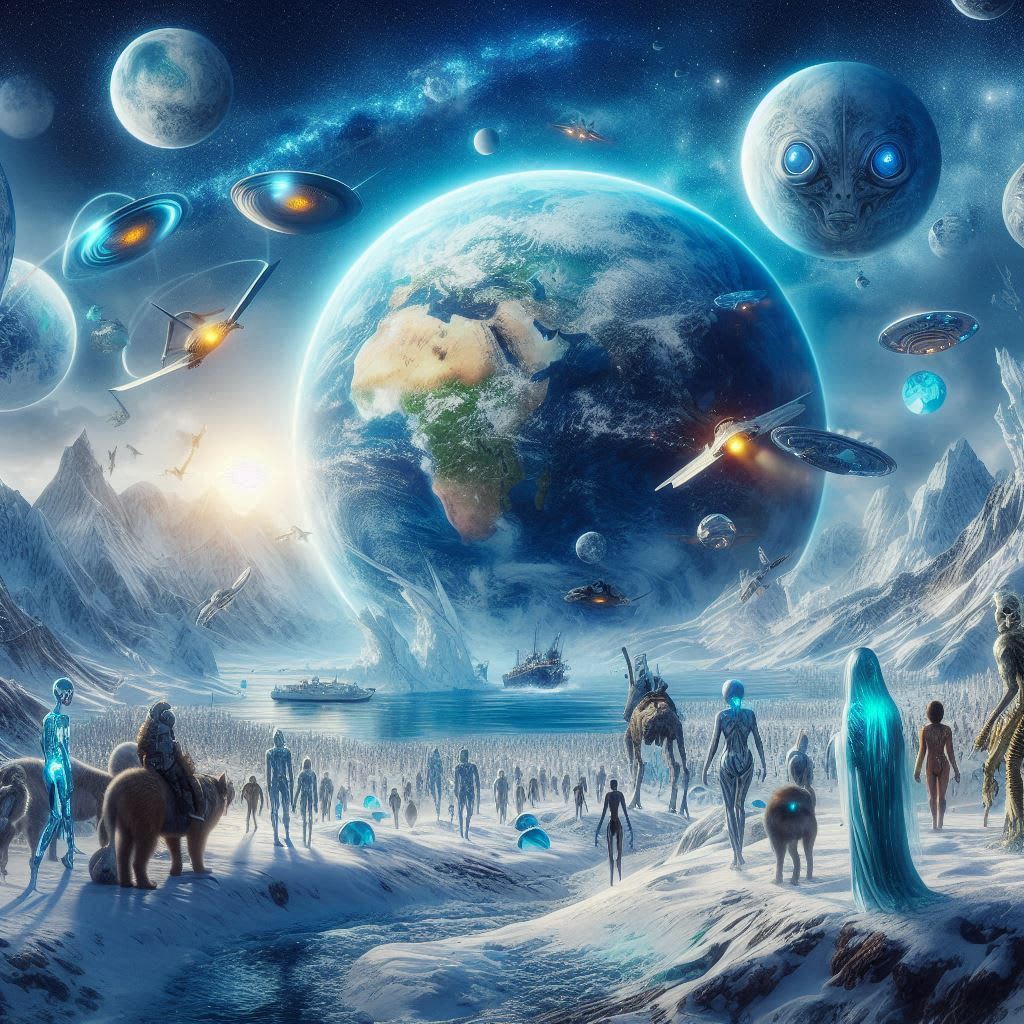
Imagine stepping into a time machine and fast-forwarding through the ages. As you arrive 1 billion years into the future, would Earth be a vibrant home or an uninhabitable wasteland? Would it be covered in volcanoes or frozen in ice? What about humanity—would we still be around, or scattered across the galaxy, exploring new worlds? This is **What If**, and here's what would happen if you traveled 1 billion years into the future.
## The Odds Are Against Us
Let’s face it: the chances of humans still being around when you arrive are slim. Our species faces numerous existential threats that could wipe us out long before we reach the 1-billion-year mark. Climate change, overpopulation, nuclear war, asteroid impacts, and even the aging of the Sun are just a few of the hurdles we need to overcome to survive this long.
We’ve struggled to unite during global challenges like pandemics, so how can we expect to survive these monumental threats? Let’s dive into the future and see what’s in store.
## The Next 10,000 Years: The Deca-Millennium Bug
In just under 10,000 years, we’ll face a tech problem called the *Deca-Millennium Bug*. Just like the Y2K scare, this bug will mess with software that encodes the calendar year, unable to handle dates beyond 9999 AD. Hopefully, by then, we’ll have learned not to panic like we did in the year 2000.
On a brighter note, humans will likely look a lot more similar by this point—genetic differences like skin and hair color will be evenly distributed around the globe. Maybe that will finally help us get along!
## 20,000 Years: Language Evolution and Ice Ages
By 20,000 years in the future, human languages will be unrecognizable. Only 1% of our current vocabulary will remain in use, and the rest will have evolved into new forms.
Around 50,000 years from now, Earth will enter a new *glacial period*, ushering in a new ice age. Niagara Falls will have eroded into Lake Erie, and Earth's rotation will have slowed slightly, making each day longer by one second. Enjoy those extra moments of daylight—every second counts!
## 250,000–1 Million Years: New Islands and Catastrophes
In 250,000 years, a new island will rise off the coast of Hawaii as the *Loihi Volcano* emerges from the ocean. But don't get too comfortable, because 500,000 years from now, a massive asteroid will likely strike Earth, creating a crater 400 kilometers wide. The resulting fires and unbreathable air will be a catastrophe of global proportions—unless we can prevent it.
And just when you think things couldn’t get worse, a *supervolcano* eruption in 1 million years will spew out enough ash to cover continents. The lava alone would fill 75% of the Grand Canyon. This could be a repeat of the *Toba event*, which nearly wiped out humanity 70,000 years ago.
## 10 Million Years: Humanity Evolves—or Disappears?
Fast forward to 10 million years, and humanity will likely have colonized other parts of the solar system. But humans living on separate planets may evolve into entirely new species, adapted to their specific environments. Who knows what we might look like then—if we're still around?
## 50–100 Million Years: Tectonic Shifts and Collisions
In 50 million years, *Africa will collide with Eurasia*, closing off the Mediterranean Sea and forming a new mountain range. This range might include a peak taller than Mount Everest. Out in space, *Mars’ moon Phobos* will collide with the planet, creating a stunning ring system like Saturn’s.
Meanwhile, back on Earth, the Hawaiian Islands will have sunk beneath the waves, and another massive asteroid, like the one that wiped out the dinosaurs, will strike—this one 10 kilometers wide.
## 250 Million–600 Million Years: Pangaea Ultima and Mass Extinctions
Around 250 million years from now, Earth’s continents will fuse into a supercontinent called *Pangaea Ultima*. It won’t last long, though—by 400 to 500 million years, tectonic forces will pull it apart once again.
A *gamma-ray burst* could strike Earth within 500–600 million years, damaging our atmosphere and triggering mass extinctions. This cosmic event would be a real existential threat, leaving our planet vulnerable to deadly radiation.
## 800 Million–1 Billion Years: The End of Complex Life on Earth
As the Sun’s brightness increases over time, Earth’s temperature will rise dramatically. By 800 million years, carbon dioxide levels will plummet, halting photosynthesis. Without photosynthesis, oxygen will vanish, and complex life will disappear. By 1 billion years, our planet will be unbearably hot, with average temperatures reaching 47°C (116°F).
The oceans will evaporate, leaving only small pockets of water at the poles. Earth will resemble a *damp, uninhabitable greenhouse*.
## The Final Chapter: A World Without Humans
By the time you arrive 1 billion years into the future, Earth will be a hostile and barren place, unrecognizable from the planet you once knew. The human race will be long gone—or, hopefully, thriving somewhere else in the galaxy. If you find yourself here in your time machine, it’s best not to stick around. Instead, head out to explore the cosmos. Maybe you'll encounter humans—or perhaps entirely new forms of intelligent life.
The future holds endless possibilities.
About the Creator
THiNK
Think - Your go-to destination for exploring captivating mysteries, insightful psychology, intriguing facts, and the latest news. Our mission is to spark curiosity and inspire learning. Join us as we uncover the unknown!
Donald Trump’s Venezuela Attack Stuns Europe’s Far Right
When news broke that Donald Trump had launched a military operation in Venezuela, the world was stunned. Parts of Caracas were bombarded, President Nicolás Maduro was captured, and Trump claimed it as a victory for democracy. But the shockwaves weren’t just in Latin America—they rippled through Europe’s far-right, a political family that once celebrated Trump’s bravado. Suddenly, leaders who had cheered him on were forced into a tricky spot. Let’s break down why Europe’s far-right is struggling with Trump’s latest move and what it could mean for global politics. From MAGA Cheers to Quiet Unease At first glance, it seems odd. Far-right politicians in Europe usually oppose socialism and admire strong leaders. So why would a strike against a left-wing regime cause hesitation? The answer: nationalism and sovereignty. Leaders like Viktor Orbán (Hungary), Matteo Salvini (Italy), and Nigel Farage (UK) have built their reputations on protecting their countries from outside interference. Seeing the U.S. storm a sovereign nation? That feels like exactly the kind of foreign meddling they normally condemn. Orbán offered vague statements, Salvini pushed diplomacy over bombs, and Farage called the attack “unorthodox and unlawful”. Silence and discomfort have replaced outright praise. Why Far-Right Leaders Are Torn Several factors are causing the split: 1. National Sovereignty Matters European right-wing movements love sovereignty. They campaign against the EU and global bureaucracies. But Trump’s unilateral attack looks like the exact opposite—powerful outside forces imposing their will. Supporting it openly would clash with their messaging. 2. International Law is Tricky Many far-right parties use international law as a shield against globalist agendas. Trump’s Venezuela strike had no UN mandate. That forces leaders into an awkward position: defend a lawless foreign intervention or appear inconsistent. 3. Political Risks at Home Voters in Europe are wary of foreign wars. Supporting a U.S. military adventure—especially one with civilian casualties—could hurt parties trying to win elections at home. Who Supports, Who Hesitates? Not all far-right factions are reacting the same way: Spain’s Vox seems more supportive, framing it as a fight against oppression. Robert Fico (Slovakia) criticized it as a breach of international law. Many others are staying silent, an unusual position for politicians who usually love controversy. Meanwhile, centrists and progressives across Europe have been predictably critical, calling for debates in the European Parliament and condemning the attack. The Bigger Picture Trump’s move isn’t just a Latin American story—it could reshape the global right: • Shifting Alliances For years, European nationalists admired Trump. But unilateral military action creates tension. Some may lean toward isolationism; others may support selectively. Either way, unity is under strain. • European Defense Independence The attack could boost calls for Europe to strengthen its own defense. If the far-right can’t agree on U.S. interventions, other political forces might push for European autonomy. • Messaging Challenges At home, parties must reconcile nationalist slogans with global events. Voters don’t like cheerleaders for foreign conflicts. This could reshape campaigns and messaging across the continent. Conclusion: A Wake-Up Call for Europe’s Far-Right Trump’s Venezuela operation has done more than make headlines—it’s exposed deep cracks in Europe’s far-right. Leaders who once embraced his bold style are now navigating an uncomfortable reality. Far-right movements that rail against globalization and foreign influence are forced to confront a paradox: what happens when a strongman ally behaves like the very superpower they criticize? The lesson is clear: the international right is no longer a monolith. Trump’s moves may redefine alliances, challenge messaging, and force nationalist leaders to rethink their approach to the world stage. The global political landscape is shifting—and Europe’s far-right is feeling the tremors.
By Muhammad Hassan7 days ago in Earth
Why Greenland Matters for a Warming World
Greenland, the world’s largest island, often conjures images of endless ice, rugged landscapes, and isolation. Yet in the era of climate change, Greenland has become far more than a frozen wilderness—it is a critical player in understanding global warming, rising seas, and even geopolitical strategy. As scientists, policymakers, and nations increasingly focus on Greenland, the island offers a stark lesson: what happens in the Arctic does not stay in the Arctic. Its ice sheets, ecosystems, and resources affect the planet in ways that are profound, urgent, and far-reaching. Greenland’s Ice Sheets and Global Sea Levels The most visible and alarming aspect of Greenland’s global impact is its melting ice sheets. Greenland contains roughly 8% of the world’s fresh water, stored in massive ice sheets covering more than 1.7 million square kilometers. Over the past two decades, studies have shown that Greenland is losing ice at accelerating rates. According to NASA and the European Space Agency, Greenland’s ice loss contributes about 0.7 millimeters per year to global sea level rise. That might seem small, but every millimeter counts. If Greenland’s ice sheets were to melt completely—a scenario scientists consider extreme but possible under prolonged warming—sea levels could rise by over 20 feet, inundating coastal cities and displacing hundreds of millions of people worldwide. The ice melt also affects ocean currents and weather patterns. Freshwater from Greenland flows into the North Atlantic, disrupting the Atlantic Meridional Overturning Circulation (AMOC), a crucial component of the global climate system. Changes here could mean more severe storms in Europe, shifting monsoons in Asia, and hotter summers in North America. A Rapidly Warming Arctic Greenland is warming twice as fast as the global average. Scientists attribute this to Arctic amplification, where ice and snow loss reduce the Earth’s reflectivity (albedo), causing more heat absorption. The resulting feedback loop accelerates melting and affects local wildlife, indigenous communities, and global climate systems. Polar bears, Arctic foxes, seals, and migratory birds all face habitat changes, while Greenlandic communities see challenges in fishing, hunting, and infrastructure. Roads, airstrips, and settlements are increasingly vulnerable to permafrost thaw, floods, and landslides. For climate scientists, Greenland acts as a bellwether of global change, providing early warnings of trends that could eventually affect all continents. Greenland’s Geopolitical Significance Beyond climate, Greenland is gaining strategic attention from nations worldwide. Its location between North America and Europe, combined with its ice-free ports emerging in summer, makes it a hub for shipping, scientific research, and military strategy. The United States has historically maintained a military presence at Thule Air Base and monitors Greenland’s importance in Arctic defense. China has expressed interest in Arctic shipping lanes and mining opportunities, signaling potential economic and strategic competition. Denmark and Greenlandic authorities are navigating autonomy, resource development, and environmental protection, balancing sovereignty with global pressures. The melting ice, paradoxically, opens opportunities for mineral exploration, shipping, and scientific access, even as it poses serious environmental risks. Greenland has large deposits of rare earth minerals, uranium, and iron, all increasingly valuable in the global transition to clean energy and technology. Local Communities and Indigenous Voices The Greenlandic Inuit and other local communities are directly experiencing climate change. Traditional hunting and fishing practices are affected by shifting ice patterns, changing animal migration, and unpredictable weather. While global attention often focuses on ice melt and global impact, local voices emphasize sustainability, cultural preservation, and adaptive strategies. Many communities are exploring renewable energy, eco-tourism, and sustainable fisheries as ways to protect livelihoods while mitigating climate risks. Greenland and Global Climate Policy Greenland’s situation highlights the urgency of global action on climate change. The island illustrates several key lessons: Mitigation Matters: Reducing greenhouse gas emissions is critical to slowing ice loss and protecting sea levels. Adaptation Is Essential: Coastal cities worldwide must prepare for rising waters and changing weather patterns driven by Arctic changes. Scientific Research Is Vital: Greenland serves as a natural laboratory for studying climate, ice dynamics, and ocean circulation. Understanding its trends allows for more accurate modeling and forecasting worldwide. International collaboration, including research partnerships and climate agreements, is essential to ensure that Greenland’s ice sheets do not become a catastrophic tipping point. The Global Ripple Effect It’s easy to think of Greenland as distant, but its fate touches everyone: Rising seas threaten cities from New York to Tokyo. Ocean currents shifting from ice melt influence global climate patterns. Economic implications arise from shipping routes, resource access, and disaster mitigation costs. Greenland is not just an Arctic concern—it’s a global responsibility. How countries respond to its changes will influence the world for decades to come. Conclusion: Why the World Should Watch Greenland Greenland matters because it is a microcosm of our planet’s challenges. Its melting ice sheets remind us that climate change is already here. Its mineral wealth and strategic position show that human interests will increasingly collide with environmental imperatives. Its communities illustrate the human cost of warming and the resilience needed to adapt. For a warming world, Greenland is both a warning and a guidepost. Protecting its environment, respecting its people, and monitoring its ice are not just Arctic issues—they are global imperatives. The world cannot afford to ignore Greenland. Its future is inextricably linked to the health of our planet and the security, prosperity, and safety of populations everywhere.
By Muhammad Hassan2 days ago in Earth
Miss Persephone's Manual to a Seemingly Ordinary Life
Miss Persephone was found at the dining table, her blue eyes swollen, her tears arriving and retreating like the tides of the ocean. Earlier that day, her family had visited her in the retirement home where she had lived for eight years. It was her eightieth birthday.
By Imola Tóth2 days ago in Fiction


Comments
There are no comments for this story
Be the first to respond and start the conversation.