
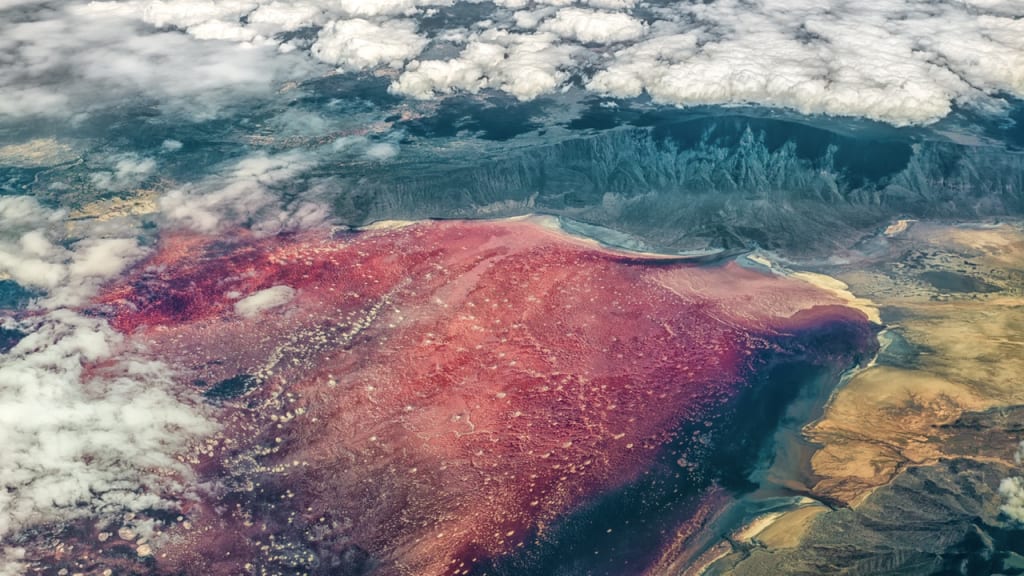
Lake Natron, known for its lethal waters and eerie resemblance to Medusa’s deadly gaze, is a place of both fascination and dread. Situated in Tanzania, this treacherous lake possesses the power to turn unsuspecting victims into stone. But what exactly makes Lake Natron so perilous? What kind of creatures call this deadly place home? And could anyone survive a plunge into its treacherous depths? Let’s explore the mysteries of Lake Natron and uncover what would truly happen if one were to jump into its ominous waters.
Before we take the daring plunge, it’s essential to understand the composition of Lake Natron. Similar to the Dead Sea, this Tanzanian lake lacks any outlets to oceans or rivers, allowing it to retain all the salt-laden rainwater that drenches the arid desert. However, what sets Lake Natron apart is its proximity to the active volcano, Ol Doinyo Lengai. This volcano ejects a unique form of lava rich in sodium and potassium carbonate known as natural carbonatite, or Natron for short. This volcanic activity releases these chemicals into the lake, turning it into a deadly mixture. In fact, Natron was historically used in Egyptian mummification due to its remarkable preservative properties. Consequently, the entire chemical makeup of Lake Natron is highly alkaline, boasting pH levels as high as 10.5, akin to that of ammonia. This extreme alkalinity gives the lake its distinct rosy hue.
The deadly consequences of Lake Natron’s waters are evident in the fate of various bird species. Wildlife photographer Nick Brandt was among the first to document the horrifying phenomenon of birds turning into stone within the lake’s dry season. In his exploration, Brandt discovered several petrified birds and other ill-fated creatures. His theory suggests that the lake’s mirror-like surface confuses birds, causing them to collide with the water as if it were an invisible barrier. The unfortunate victims, unable to escape the lake’s treacherous grasp, become calcified in stone-like husks. It is an eerie illustration of the proverbial idiom “killing two birds with one stone.”

Curiously, amidst the avian carnage, one species thrives in Lake Natron’s toxic embrace—the flamingo. These majestic birds find solace in the lake’s hazardous waters, which provide them with a safe haven from predators. Their resilient skin and scaly legs enable them to withstand the harshness of the environment. Flamingos can quench their thirst by consuming fresh water from nearby springs or geysers situated at the lake’s edges. Moreover, they possess specialized glands in their nasal cavities that allow them to filter saltwater, adapting to the lake’s toxicity. Their robust digestive systems even permit them to feed on the toxic algae thriving throughout the lake. Consequently, Lake Natron becomes an ideal sanctuary for flamingos to raise and protect their young.
However, surviving a dip in Lake Natron proves far more challenging for humans. With water temperatures reaching scorching levels of around 60 degrees Celsius, a mere five seconds of exposure can cause third-degree burns. Additionally, the shallowness of the lake conceals sharp and salty structures, making fancy dives or cannonballs a perilous endeavor. Although turning to stone wouldn’t be an immediate consequence, drowning and remaining submerged in Lake Natron would result in the hardening and preservation of the entire body. If discovered centuries later, your hair and organs might still remain intact, reminiscent of the process of mummification. The lake’s extraordinary alkalinity effectively halts the decomposition process, offering protection against hungry vultures and other scavengers seeking a meal. . . . . . . . . . . . . . . . . . . . . . . . . . . . .
About the Creator
O-Ring Seals Market Size and Forecast 2025–2033
Introduction In an era defined by advanced engineering, sustainability goals, and performance efficiency, the smallest components often play the biggest roles. Among these unsung heroes of modern manufacturing are O-ring seals—simple, circular devices that quietly prevent leaks, ensure safety, and keep critical systems functioning under extreme conditions.
By Aaina Oberoi4 days ago in Earth
The Refrigerant Transition
Cooling seldom features in climate headlines, yet it is one of the quietest success stories of the last decade. Under the Kigali Amendment to the Montreal Protocol, countries are phasing down hydrofluorocarbons (HFCs)—super-pollutant refrigerants—while retailers and manufacturers rapidly switch to ultra-low-GWP “natural” refrigerants such as carbon dioxide (R744) and propane (R290). Fully implemented, Kigali alone can avert roughly 0.4–0.5°C of warming by 2100; paired with efficiency improvements, the avoided warming can be closer to ~1°C—an enormous contribution from a single policy family [1–2].
By Futoshi Tachino6 days ago in Earth



Comments
There are no comments for this story
Be the first to respond and start the conversation.