
What Happens When Two Stars Kiss?
Exploring the Fascinating World of Binary Stars, Vampire Stars, and Zombie Star

This may sound a little bit like paparazzi fodder, but it's actually a cosmic twist: a group of international astronomers have figured out the relatively simple life cycle of a solitary star, which is to be born in large gassy regions of space, burn through its fuel, and eventually explode as a supernova; however, when stars are born relatively close to each other, their gravitational pull can cause problems and captivate them into what appears to be an endless dance. Although these stars have been circling each other for billions of years, their "kiss" only lasts for a few million years, which is a blink of an eye in cosmic terms. At times, they are so near to one another that they are practically touching.
The primary investigator of this research set out to locate these binary stars ensnared in this type of celestial embrace. He concentrated his search on the stunning Tarantula Nebula, which is situated in the Large Magellanic Cloud, 160,000 light-years from Earth, and is a region of star formation. The gleaming double star system that was different from the others was finally visible. The two stars that were discovered there were rather massive and almost the same size, with a combined mass that was almost 57 times more than that of our sun. Only three other binary systems with such a large mass had been found up until now. Due to their close proximity, these two stars produced a strong gravitational attraction, causing them to orbit one another once a day at an astounding rate, with a distance of only 7.4 miles between their centers. Because the stars were so near together, their fuel could mix and form a bridge, sharing about thirty percent of their total volume between them. This system also has insane temperatures.
Internal mixing of the stars' energy appears to have the potential to extend their lives, allowing for the burning of more fuel for longer periods of time, but this is only a short-term benefit. The two most likely scenarios for the stars' ultimate fate are either merging to form one giant star that would eventually explode into a supernova or exploding separately and spending the remainder of their years as black holes orbiting each other. The process of merging would likely take approximately 600,000 years, while the process of becoming binary black holes would likely take another 3 million years. In either case, the stars would eventually be destroyed, unless, of course, the stars turn out to be two distinct black holes, floating apart across the emptiness of space. That may also happen.
Stargazers recently witnessed something truly amazing: the two brightest planets in the sky, Jupiter and Venus, came so close to each other that, from Earth, it looked as though they were about to collide or even kiss. In actuality, they are still 400 million miles apart.
The other fascinating topic that astronomers enjoy discussing is G objects, which are celestial objects that resemble clouds of gas and dust but behave like stars. In the center of our galaxy, there is a supermassive black hole with a mass 4 million times that of our sun. Recently, scientists discovered that two mysterious G objects, known as G1 and G2, are located fairly close to this black hole. The most likely explanation for G2's presence is that it was once two stars orbiting in tandem and merging to form an incredibly large star covered in unusually thick gas and dust. During G2's closest approach to the black hole, it displayed a peculiar signature: it was long, and when it approached the black hole, a large portion of its gas was split apart. It is currently becoming more compact once more after losing its outer shell.
The material that the G objects lose when they pass the centre black hole is what has everyone so enthusiastic about them. Tidal forces pull this substance off of them. The fragments will eventually drop into the black hole, producing an amazing display of rockets. This occurs as a result of the material being consumed by the black hole heating up and radiating out before vanishing behind the scenes of the event. The terrifying edge surrounding a black hole, from which nothing can escape, is known as the event horizon. It appears that four more G objects have been found by scientists, and they are all situated 0.13 light-years apart from this black hole. It's possible that the strong gravity of this enormous black hole caused all six objects to come together and merge from their former status as binary stars. The process of combining two stars typically takes more than a million years. As one of the few chances we have to examine how objects behave close to a supermassive black hole without being engulfed, we really want more G objects.
However, are you familiar with variable stars? Gaze up at the sky; we tend to think of stars as constant, everlasting lights. Sure, some stars may appear constant, but others undergo variations in brightness over time; these are known as variable stars. In a matter of days, months, or even years, some of them fade and then reappear. We're talking about changes that astronomers can only detect with equipment and over longer time periods—we can't see it with the naked eye.
What about monster stars? Consider a binary system consisting of a red giant and a white dwarf star, circling each other much to celestial ballet dancers. The red giant has aged and become weary. It was once a bright and fiery star. Once held firmly in place by its gravity, its outer layers of hydrogen have now deteriorated, leaving it open to attack by the denser, smaller white dwarf. The vampire star, a white dwarf, sees a bright future in its larger sibling's hydrogen fuel and is envious of it. The vampire star uses its strong gravitational pull to pull hydrogen from the outer layers of the red giant as they spin together. The vampire star has a blue light about it, appears more lively, youthful, and full of vitality than its elderly dance companion.
The horror isn't limited to vampire stars—it also includes zombie stars. There are times when a red giant bursts and leaves behind a white dwarf remnant rather than entirely rupturing into smaller parts. It is essentially a zombie star that was extinct but has since returned to life. This zombie, however, isn't your typical one; instead, it's a star with a desire for hydrogen, the same material that its vampire brother has been stealing from it for the entire time. In addition, if the zombie star gets near enough to its target, it will begin to refuel its core by sucking in material, igniting a hydrogen explosion that will explode in a show of cosmic retaliation. It's an amazing occurrence; These explosions are far fainter than regular supernovae, so we generally won't even be able to detect it, but when it does happen, the subsequent blast is absolutely spectacular, destroying both the vampire star and its zombie brother.
It appears that zombies and vampires might not be entirely real after all. Not only are we composed of stardust, but our similarities to stars are much more than previously believed. For instance, stars enjoy spending time with their close companions; in fact, the majority of stars prefer to move across the universe in groups. It is a collection of stars that are ultimately drawn near one another by gravity. The majority of the stars in the cluster are similar in age and type—I assume they have similar interests and pastimes. Their social lives are even better than mine. All of that for now. So, hey, if this quells your curiosity, share it with friends and leave a comment.
Thank you!
About the Creator
Keep reading
More stories from writers in Earth and other communities.
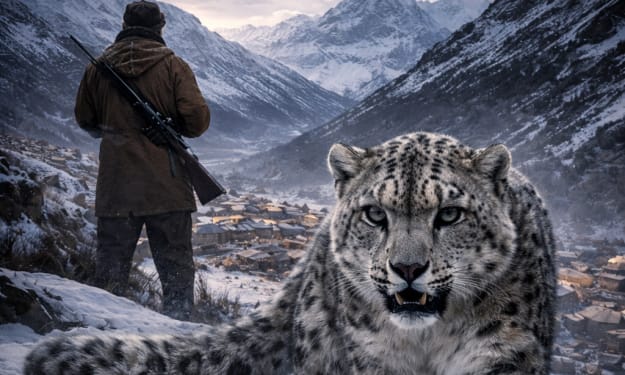
Human Revenge: A Hidden Cause Behind the Decline of Snow Leopards
High in the rugged mountains of Central and South Asia lives one of the world’s most mysterious and beautiful big cats—the snow leopard. Known for its thick grey-white fur, long tail, and incredible ability to blend into rocky landscapes, this elusive predator has fascinated scientists and wildlife lovers for decades. Yet despite its beauty and ecological importance, the snow leopard faces a growing threat: human revenge.
By Irshad Abbasi 7 days ago in Earth



Comments (1)
Wow! the kissing of the two stars story is so lovely and amazing.