
Webb Telescope Shines: Mirrors Perfectly Aligned!
James Webb Space Telescope Achieves Flawless Mirror Alignment for Stunning Cosmic Views

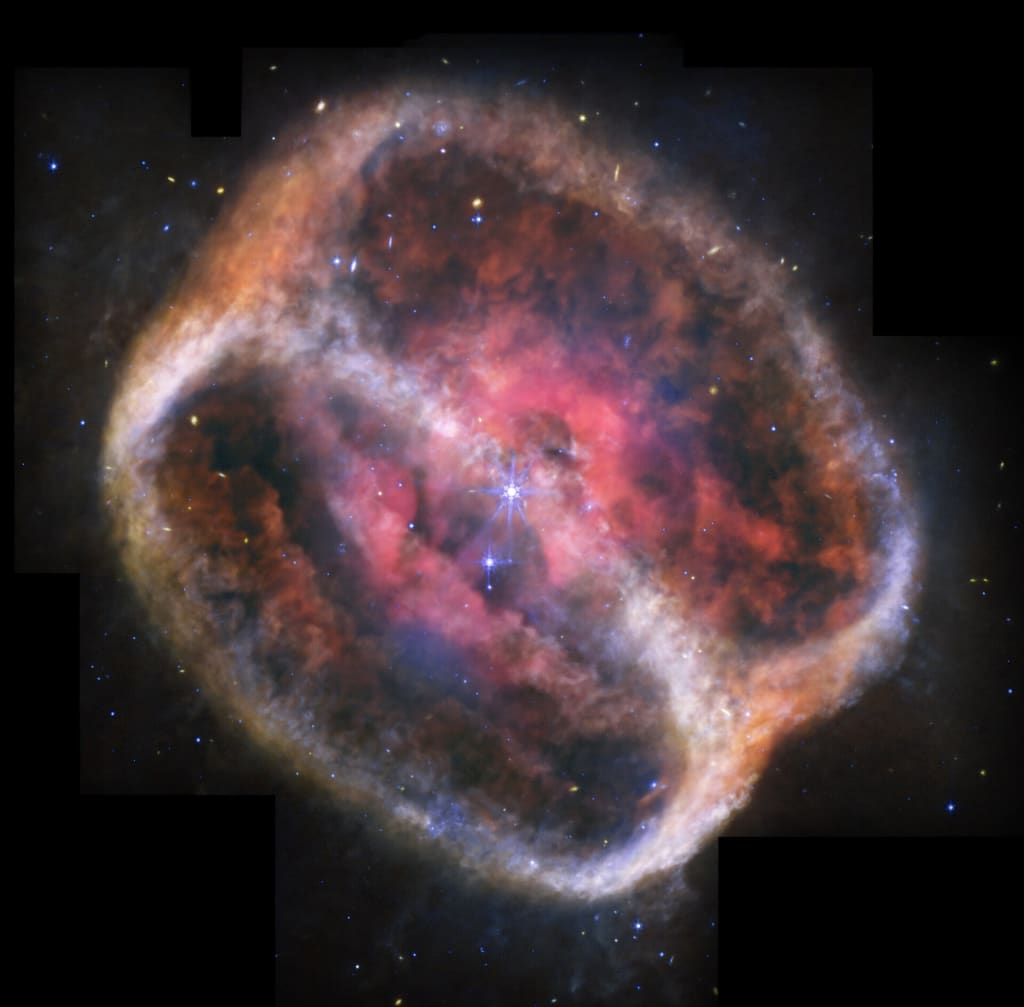
The folks behind the James Web Space Telescope have done it. They have completely aligned all of the mirror segments across all of the instruments. And to commemorate the occasion, we got an amazing set of images from all the instruments, including Miri. It all started with the near infrared camera or near cam, all the way back in February.
At the time, the mirror segments weren't aligned, so when they took an image of a star, they got 18 separate images, and then they painstakingly aligned them together, first stacking them on top of each other, and then making finer and finer adjustments in a series called phasing. And this brought all 18 mirror segments to basically form a single mirror.
And the result was a single star with eight large diffraction spikes, plus two smaller horizontal ones. After getting near cam sorted, the team were then able to move on to the near infrared spectrograph or near spec, the find guidance sensor and near infrared slit list spectrometer or nearest. And finally, the mid-infrared instrument or miri.
Now near spec and FGS nearest are both infrared instruments, so they were relatively easy to move on to next because they were already just about at their operating temperatures, much like near Camm was. But the mid infrared instrument, or Miri still needed to be cooled down to lesson seven, Kelvin, which acquired the use of a cryo cooler.
Now each instrument was individually brought into focus by taking multiple images of the same single star at different locations in each instrument's field of view. And then tiny phasing adjustments of just a few nanometers each were made to the mirror segments to bring those instruments into focus.
So until now, the idea was just to look at empty parts of the sky with just one bright star in it. But for this final alignment, check, Webb was pointed at a crowded field of stars in the large Maal cloud, and the results are stunning. Every field in focus, including Miri. But something is a little bit strange with the Miri image.
Its images appear a little bit fuzzier compared to the others, and rather than the six large spikes, MIRI stars have these fat, horizontal and vertical bars. Oh, and the near spec instrument appears to be missing some rows. Well, it turns out there are reasons for all of these weird little features, and we're gonna break down this entire image and just talk about how it was put together and what it's telling us now about Web's future performance.
But first though, I'd like to take a second and thank Magellan tv. I. Who are very kindly sponsoring today's video physicist, Jim Al Kaldi's, guide to Life, the Universe, and everything is an original two part series that shows us how science gives us insight into the biggest questions of all. How did the universe come into being?
How did life begin on earth? What is the nature of space and time, and how will it all end? This exclusive series is just one of more than the 3000 documentaries available on Magellan tv. Documentaries about nature, history, science, and technology are added each week and are presented without commercial interruption.
Best of all, Magellan is offering my viewers a full month of their award-winning content absolutely free. Just use the link in the description of this video. I. So this particular image that we're seeing here is obviously it's a collection of images made by each instrument, and it's kind of a rare treat to see them like this because not all of the detectors will actually produce full field images like this.
I. For example, near spec is a spectrograph, so it's typically going to produce a series of spectra and the Find guidance sensors normally only looks at a sub array of pixels around a GuideStar, and even then they don't use it for science. So we're not gonna see many images coming down from FGS. And by the way, these are just the raw uncalibrated images.
As each instrument is put through its commissioning, they'll be able to work out where are the individual artifacts and weird characteristics that can later be subtracted out of the science data. So the practical upshot is that the images that we're gonna be getting from web down the road are actually going to look a lot better.
They're gonna be even cleaner and offer more details than what we can see here. So this is actually web at its worst. The other thing is that these images are just monochromatic engineering images. They were each taken through a single wavelength pass band for each instrument. Normally we can't see infrared anyway because they are, by definition invisible to the human eye.
So the colors that we will eventually get are always gonna be borrowed from the visible part of the spectrum and mapped onto the infrared. So blue belongs to the shorter infrared wavelengths while red belongs to the longest ones, but that's not what's happening here. All of the images were given the same color set to represent different intensities.
And that way it makes it easier for humans to do a proper apples to apples evaluation and compare everything and just visually check to make sure that everything is okay. And yes, they did use computer algorithms to calculate that everything was okay, but you just sometimes have to look at it to know for sure.
One thing that these images all have in common is that they're all what's called diffraction limited, and that means that they can't really get any sharper because of the effects of light defracting off of the telescope hardware and the internal optics of the instrument. So really, these images are as sharp and as best focused as the laws of physics and optics allow.
And speaking of sharpness, I mean this is exactly why we are so excited by these images. All of the infrared telescopes we've flown to date carried relatively small mirrors and therefore got relatively low resolution, but with a six and a half meter primary mirror. Web is bringing us details that we've never seen before in the infrared.
So let's just take a quick walk around this image and just geek out on it a little bit. Uh, beginning with the two images from near cam that are side by side, that's the near infrared camera. They have these iconic diffraction spikes and the six large spikes come from diffraction of light off of the edges of the hex segments, and the two small horizontal spikes come from the vertical strut.
Spikes like these are really easy to produce when web is looking at a bright star. In practice though, web is really not gonna be looking at bright stars very often, so we're not likely to see these cropping up too much, at least not as spectacularly as we see here. Now, NCA was the first instrument to have its field aligned, and I talked more about that in a previous video, so feel free to check that out to see how that works.
But the NCA instrument is fitted with some special, what's called Wavefront sensing equipment that allow it to serve as the primary imager for all things mirror alignment. But this is such an important camera that they actually built two of them side by side for redundancy. So we're getting two main cameras in one package.
Next up is the near infrared spectrograph or near spec. This is the instrument where the light passes through an array of 250,000 micro shutters, and these individual shutters can be opened to simultaneously take spectra of multiple objects in the field of view all at once. The spectra are long and can fill out most of a row in the array.
So in practice, only one shutter is open for a given row, but near spec can also take images for calibration purposes or for acquiring targets. Now, when it's imaging, all of the shutters are opened. Well, almost all of them. If you look closer at the near spec image, you'll see some dark rows and columns.
It turns out that about 14% of the shutters are not operational. I. This is something that's been known about for a long time. And ideally, the shutters all would've been repaired or replaced before launch. But after some analysis, they decided it was actually better to just seal off the rows that had stuck shutters and use the remaining rows for science instead.
And that's really okay because there's plenty of shutters that are still operational. So there really wasn't an impact to science. Obviously it's possible that some additional shutters could fail in the years to come. If a shutter fails to open, it's actually not that bad of a problem because there's still a couple hundred thousand operational shutters left.
But if too many shutters are stuck in the open position, then you start getting too many unwanted spectra interfering with the spectra of your science targets. There's actually a contingency, a kneeling procedure to heal any failed open shutters that might emerge over time. This procedure heats the arrays for several minutes, allowing the shutters to unstick, but this is a procedure that they are unlikely to perform anytime soon or perhaps even never, because once it's been warmed up, the array has to passively cool back down again, and it will likely need to be recalibrated afterwards.
So in practice this, a kneeling contingency would be a huge disruption to science and it won't be used unless there's an unacceptable buildup of failed open shutters over time. I. Next is the fine guidance sensor near infrared imaging, slit the spectrograph or FGS Nearest. Nearest is an imaging spectrograph, so it can take images as well as spectra.
As an imager. It's gonna primarily be used to operate in parallel with the near infrared camera, so that allows web to do a little bit more science on extended fields. It's also capable of obtaining a spectrum of everything in its field of view only. There are no micro shutters in nearest. You're going to get a spectrum of every single point, and you're probably gonna have some occasional overlap, but this is a really good way of doing a spectroscopic survey of a cluster of stars and maybe finding something interesting that you didn't know was there before.
The fine guidance sensor are a pair of cameras that's really just reserved for guiding only. They typically won't take full frame images like you see here, because what they do instead is they look at individual guide stars that have been preselected ahead of time. I. They read out the Star's position about once per second and that information gets fed into Webb's guidance.
Loop Webb is then able to make real time adjustments to its pointing to make sure that the stars stay locked in Fgss field of view, and therefore the science target stays locked in the instruments field of view. Finally we have the mid-infrared instrument or Miri. This image was taken at 7.7 microns.
Compare that to Spitzer's Irac camera of the same region taken at eight microns. And because it is mid-infrared, MIRI's able to detect cooler, more diffuse materials, and that's why we see all this beautiful nebulosity in Mary's field. But if you look at Miri, you'll notice that its stars appear weird. In particular, MIRI's features these strong horizontal and these tall vertical spikes that are kind of superimposed over the six large diffraction spikes from the telescope.
Now, I had no idea what was going on here until I came across a tweet thread by Andres Gaspar, who is one of the lead investigators of the Myrie instrument, and he did a beautiful explanation, and I'm just gonna try to summarize it here. It turns out this is actually something that's unique to the detector's physical architecture, and the wavelength at which it observes.
MIRI's detector is essentially a thin layer of silicon that's sensitive to mid-infrared that's sandwiched between a layer of transparent silicon and metalized contacts. The infrared layer and the metal contacts form the pixels in the detector, and they have what's called a high quantum efficiency above 10 microns, and that means that they can absorb up to something like 80% of the IR photons landing on them.
But that efficiency plummets to 27% at five microns. Now, normally the photons strike the layer in such a way that the photon lands squarely inside the pixel, right above the contact and gets absorbed. But others will strike at the edges between the contacts. Those tiny gaps form a square lattice that photons can defract off of.
When you shine a laser through a square aperture, you get a large cross shaped pattern. So the pattern that forms in mirror is the result of some of the photons defracting off the square lattice multiple times together. They form a large diffraction cross on top of the diffraction pattern from the telescope.
But another reason that the images appear the way that they do is because these are longer wavelengths, so you're gonna get slightly lower resolution. In fact, MIRI is gonna get about half the resolution on average as the near infrared instruments can get. But again, talk about an enormous leap over previous mid-infrared instruments.
But now that web's mirrors are fully aligned, the instrument teams are moving all in with commissioning. That means making a series of observations to put each instrument through its paces. That means testing all of the detectors, using every combination of filter and pupil wheels. It means doing imaging and spectroscopy and colonography and making sure everything works as expected.
It also means finding all of the dark current, the noise, all of the artifacts, and. Figuring out exactly how they're all performing now that they're in space and cool to their operating temperatures. So far, everything is performing as well, or even better than the models have predicted. So this is a really amazing moment in Webb's commissioning process.
About the Creator
safiuzzaman
Hi, I’m Saifuzzaman, a passionate content writer with a knack for crafting engaging and impactful stories. I specialize in creating compelling content that resonates with audiences. Whether it’s blog posts, articles, or social media copy.
Keep reading
More stories from safiuzzaman and writers in Earth and other communities.
Unveiling the Spiritual Essence of Meditation: Harnessing Cosmic Energy
Spiritual reality takes you through a unique journey, a journey which will change your life, a journey which will enrich you and make you knowledgeable and blissful. Spiritual reality is a program on meditation and meditation experiences while you watch this program. Be totally relaxed. Just witness it.
By safiuzzaman9 months ago in Humans
Exclusive: Amazon Plans Thousands More Corporate Job Cuts Next Week, Sources Say
Amazon, one of the world’s largest e-commerce and technology companies, is reportedly planning to announce thousands of additional corporate job cuts next week, according to sources familiar with the matter. This latest round of layoffs is part of a broader trend of corporate restructuring at the company, which has seen waves of job reductions in recent months.
By Muhammad Hassanabout 8 hours ago in Earth
Trump Slams UK Deal to Hand Over Chagos Islands After Previously Backing It
If you thought politics couldn’t surprise you anymore, Donald Trump just proved otherwise. In a dramatic U-turn, the former U.S. president criticized the United Kingdom’s decision to transfer sovereignty of the Chagos Islands to Mauritius—a deal he had previously backed. What was once considered a solution to a decades-long dispute has now become a hot topic, sparking debates about strategy, diplomacy, and international trust.
By Muhammad Hassan3 days ago in Earth




Comments
There are no comments for this story
Be the first to respond and start the conversation.