
USA vs Iran: A Military Mismatch in 2026
David's Sling vs. Goliath's Hammer

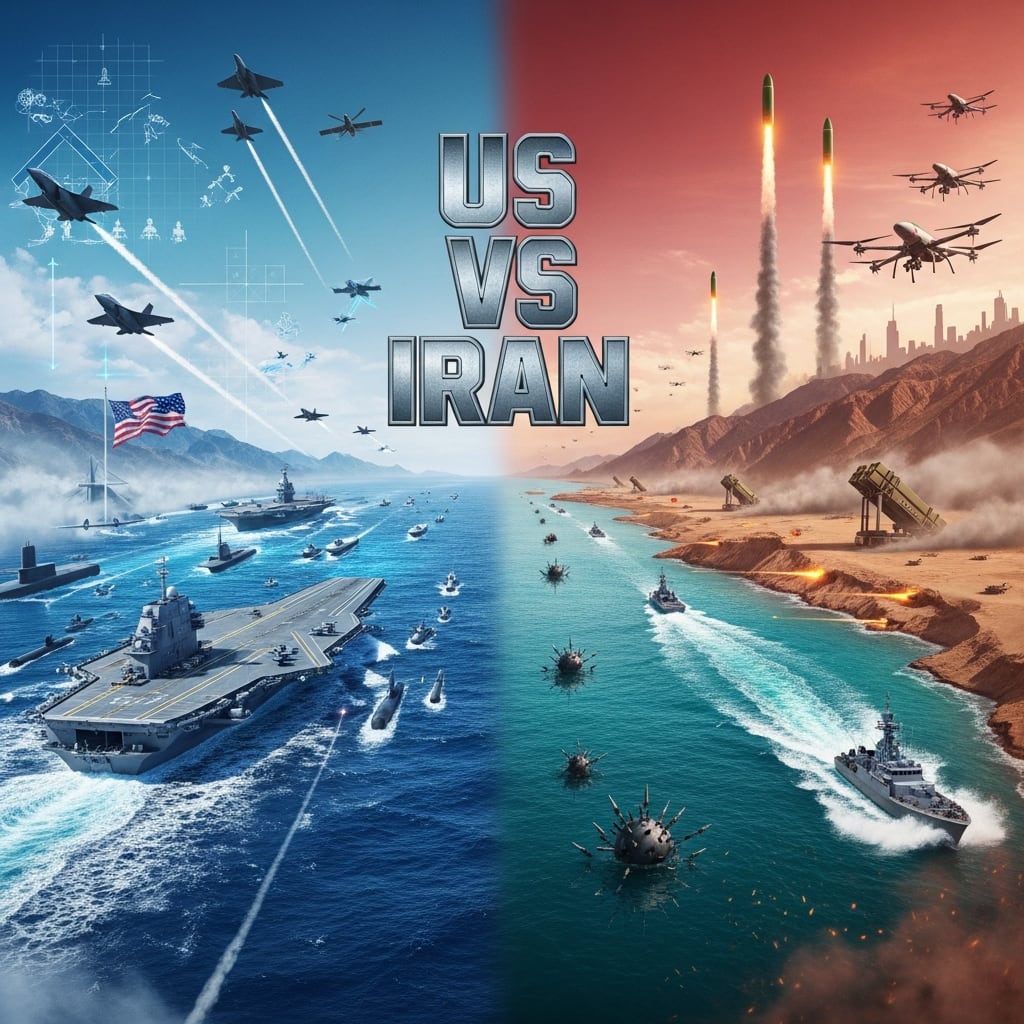
Comparing the U.S. and Iranian militaries is not about who would win a fair fight. It's about understanding two completely different ways of thinking about war. By 2026, the gap between their traditional strength will be wider than ever. The U.S. is a global superpower built to fight and win anywhere. Iran is a regional survivor, built to make an invasion so painful that no one would ever try.
The Conventional Fight: No Contest
In a head-to-head battle of jets, tanks, and ships, the U.S. wins in every single category by a jaw-dropping margin. It's not just about having more equipment; it's about having technology from a different century.
· In the Skies:The U.S. Air Force and Navy fly over 13,000 military aircraft. This includes about 1,900 5th-generation stealth fighters like the F-35. These jets are invisible to most radars and can strike targets from hundreds of miles away. Iran's air force, with about 500 planes, relies on jets from the 1970s and 80s. Their best fighters are old American F-14s and Russian MiGs, maintained with smuggled or homemade parts. In 2026, facing U.S. stealth jets, most Iranian pilots would be shot down before they even saw the enemy.
· On the Sea :The U.S. Navy rules the oceans with 11 nuclear-powered aircraft carriers. Each carrier is a 4.5-acre floating airbase that can operate for 25 years without refueling. They are surrounded by a protective fleet of cruisers, destroyers, and submarines. Iran has zero aircraft carriers or large warships. Its naval strategy is based on speed and surprise in its own backyard—the narrow Strait of Hormuz. It uses hundreds of small, fast attack boats and midget submarines that can swarm larger ships. It's like a wasp trying to sting a bear.
· On the Ground:The U.S. Army and Marines field over 6,000 advanced main battle tanks, like the M1 Abrams. These tanks have computers that can hit a target while moving at full speed. Iran's army has more tanks—over 2,000—but most are older Soviet-era models from the 1960s and 70s. Their armor is thin, their guns are inaccurate, and they would be easily destroyed in open combat.
Iran's Real Strategy: The "Axis of Resistance" and Asymmetric Warfare
Iran knows it can't win a toe-to-toe fight. So, for decades, it has built a different kind of military. Its real power isn't in its own army, but in its influence over a network of allied militias across the Middle East. This is called the "Axis of Resistance."
· Proxy Forces:Through its Islamic Revolutionary Guard Corps (IRGC), Iran funds, trains, and arms groups like Hezbollah in Lebanon, the Houthis in Yemen, and various militias in Iraq and Syria. These groups act as Iran's long arm. They can attack U.S. allies or bases without Iran firing a single official shot. This gives Iran power and protection—it can deny responsibility while still causing major damage.
· The Missile and Drone Arsenal:This is Iran's greatest equalizer. It has built the largest and most diverse stockpile of ballistic missiles in the Middle East—thousands of them. These aren't as accurate as American ones, but they are "good enough" to overwhelm defenses and strike cities, airports, and military bases across the region, including U.S. bases. More recently, Iran has become a major producer of cheap suicide drones (like the Shahed-136). These are the "poor man's air force"—hard to detect and cheap to make, perfect for swarming expensive air defense systems.
The 2026 Scenario: Stalemate Through Fear
So, what does a conflict look like in 2026? It would be messy, ugly, and devastating for the region—a war neither side truly wants.
The U.S. could, with little doubt, destroy Iran's conventional military. Its air force and navy could wipe out Iranian bases, ships, and air defenses in a matter of weeks. This is called "establishing air dominance."
But then what? Invading and occupying Iran—a country three times the size of Iraq with over 80 million people and mountainous terrain—would be a disaster of unimaginable scale. This is where Iran's real weapons kick in.
In response to a U.S. attack, Iran would not fight fair. It would unleash its asymmetric toolkit:
1. Closing the Strait of Hormuz with mines, boats, and missiles, choking off 20% of the world's oil supply and triggering a global economic crisis.
2. Launching massive missile and drone barrages at U.S. bases in the Gulf, Israel, and Saudi Arabia.
3. Ordering its proxy militias to attack U.S. personnel and allies across Iraq, Syria, and Lebanon with rockets and drones.
The U.S. would win every battle, but Iran would make sure there was no such thing as a clean victory. The goal for Iran is not to defeat the U.S. military, but to inflict so much pain—in American casualties, in global oil prices, in regional chaos—that no U.S. president would consider the war worth starting.
Conclusion: Two Different Games
In the end, the U.S. military is built to win wars. The Iranian military is built to prevent them. By 2026, America's technological hammer will be bigger and smarter than ever. But Iran will have spent the years making the entire region a field of traps, ensuring that swinging that hammer would be an act of catastrophic self-injury for the world. It’s the ultimate stalemate, born from a terrifying, mutual understanding of weakness and strength.
About the Creator
LegacyWords
"Words have a Legancy all their own—I'm here to capture that flow. As a writer, I explore the melody of language, weaving stories, poetry, and insights that resonate. Join me as we discover the beats of life, one word at a time.
Keep reading
More stories from LegacyWords and writers in Earth and other communities.
A Peek Into a Smoggy Future
Hey there. Trying to figure out where the air might be toughest to breathe at the end of next year? It’s a forward-looking question, and anyone who gives you a firm list is guessing a bit—we don’t have a crystal ball. But by looking at stubborn, years-long trends and how winter works, we can make a very educated forecast.
By LegacyWords3 months ago in Earth
The Fiery Circle: Understanding the Pacific Ring of Fire
The **Pacific Ring of Fire** is not a literal ring of flames, but it is undoubtedly the most geologically volatile region on Earth. Stretching approximately 40,000 kilometers (25,000 miles) in a massive horseshoe shape, it traces the coasts of the Pacific Ocean—from the southern tip of South America, up along the coast of North America, across the Bering Strait, down through Japan, and into Southeast Asia and New Zealand.
By Irshad Abbasi 7 days ago in Earth
My First Time Skiing and I Got Lost, Alone, in the French Alps
Looking back, I can trace some of my life’s biggest adventures to a simple action from my sister. She’d introduced me to Tommy (a very long time ago), a colleague of hers, who had overshared his penchant for Italian-looking women, and I ticked that box.
By Chantal Christie Weissabout 12 hours ago in Humans


Comments
There are no comments for this story
Be the first to respond and start the conversation.