
Unveiling the Secrets of the Mighty Megalodon Shark
The Megalodon's Legacy: From Ancient Predator to Modern Fascination


Introduction:
The prehistoric era was home to magnificent creatures that ruled the oceans, and one of the most awe-inspiring predators of all time was the mighty Megalodon shark. With its colossal size and incredible power, the Megalodon continues to captivate our imagination. In this blog, we will dive deep into the world of the Megalodon, exploring its characteristics, habitat, diet, and ultimately unraveling the mysteries surrounding this fascinating ancient predator.
The Enigmatic Megalodon:
As we embark on our journey to uncover the secrets of the Megalodon, let us first understand the significance of this legendary shark. The Megalodon, scientifically known as Carcharocles megalodon, was a massive shark that lived approximately 23 to 2.6 million years ago during the Cenozoic Era. It is believed to be the largest shark ever to exist, with estimates suggesting that it reached lengths of up to 60 feet or more.
Unparalleled Size and Anatomy:
One of the distinguishing features of the Megalodon was its immense size. Fossil evidence, such as teeth and vertebrae, provides insights into its anatomy and allows scientists to estimate its dimensions. The Megalodon's teeth, for instance, could measure up to 7 inches in length, far surpassing the teeth of any living shark species today. These colossal teeth were specially designed for gripping and tearing apart the flesh of its prey, indicating its role as a formidable predator.
Megalodon's Habitat:
To understand the Megalodon's habitat, we need to transport ourselves back to the ancient oceans it once roamed. Fossils of the Megalodon have been found in various parts of the world, suggesting that it had a wide distribution. It likely inhabited warm coastal waters, where abundant prey could be found. Oceans during the Megalodon's era were teeming with marine life, providing the perfect hunting grounds for this apex predator.
Feeding Frenzy:
The Megalodon was an apex predator, occupying the highest position in the prehistoric food chain. Its diet primarily consisted of marine mammals, including whales, dolphins, and seals. With its massive jaws and sharp teeth, the Megalodon would have been a fearsome sight as it launched attacks on its unsuspecting prey. Its incredible bite force and serrated teeth allowed it to inflict devastating injuries, ensuring a successful hunt.
Megalodon Extinction Theories:
While the Megalodon once ruled the oceans, it mysteriously vanished from the Earth's waters around 2.6 million years ago. Scientists have proposed several theories to explain its extinction. One prevailing theory suggests that changes in oceanic conditions and a decline in food sources may have played a significant role. Another theory speculates that increased competition with other large predators led to the Megalodon's demise. However, the exact reason for its extinction remains a subject of scientific debate.
Megalodon's Legacy:
Although the Megalodon is long extinct, its legacy lives on. Fossilized teeth and other remnants continue to be discovered, offering valuable insights into the ancient world and the creatures that inhabited it. The Megalodon's colossal size and unmatched power have made it a subject of fascination in popular culture, inspiring books, documentaries, and even movies. Its formidable reputation as the apex predator of the seas has solidified its place in history.
Conclusion:
The Megalodon, with its massive size, awe-inspiring anatomy, and role as an apex predator, remains one of the most captivating creatures to have ever existed. Through fossil evidence and scientific exploration, we have gained valuable knowledge about this ancient shark. While the mysteries surrounding its extinction persist, the Megalodon's legacy as a legendary predator continues to fuel our imagination and curiosity about the wonders of the prehistoric world.
About the Creator
Keep reading
More stories from Syed Shafqat Ali and writers in Earth and other communities.
Exploring the Fascinating World of Time Travel and its Intersection with Science
Introduction: Time travel has captivated human imagination for centuries, fueling countless works of literature, movies, and scientific inquiries. The concept of traversing through time, exploring the past or future, has both intrigued and puzzled us. In this blog post, we will delve into the fascinating world of time travel and its intersection with science. From the theoretical possibilities to the scientific theories surrounding this captivating subject, we will embark on a journey that stretches the boundaries of our understanding.
By Syed Shafqat Ali3 years ago in Education
Magnetic Magma earth
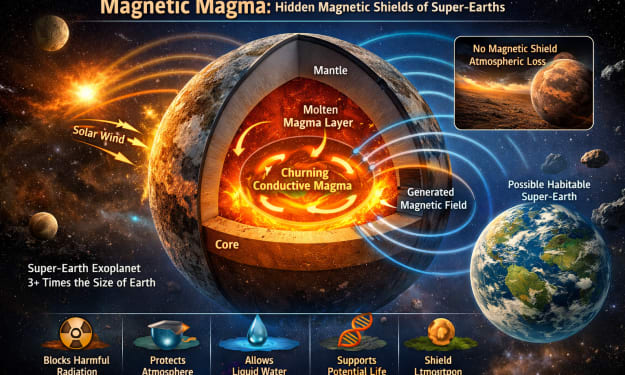
Super-Earths are rocky exoplanets more than three times the size of our planet, with far greater internal pressures and temperatures. For years, scientists assumed that if these worlds had magnetic fields, they would form the same way Earth’s does — through movement in a molten iron core. However, new laboratory experiments suggest something very different may be happening deep inside these massive planets. Under extreme pressure, certain molten rocks become electrically conductive. When these materials churn and circulate between the core and the mantle, they can generate magnetic fields on their own. This means a super-Earth might not rely solely on its core for protection. Instead, a thick, dynamic layer of magma could act as a natural magnetic shield, powered by internal heat and motion.
By USA daily update 7 days ago in Earth
Media: The Amplifier of Injustice
Media does not report reality. It selects, compresses, and amplifies fragments of it according to incentives largely unrelated to truth. What reaches the public is not an account of events; it is an engineered sequence designed to capture attention, provoke reaction, and sustain engagement.
By Meridian Vox4 days ago in Earth
Dead and Wearing Green
She was wearing that green dress when I first saw her, five years ago to the day. Flowing meadow fabric draped over long legs, thick auburn hair flowing down her back. That smile. Of course, she is still beautiful now. But now she is no longer alive.
By Karen Cave6 days ago in Fiction



Comments