
Magnetic Magma earth
How super-Earth interiors create unexpected magnetic shields through pressure, heat, and electrically conductive magma layers

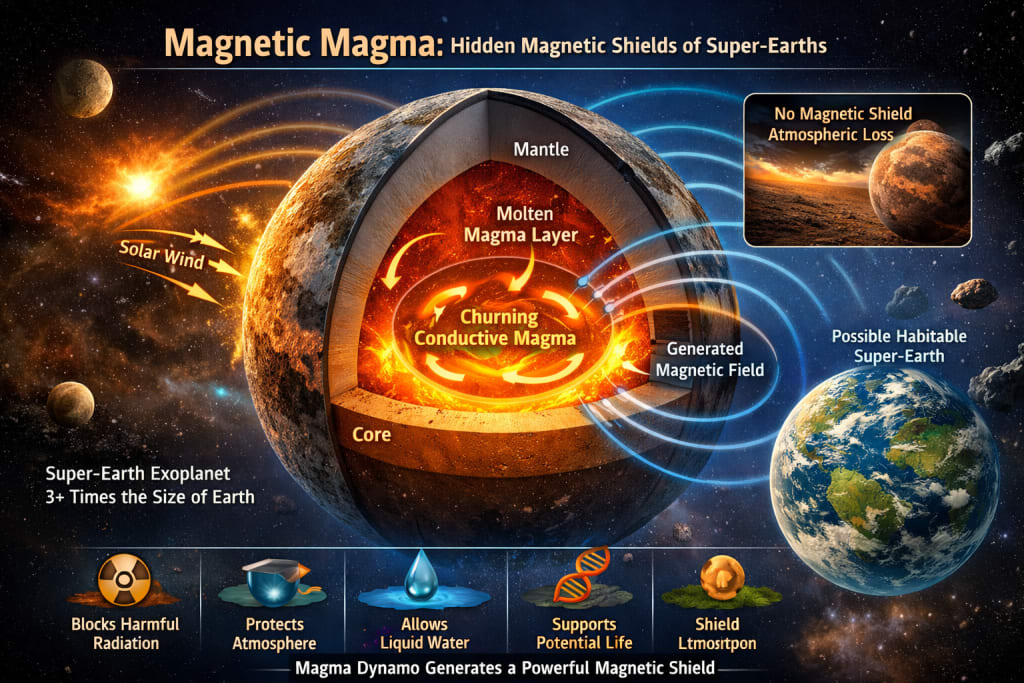
Super-Earths are rocky exoplanets more than three times the size of our planet, with far greater internal pressures and temperatures. For years, scientists assumed that if these worlds had magnetic fields, they would form the same way Earth’s does — through movement in a molten iron core. However, new laboratory experiments suggest something very different may be happening deep inside these massive planets. Under extreme pressure, certain molten rocks become electrically conductive. When these materials churn and circulate between the core and the mantle, they can generate magnetic fields on their own. This means a super-Earth might not rely solely on its core for protection. Instead, a thick, dynamic layer of magma could act as a natural magnetic shield, powered by internal heat and motion.
Why magnetic fields matter for life by blocking radiation, preserving atmospheres, and stabilizing planetary climates
A strong magnetic field is one of the most important ingredients for making a planet habitable. Without it, harmful radiation from a star can strip away the atmosphere over time, as happened on Mars. Magnetic protection deflects charged particles and solar wind, preventing atmospheric loss and shielding the surface from dangerous radiation. This creates a more stable climate, allowing liquid water to remain on the surface and increasing the chances that life could develop and survive. On Earth, this invisible shield plays a crucial role in preserving the air we breathe and protecting living organisms. If super-Earths possess even stronger or more widespread magnetic fields than Earth, their potential to host life becomes significantly more promising in the search for habitable worlds.
Laboratory experiments recreating colossal pressures reveal surprising behavior of molten rocks deep inside super-Earth planets
To understand what happens inside super-Earths, scientists recreated the intense pressures found thousands of miles below their surfaces. Using advanced equipment, researchers squeezed materials to pressures far beyond those at Earth’s core. Under these conditions, rocks behaved in unexpected ways. Certain minerals melted into forms that conducted electricity far better than previously believed. This discovery was crucial because electrical conductivity is necessary for generating magnetic fields. The experiments showed that, under super-Earth conditions, magma layers could become active participants in creating magnetism. Instead of being passive molten rock, these layers could flow, circulate, and produce powerful magnetic effects. These findings challenge long-standing assumptions about how planetary magnetic fields must form and expand our understanding of planetary interiors.
The hidden layer between core and mantle could act like a dynamo generating magnetic protection
On Earth, the magnetic field comes from the movement of liquid iron in the outer core, a process called the dynamo effect. But in super-Earths, the story may be more complex. Between the core and the mantle lies a thick region where molten rock may be present for billions of years. If this layer becomes electrically conductive under high pressure, it can behave like its own dynamo. As heat from the core rises and the planet slowly cools, this magma layer churns continuously. That motion, combined with electrical conductivity, can generate a magnetic field separate from the core. This hidden dynamo could create a broader, more stable protective shield, potentially lasting longer than Earth’s core-driven magnetic field.
Comparing Earth’s iron core dynamo with magma-driven magnetism on larger rocky alien worlds elsewhere distant
Earth’s magnetic field depends heavily on the composition and motion of its iron core. If that motion were to slow significantly, the field would weaken. Super-Earths, however, may not be limited in the same way. Their larger size means more internal heat, stronger gravitational pressure, and thicker internal layers. These conditions allow magma-driven magnetism to play a bigger role. Instead of relying on a single region for protection, these planets may generate magnetism across a broader internal zone. This could result in stronger, longer-lasting magnetic fields than Earth’s. In some cases, super-Earths might be even better protected from stellar radiation than our own planet, increasing their long-term habitability prospects in distant solar systems.
Implications for searching habitable exoplanets and identifying worlds capable of sustaining long-term surface life complex
This discovery has major implications for how scientists search for habitable planets beyond our solar system. Previously, researchers focused on a planet’s size, distance from its star, and atmospheric conditions. Now, internal structure and magnetic potential may become equally important factors. If super-Earths naturally generate protective magnetic fields through magma layers, many more of these planets could be considered candidates for life. Telescopes and future space missions may begin looking for signs that indicate strong magnetic activity. Understanding which planets can hold onto their atmospheres and shield their surfaces from radiation helps narrow the search. Super-Earths, once thought to be too extreme, may turn out to be some of the most life-friendly worlds in the galaxy.
About the Creator
USA daily update
News, Politics, Technology Updates
Keep reading
More stories from USA daily update and writers in Earth and other communities.
Why Earth is round why not plan?
For thousands of years, humans have wondered about the true shape of the world beneath their feet. Early civilizations imagined many possibilities: a flat disc, a giant mountain, or even a floating island. However, careful observation of nature, the sky, and the seas gradually revealed something remarkable — Earth is round. Not perfectly like a ball, but very close to a sphere, slightly flattened at the poles. This shape is called an oblate spheroid. The evidence for this conclusion comes from ancient observations, modern science, and direct images from space.
By USA daily update 2 days ago in Earth
Rebuild of Old Bus Depot Given Green Light
Plans to rebuild a long-disused bus depot have been officially approved, marking a significant step forward in a project expected to transform a neglected urban site into a modern and functional development. The decision has been welcomed by local authorities, planners, and community leaders, who say the rebuild will breathe new life into the area while preserving its role in public transport and urban regeneration.
By Aarif Lashari6 days ago in Earth



Comments
There are no comments for this story
Be the first to respond and start the conversation.