
UNUSUAL LAKES AROUND THE WORLD
What can be found in these lakes?

Lakes,they're a common sight around the
world providing breathtaking scenery, and
valuable resources ,however some Lakes
stand out for their unique features and
unusual characteristics from lakes that
change color to those with underwater
waterfalls join me on a journey to
discover the top 15 most unusual Lakes
on planet Earth.
15. Abraham Lake Canada Abraham
lake is a man-made Reservoir in the
western province of Alberta Canada
located along the northern Saskatchewan
River it was created in 1972 as a result
of the construction of the Bighorn Dam
and now it stretches over an area of
around 20 square miles or about 53
square kilometers as well as being an
unusually large artificial Lake that has
a deep blue coloration it's become
renowned for a strange phenomenon that
sees bubbles become trapped when it's
covered in ice these ice bubbles are
formed during the winter months when the
lake freezes over and are formed when
the plant matter and organic materials
at the bottom of the lake decompose and
methane gas is released and Rises to the
surface this happens throughout the year
but during the winter the gas gets
trapped under the ice and forms pockets
and Bubbles that get Frozen in place as
the temperature drops these Frozen
bubbles create an incredible display
especially because the Clear Water of
the lake turns into virtually
transparent ice and it almost appears as
if the bubbles have been trapped in time
unsurprisingly this phenomenon has meant
that between mid January and
mid-February the lake has become one of
the most popular visitor destinations in
the region with people traveling from
around the world to see it for
themselves
14. Laguna Colorado Bolivia Laguna
Colorado which translates to mean red
Lagoon is a stunning Salt Lake located
in the southwestern part of Bolivia near
to the border with Chile the lake which
covers an area of around 23 square miles
or 60 square kilometers is surprisingly
shallow with an average depth of just
about a foot or about 35 centimeters and
it gets its name because of its striking
red color which is caused by the
presence of red algae that grow in the
Salt Flats surrounding the lake the lake
also has high concentrations of borax
and other minerals which form into milky
white islands that adds to its mystical
appearance a highly salty lake like this
which is at an altitude of more than
fourteen thousand feet or 4200 meters
above sea level would normally not
support much Wildlife but the red
colored algae supports huge populations
of flamingos with thousands of James's
flamingos as well as Andean and Chilean
flamingos too the Lake's color the
presence of so many flamingos and the
species that roam the shores to prey on
them mean that not only is this a
popular tourist site today but look
Colorado has long been an important
place for local culture it's within the
Eduardo everroa and the infauna national
reserve and around it are a number of
important archaeological sites such as
ancient ruins and rock paintings that
give a fascinating insight into the
lives of the pre-colombian civilizations
that live there
13. Pitch Lake Trinidad
found in Southwestern Trinidad in the
village of La Brea Pitch Lake isn't
exactly what you'd normally expect from
a lake because instead of being full of
water it's the largest natural deposit
of asphalt in the world covering an area
of around 0.15 square miles or 0.4
square kilometers it's thought to be up
to 250 feet or 76 meters deep and
contains an estimated 10 million tons of
liquid asphalt the lake is believed to
have formed over 10 000 years ago at a
time when the Caribbean tectonic plate
shifted and created a fault line beneath
where the lake is now this has allowed
oil from a deep deposit to be forced up
towards the surface where the heat of
the sun evaporates the lighter elements
to leave the heavier asphalt behind used
throughout the centuries to coat ships
and even line many of the first asphalt
roads in New York City and Washington DC
it's still an active site for asphalt
mining today and is a vital part of the
local economy it's also become a popular
tourist destination too because of how
strange the lake is and its surroundings
are visitors are able to see bubbling
Tar Pits which are created by the
movement of the pit under the surface
and natural asphalt sculptures that have
been formed as the pitch solidifies with
cones arches and columns that are in
some cases up to 10 feet or 3 meters
high
12. Lake van Turkey Lake van is a
unique place that's in Eastern Turkey
that covering an area of around 1450
square miles or 3 700 square kilometers
reaches a maximum depth of 490 feet or
about 150 meters and it's an important
source of water in the region it's one
of the largest lakes in the world that
doesn't have an outlet which means that
minerals become trapped in the water
that as a result has a salinity of more
than three times that of the ocean this
means that despite being at an altitude
of 5300 feet or about 1600 meters above
sea level ice rarely forms on it like it
does on other water sources in the area
the lake has a vivid turquoise color
which is due to the presence of algae
and this food source has allowed several
endemic species of fish to develop such
as the Pearl mullet and a type of stone
Loach in many ways though the features
that truly make the lake unique are
human-made ones and the area is one of
turkey's most important archaeological
sites in 2017 researchers discovered a
submerged ancient city within the Lake's
Waters that's believed to date around 3
years ago known locally as the vanishing
City it's not yet clear who once lived
there but it's hoped that among the
remains of the walls structures and
perhaps even a castle there will be
Clues to what life was like before as
historians suspect the site was
destroyed by an earthquake on akadamar
island which is in the lake there's also
the stunning Armenian Holy Cross
Cathedral that dates back to the 10th
century and is famous for its intricate
Stone carvings and beautiful frescoes
while other smaller buildings around the
lake still stand as memories of the rich
cultural heritage of the region over
many centuries
11. Lake pukake New Zealand Lake
pukake which is in the Mackenzie Basin
of the south island of New Zealand is a
stunning place that's well known for its
vibrant blue color and its unique
location near the base of the Southern
Alps it's this location that's resulted
in its incredible coloration because the
water that flows into it comes from the
Tasman and hooker glaciers as these
large mounds of ice move through the
mountains they grind rock into a fine
powder that's known as glacial flower
and is then carried by the Melt water
into the lake where it creates the Milky
blue-green color that's unique to this
region on a clear day it's amazing to
see and the effect is magnified by the
sheer size of the lake that has a
surface area of 69 square miles or
almost 179 square kilometers and is the
largest of the three glacial lakes in
the region with a maximum depth of 230
feet or about 70 meters it's long been a
famous national landmark with an island
on the lake once featuring on New
Zealand's currency but it looks very
different today than it did just a few
decades ago that's because with its
elevation around 1700 feet or 518 meters
above sea level it was seen as the ideal
place to build a hydroelectric plant
especially as it only had one outflow at
the southern end this was dammed up and
replaced with a series of canals and
actually allowed for the level of the
lake to be increased by about 150 feet
or 46 meters controversially this has
meant that the famous island was
submerged and a number of natural
habitats were destroyed but this is
meant that the vast majority of the
Region's power is generated at the lake
instead of relying on fossil fuels
10. Lake Michigan United States
Lake Michigan is one of the largest
freshwater lakes in the world and it's
the only great lake that is entirely
within the United States located on the
border of Illinois Wisconsin Michigan
and Indiana Lake Michigan is a popular
destination for visitors with plenty of
things to do both on the water and
around it it's a huge body of fresh
water with a surface area of over 22 000
square miles or 58 000 square kilometers
and it makes it the fifth largest lake
on the planet and unsurprisingly a
hugely important feature of the region
several major cities including Chicago
Milwaukee and Green Bay are located on
its Shores and it's connected to the
rest of the Great Lakes system through a
series of locks and canals the lake is
also home to various ports and harbors
and these facilitate shipping and
commerce throughout the entire Midwest
with more than 1600 miles or about 2500
kilometers of Shoreline featuring sandy
beaches towering sand dunes rugged
Cliffs and Rocky outcrops the diverse
landscape hasn't just been crucial to
Modern development but has been a
lifelong for people for thousands of
years the earliest inhabitants here are
believed to have been the Hopewell
culture who first settled there more
than 2 000 years ago and since then
successive groups have relied on the
fresh water the fish and the fertile
land around the lake to survive many
have argued that without Lake Michigan
in particular it would have been far
trickier for humans to migrate across
the continent and that has been one of
the most vital resources in the
establishment of the country that we
know today
9. Dead Sea Jordan Israel the
Dead Sea is a saltwater lake located on
the border between Jordan and Israel
it's one of the saltiest bodies of water
in the world with a salinity level
that's nearly 10 times that of the ocean
and it's this high salt content that's
led to several unusual properties that
make it a unique and fascinating place
the lake which is 1412 feet or about 430
meters below sea level is fed by several
Rivers but it has no Outlet which means
that the water evaporates and leaves
behind a high concentration of minerals
and salts as a result the water is
incredibly buoyant and allows people to
float effortlessly on the surface in
fact it's nearly impossible to sink in
the Dead Sea due to the water's high
density another valued property of the
Dead Sea is its mud as the sediment at
the bottom of the lake is rich in
minerals and other beneficial substances
that have been used for centuries for
their healing properties visitors to the
Dead Sea can cover themselves in mud
which is believed to help alleviate skin
conditions such as psoriasis and eczema
as well as reducing inflammation and
promoting relaxation so it has for a
long time been used as a spa resort
records of people traveling there for
its health benefits date back thousands
of years it's mentioned in the Bible and
it's believed that King David and King
Herod both use the lake for their own
purposes unfortunately though human
activity in recent times has meant that
the Dead Sea is shrinking at an alarming
rate so much more water is being taken
from the rivers that feed the lake that
has lost nearly one third of its surface
area in the last 50 years and it's
expected to continue shrinking in the
coming years efforts are underway to
address this issue and preserve it for
future Generations but whether these
attempts will be successful or not is
yet to be seen
8. Lake candy Kazakhstan Lake
candy is a natural wonder located in the
tianshan mountains of Kazakhstan and is
known for its beautiful clear turquoise
blue water and a strange site that's
visible beneath the surface it's only a
recently formed Lake as it was created
following an earthquake in 1911 that
triggered a landslide that blocked The
Gorge of the candy River and in the
following years water from snowmelt and
Mountain Streams began to build up
behind this blockade with the lake
developing in a natural dip in the
landscape it's because of the way this
happened that the lake has become such a
popular and unusual place to visit
because the water is so clear you're
able to see a submerged Spruce Forest
which had originally grown on dry land
rising from its depths the Trunks and
branches of some of the trees still
reach above the Lake's surface and
create a surreal and haunting atmosphere
that's unlike any other lake in the
world despite having low oxygen levels
the water so cold that it's actually
preserved the tree trunks so they're
able to continue growing and act as a
host for various types of algae that
further add to the mystical feel of the
play with a large population of rainbow
trout in the lake as well as a pristine
forest habitat around it with animals
like deer foxes and bears it truly is a
one-of-a-kind Lake to visit
7. Lake vostok Antarctica now
you'd normally expect that there would
be images of the 16th largest lake in
the world but lake vostok is one of the
least explored places on the planet
that's because it's a sub-glacial lake
in Antarctica and lies 13 000 feet or 4
000 meters beneath the East antarctic
ice sheet it's one of the largest known
sub-glacial lakes in the world with a
surface area of around 4 800 square
miles or 12 000 square kilometers it's
got a maximum depth of more than 2 600
feet or 800 meters it was first
discovered in 1957 by a team of Soviet
scientists who were conducting research
on the Frozen continent and noticed an
anomaly in their readings beneath the
ice since it was found the lake has been
the subject of intense scientific
interest and it's believed to contain
some of the oldest and most pristine
water anywhere on the planet amazingly
the water that it contains is thought to
be more than a million years old and
it's been isolated from the surface for
hundreds of thousands of years unusually
you'd expect this water to have Frozen
because the temperatures are well below
freezing but the pressure that's exerted
on it by the ice sheet means that it
remains liquid the few tests that have
been conducted from drill samples have
shown this water to contain high levels
of oxygen and other gases as well as a
range of microorganisms including
bacteria that have adapted to the
extreme conditions in the lake as well
as providing a valuable insight into
what the world was like so long ago it's
possible that continued study of this
Lake could help scientists learn more
about the origins of life on Earth and
perhaps even the possibility of life
elsewhere in the universe
6. Lake nakuru Kenya lake nakuru
is a shallow alkaline Lake that's
located in the rift valley region of
Kenya it's believed to have been formed
around 3 million years ago during a
particularly violent geological time in
the region when tectonic plates were
shifting and is located in a Depression
known as the greybin which was formed by
the rift valley activity it's fed by
several rivers and streams including the
Enduro River and these bring
nutrient-rich waters from The Mao
escarpment with no natural outflow and
continual hot temperatures the only way
for water to leave the lake is usually
through evaporation and because of very
strict wet and dry seasons in the region
this means the water level fluctuates
dramatically it has an average depth of
about a foot or about a third of a meter
and this can increase by as much as
almost 10 feet or 3 meters with the
influx of water during the rainy season
this floods the surrounding grasslands
and deposits nutrients which means the
land is wonderfully fertile and supports
a thriving ecosystem of thousands of
different species while the water's pH
levels range between 7.5 and 9.5
depending on the time of the year it
supports algae and fish as well as
flamingos pelicans and other various
water Birds and the land around it is
just as impressive so much so that it's
been turned into a national park to act
as a sanctuary for a number of rare
animals such as giraffes and one of the
largest populations of both black and
white rhinos in this part of Africa
5.Boiling Lake Dominica
Boiling Lake on the island of Dominica
in the Caribbean is as the name would
suggest full of water that's constantly
boiling and steaming and is one of the
hottest and most geologically active
bodies of water in the world formed as a
result of volcanic activity in the area
which is technically described as a
flooded fumeral and it's within the
crater of a volcano where the water is
heated by the underlying magma chamber
this can cause the water temperature to
reach up to 212 degrees Fahrenheit or
100 degrees Celsius so it is actually
boiling and is definitely not somewhere
that you'd want to swim in or attempt
any other recreational activities it is
though a popular tourist attraction
because the site of it is truly bizarre
and it's also an important site for
scientific research because of its
unique geology and chemistry and the
presence of several unique species of
plants and animals that have adapted to
the extreme conditions around it thought
to be up to 195 feet or 59 meters deep
the water level and volatility of the
lake have been seen to change
substantially since it was first
scientifically documented in 1870 often
in line with volcanic events that happen
nearby this is a reminder that it's
still a geologically active region and
anyone hiking there needs to be cautious
of potential landslides in the area
around the lake or even of course an
eruption taking place through the lake
itself that could happen at any time
without any warning
4. Lake Titicaca Bolivia Peru
Lake Titicaca is a large deep lake
that's located on the border between
Bolivia and Peru in South America it's
the highest navigable lake in the world
with an elevation of more than 12 500
feet or 3 800 meters above sea level and
it covers a surface area of
approximately 3 200 square miles from
about 8 300 square kilometers it's fed
by five major rivers and at least 20
smaller streams and has 41 Islands some
of which have been inhabited for
hundreds of years it's a vital source of
water and food in the area with more
than 530 known aquatic species that live
there and evidence has been found that
shows communities first settled by the
lake many thousands of years ago it's
believed for example to have been a
sacred site for the Incas who considered
the lake to be the birthplace of the Sun
and around its Shoreline there are a
number of ancient ruins and
archaeological sites including the
remains of the ancient city of tiwanaku
which dates back more than 2 000 years
to this day large communities rely on
the lake for their livelihoods mainly
from fishing and agriculture but it's
also an extremely popular tourist
attraction with people traveling from
around the world to see the ancient
sites and also visit the unique
artificial islands that are built by the
uros people to take full advantage of
the resources that the lake has to offer
3.Lake Natron Tanzania found
in the angorogoro district of Tanzania
like Natron is found in a geological
Rift and as a result has developed
several unusual attributes measuring up
to 35 miles or 57 kilometers long and 14
miles or 22 kilometers wide it's just
9.8 feet or under 3 meters at its
deepest something that's a result of the
extreme temperatures in the region and
consequently high levels of evaporation
it's fed mainly by the southern iwassan
Giro River along with a number of hot
springs in the surrounding area that
release mineral-rich water so the
effects of the evaporation rate are
magnified whereby large quantities of
salt-based minerals mainly natural and
Trona are left behind and it can at
times cause the pH of the water to rise
above 12 which is around the same as
ammonia or bleach this is inhospitable
for most animals but is the perfect
environment for a certain algae that
turn the water red and for flamingos
that feed on the algae it's actually
home to the largest breeding flock of
flamingos in East Africa who benefit
from the caustic water as it acts as a
natural protective barrier from
predators that would otherwise Target
their nests during the breeding season
several fish species are endemic to the
perimeter of the lake where the water is
less salty and have adapted to the
extreme environment but apart from these
the area surprisingly bereft of wildlife
the surrounding land too is Barren with
very little plant life and the only
animals you'll see there are the herds
of cattle passing through
2.Kalamutu Indonesia
elemutu is a volcanic crater lake
located on the island of Flores in
Indonesia and is undoubtedly one of the
most unusual natural formations in the
world because it's actually made up of
three independent lakes that change
colors at seemingly random intervals
these Three Lakes are known
asapolo and each will be a shade of blue
green or red depending on various
conditions and it's such a strange
occurrence that the Lakes have become a
central part of the local belief system
with these colors said to represent the
spirits of the Dead they formed over
thousands of years as water accumulated
within the Caldera of what's now
considered to be a dormant volcano but
it's the gas and elements like iron and
manganese that are still released that
create this wonderful display when
present in the right quantities they'll
trigger chemical reactions and due to
something called oxidation reduction
chemical Dynamics the color will change
it's not a regular event with the most
active time in recent years being in
2016 when the color shifted six
different times within 10 months but
this relative Rarity just makes it all
spectacular if you're lucky enough to be
there when it happens
1.Lake NEOS Cameroon
most lakes are a vital source of water
and food for local communities to help
them Thrive but like NEOS and Cameroon
is the complete opposite and is the
deadliest lake in the world formed
within a volcanic crater and with a
beautiful deep blue color it's mostly
known for an event that took place in
1986 that resulted in the deaths of more
than 1700 people as well as many
thousands of livestock in the
surrounding villages on that fateful day
a limnic eruption happened which is when
carbon dioxide and other gases that had
accumulated at the bottom of the lake
suddenly Rose to the surface this
created a huge plume of toxic gas that
engulfed the surrounding area and
because the cloud was Heavy it flowed
downhill and suffocated every living
thing on its path frighteningly the
exact cause of the eruption is still not
fully understood but it's believed to be
related to volcanic activity in the area
since This Disaster measures have been
taken to prevent similar events from
happening again with pipes being
installed at the bottom of the lake to
release the gas buildup slowly and
safely and regular testing of the Lake's
chemistry and gas levels it's also
become an important site of scientific
interest in the hope that it might help
determine if any other lakes in the
world is at risk of something similar so
that steps can be taken before that
happens.
About the Creator
Keep reading
More stories from Khuliso Muragana and writers in Earth and other communities.
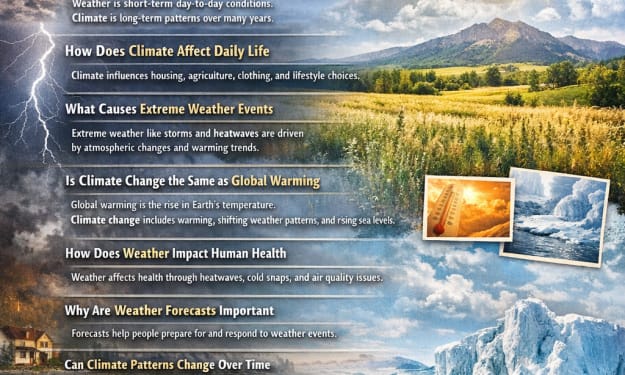
Weather and Climate Understanding the Forces That Shape Our Daily Lives
Weather and Climate Understanding the Forces That Shape Our Daily Lives Weather and climate play a central role in how people live work travel and plan for the future. From daily temperature changes to long term climate patterns these natural systems influence agriculture health economies and even global stability. Understanding the difference between weather and climate and knowing how they affect human life has become more important than ever especially as the world experiences more extreme conditions.
By America today a day ago in Earth
Autonomy Is The Real Privilege
Good morning, freedom-seekers! Today we’re gonna be looking at autonomy. A strange word, I know; one many would probably look at blankly and run away from on sight. We’re gonna figure out what it actually means, consider how it’s achieved, and decipher just how deeply most of us are tangled up in dependence without realising it.
By That ‘Freedom’ Guy5 days ago in Humans


Comments
There are no comments for this story
Be the first to respond and start the conversation.