
Unleashing the Fury of Earth’s Fiery Heart
How the Inner Workings of Our Planet Shape Volcanoes, Supervolcanoes, and Global Climate

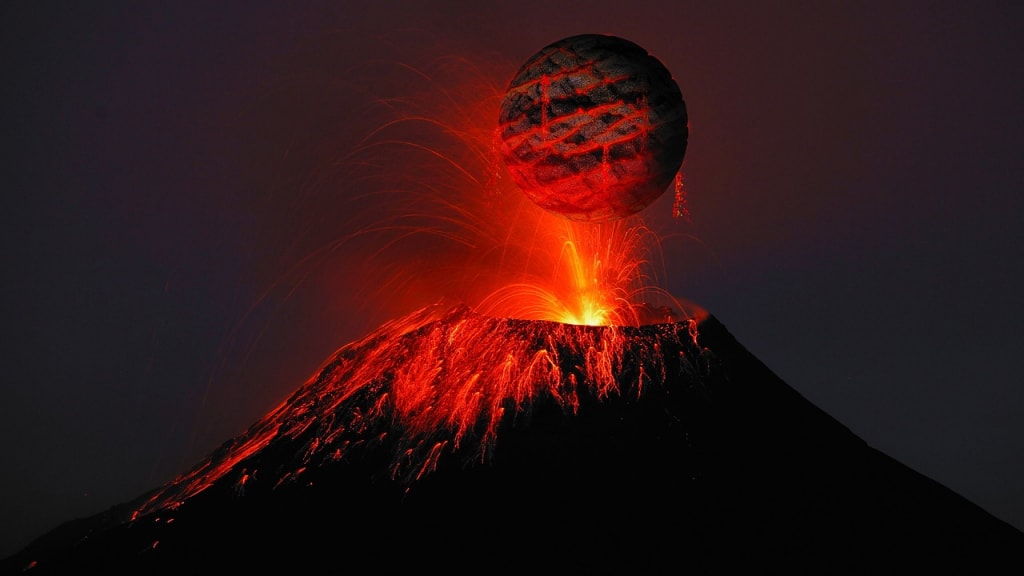
Beneath our feet, Earth is not the static, lifeless ball it might seem to be. Instead, it is a colossal sphere of semi-molten rock, a planet still very much alive with energy. Deep in its core lies a heart of iron that burns as hot as the surface of the Sun. This incredible heat—left over from our planet’s formation and continuously generated by the radioactive decay of countless tons of unstable elements—fuels powerful upwellings of rock. These colossal currents, spanning thousands of kilometers, strive to reach the surface, but they must first overcome the Earth’s outermost shield: the crust.
At first glance, Earth’s crust appears as a solid, protective barrier. However, it is in truth a delicate, fragile layer—a mere “apple skin” draped over the roiling, dynamic behemoth that is our planet’s interior. This barrier can sometimes fail in dramatic fashion when massive buildups of energy break through in sudden, catastrophic events. When these apocalyptic forces are unleashed, they result in eruptions that can be tens of times more powerful than all of humanity’s nuclear weapons combined. The consequences are dire: the climate can shift dramatically within a single year, and continents can be buried under toxic ash and gases.
The Birth of Volcanoes: Tectonic Plates and Mantle Plumes
Volcanoes come in many shapes and sizes—from towering, snow-capped mountains to gentle lava domes. Yet, fundamentally, they have two main sources. The first arises at the boundaries between tectonic plates. These plates are enormous segments of Earth’s crust that fit together like pieces of an ancient jigsaw puzzle. There are seven major tectonic plates along with numerous smaller ones, each moving at speeds of up to 15 centimeters per year. While this might seem glacial by human standards, over geological timescales, these motions amount to a titanic struggle for survival.
At these plate boundaries, collisions and separations occur constantly. When one plate is forced under another—a process known as subduction—the downgoing plate crumbles and is forced into the Earth’s mantle, where temperatures soar to around 1300° C (2372° F). Here, in a region called the asthenosphere, the intense heat is enough to melt rock into a liquid state. However, the immense pressures keep the rock in a superheated but solid form until circumstances allow a tiny portion to melt into magma. This magma, being less dense than solid rock, begins its upward journey in furious, bubbling spurts. It accumulates in sponge-like reservoirs right beneath the Earth’s crust. Once enough magma gathers, it can break through the crust, leading to the explosive, awe-inspiring phenomena we recognize as volcanoes.
This process is not just about the creation of mountains; it is a kind of cosmic “revenge” played out on a planetary scale. The plate that wins the struggle to remain on the surface eventually crumbles to form a new mountain range, while the losing plate is swallowed into the depths below, often triggering volcanic activity as a final act of defiance.
The second source of volcanoes is linked to mantle plumes. These are columns of abnormally hot rock that rise from the boundary between the Earth’s core and its mantle, all the way to the surface. While our understanding of mantle plumes is still developing, they can be thought of as weather patterns deep within the Earth’s interior. Much like storm clouds formed by rising warm air, these plumes can eventually break through the crust to create volcanoes in regions far from any tectonic plate boundaries. Such volcanoes often remain active over long periods, even as the surface tectonic plates shift around them.
Measuring the Fury: The Volcanic Explosivity Index
Scientists use a logarithmic scale known as the Volcanic Explosivity Index (VEI) to gauge the power of volcanic eruptions based on the volume of material ejected. The scale starts with minor events and escalates to cataclysmic super eruptions. For instance, a VEI 2 eruption might eject enough lava to fill 400 Olympic swimming pools. On a VEI 3 scale, eruptions can cause serious local devastation, as seen with the 2021 eruption of the Samaru volcano in Indonesia, which destroyed thousands of homes.
At a VEI of 5, eruptions become truly catastrophic. These events can eject cubic kilometers of debris—comparable to an entire lake of molten rock being hurled skyward. The 2022 eruption of Hunga Tonga-Hunga Ha’apai, for example, generated shock waves that circled the globe multiple times and even created oceanic white tsunamis.
A VEI 6 eruption is nothing short of world-changing. In 1883, the Indonesian volcano Krakatoa erupted almost continuously for five months. One of these explosive events produced the loudest sound in recorded history—ten trillion times louder than a rocket launch. The eruption generated 30-meter-high tsunamis that decimated nearby coastal populations, while enormous quantities of gas and ash were cast into the atmosphere. Global temperatures dropped by nearly 0.5° C, and red, dusty sunsets lingered for years.
At a VEI of 7, we encounter what might be called super-colossal eruptions. These are millennial-scale events that have shaped the course of human civilization. The 1815 eruption of Mount Tambora, for example, released 400 times more energy than the infamous Krakatoa. With 140 billion tons of ash and dust thrown high into the atmosphere, the following year became known as the “Year Without a Summer,” with widespread crop failures and over 100,000 deaths.
Supervolcanoes: Myths, Realities, and the Deep-Seated Threat
The term “supervolcano” is often used in popular culture to evoke images of unstoppable, apocalyptic forces. In reality, the term was coined by the media rather than defined by scientists. What makes these volcanoes truly special is not that every eruption is a super event, but rather that they build up pressure over hundreds of thousands of years. Deep within the Earth, colossal magma reservoirs form several kilometers below the surface. Over time, pressure builds until it eventually forces the overlying rock upward by several meters. When this pressure becomes too much, the rock cracks, and a catastrophic release of billions of tons of gas and ash occurs at supersonic speeds.
Imagine a boiling pot of water whose lid suddenly pops off—only on a scale that defies comprehension. The eruption might expel at least 1,000 cubic kilometers of material, a fraction of the total volume of the magma reservoir. The ground then collapses into the void left behind, forming a massive depression known as a caldera. Over hundreds of thousands of years, the cycle repeats: pressure rebuilds, and another super eruption looms on the horizon.
It is estimated that one of the few volcanoes capable of such super eruptions might erupt catastrophically every 177,000 years on average. While this may seem terrifying, these events are far more frequent than comparable asteroid impacts. The most recent super eruption—the Oruanui eruption in New Zealand—occurred 26,500 years ago. It unleashed energy equivalent to dozens of billions of tons of TNT, reshaped the landscape by carving out a caldera nearly 20 kilometers across, and cooled the entire southern hemisphere abruptly.
Even more striking was the Lake Toba eruption approximately 74,000 years ago, which ejected an astounding 5,300 cubic kilometers of material. This event blanketed parts of South Asia with up to 15 centimeters of ash, triggering a rapid global temperature drop of 4° C. The resulting volcanic winter likely lasted a decade, followed by centuries of drought and environmental stress that may have reshaped human evolution itself.
A Balanced Perspective on a Fiery Planet
Despite the dramatic potential of these natural events, it is important to put the threat into perspective. Supervolcanoes, and even the more frequent eruptions of “regular” volcanoes, are unlikely to end humanity. While they can certainly cause widespread disaster and regional devastation, modern monitoring techniques allow us to track subtle changes in magma reservoirs—such as ground swelling and rising temperatures. These early warnings provide crucial time for evacuation and for developing strategies to mitigate the climate-disrupting effects of volcanic ash and sulfur emissions.
Moreover, humanity’s ingenuity should not be underestimated. We have already demonstrated the ability to manage and mitigate other planetary hazards, such as redirecting asteroids. In the future, we might even harness the geothermal energy stored within these magma reservoirs, transforming a destructive force into a beneficial one. As science and technology advance, we continue to explore innovative ways to live in harmony with our dynamic planet.
In conclusion, while the forces driving volcanic eruptions are awe-inspiring and, at times, terrifying, they are also a fundamental part of Earth’s evolutionary process. Our planet’s inner fury has not only shaped its surface but also its climate, ecosystems, and even the course of human history. So, though an angry, churning inferno lies deep beneath us, it remains a force that we can understand, monitor, and, ultimately, coexist with.
About the Creator
Lisa Ann Bastiaan
Fueled by curiosity and a passion for truth, I delve into mysteries, science, and human psychology. Through storytelling, I uncover the unknown, spark discovery, and ignite meaningful conversations about the fascinating.
Keep reading
More stories from Lisa Ann Bastiaan and writers in Earth and other communities.
What Would Happen if the Earth Suddenly Stopped Spinning?
Imagine a world where the Earth suddenly comes to a stop. No gradual deceleration, no warning – just an abrupt cessation of its spin. It may sound like a sci-fi nightmare, but the consequences would be far from fictional. Everything we know about our planet's weather, climate, and even life itself would be turned upside down. Let's explore what would happen, from the immediate effects to the long-term devastation.
By Lisa Ann Bastiaan11 months ago in Earth
Global Lawn Mowers Market Set for Strong Growth as Smart Landscaping Goes Mainstream (2025–2033)
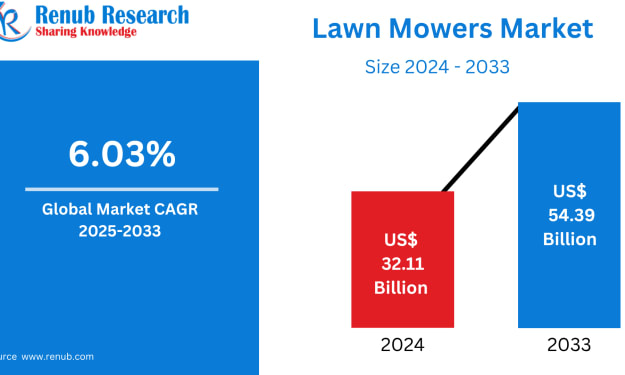
Global Lawn Mowers Market Size & Forecast 2025–2033 The Global Lawn Mowers Market is entering a transformative decade, reshaped by rapid urbanization, the rise of smart homes, and growing environmental awareness. According to Renub Research, the market is projected to grow from US$ 32.11 billion in 2024 to US$ 54.39 billion by 2033, expanding at a CAGR of 6.03% from 2025 to 2033.
By jaiklin Fanandish4 days ago in Earth
Light Builder Waste Skip Bins: Convenient Solutions for Small Projects
Whether you’re renovating your home, cleaning out a small construction site, or completing a DIY project, managing light building waste efficiently is essential. Light builder waste skip bins provide an easy, safe, and environmentally friendly way to dispose of debris without hassle. In this blog, we’ll explore the benefits of light builder waste skip bins, how to choose the right size, and tips for using them effectively.
By Sydney Skip Binsa day ago in Earth
Autonomy Is The Real Privilege
Good morning, freedom-seekers! Today we’re gonna be looking at autonomy. A strange word, I know; one many would probably look at blankly and run away from on sight. We’re gonna figure out what it actually means, consider how it’s achieved, and decipher just how deeply most of us are tangled up in dependence without realising it.
By That ‘Freedom’ Guy3 days ago in Humans


Comments
There are no comments for this story
Be the first to respond and start the conversation.