
Unique Animal Facts
10 unique animals you probably didn’t know existed.
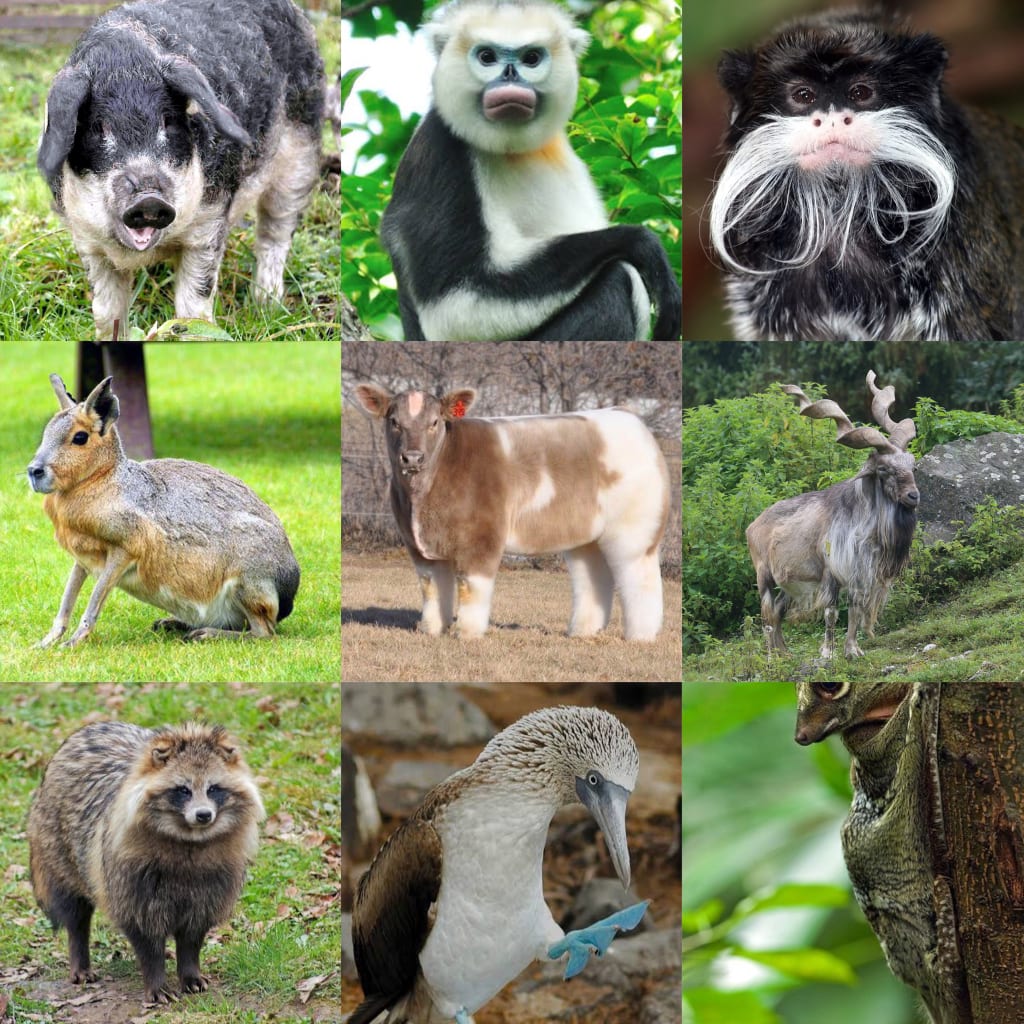
I have compiled a collection of ten extraordinary animals that you've likely never encountered or even heard of before. Prepare to be amazed!
And as a delightful bonus, I have something that will leave you awestruck.
10.) Mangalitsa pig, also known as a pig in sheep's clothing.
This curly-haired pig originates from Hungary and was discovered in the mid-19th century. With its fleece covering, it closely resembles a sheep, hence its name. The fleece can be black or red, but these adorable creatures are most commonly blond. The Mangalitsa pig is the last remaining pig species with such a remarkable winter coat. Unfortunately, by the 1990s, it was on the brink of extinction, with fewer than 200 pigs left in Hungary, all due to their exceptionally delicious lard. Thankfully, the future of the Mangalitsa pig looks much brighter nowadays!
9.) Rhinopithecus, or the golden snub-nosed monkey.
This species is named roxellana, and there's an interesting story behind it. It is believed that they were named after the reputed snub-nosed courtesan of Suleiman the Magnificent, a 16th-century Sultan of the Ottoman Empire. Another intriguing fact about these monkeys is the noticeable difference between males and females. Males are twice as heavy as females and have a different coloration. Females have darker or even black tones on their foreheads and upper parts. The infants have such a light coat that it may appear white in the sunlight.
8.) Emperor tamarin.
This little creature truly resembles an emperor or a wise old man, thanks to its fabulous mustache. They were named after the German Emperor Wilhelm II, due to the resemblance of their mustache to his. These cute creatures measure only about 10 inches (26 centimeters) in size, but their tails can reach up to 16 inches (40 centimeters) in length. They live in groups of 4 to 20 individuals and often give birth to twins. While they primarily feed on flowers, nectar, and fruit, tamarins can also indulge in a diet that includes frogs, snails, and even small birds.
7.) Patagonian Mara.
If you ever wondered whether this animal is a cross between a kangaroo and a hare, think again. The Patagonian Mara is actually the fourth-largest rodent on our planet. There are several fascinating facts about them. Females often place their offspring in creches for safety, and males assist in guarding their babies. When threatened, they grunt and squeal like guinea pigs. These animals can leap up to 6 feet (182 centimeters) in the air when startled. As for their temperament, they can be quite skittish.
6.) Fluffy cow.
Contrary to popular belief, these adorable, fluffy cows are not a new breed. They belong to existing breeds. However, they are cared for by specialized individuals whose job is to wash, dry, and style the cows to achieve their fluffy appearance. Daily maintenance is necessary, and it takes months of regular grooming to achieve their charming, toy-like look. This grooming is primarily done for shows, and it typically takes about two hours to prepare them before a performance. Hair sprays are used to hold their fuzz in place, and natural oils are applied to make their fur look shiny. How much time do you spend in front of the mirror?
5.) Markhor goat
If you come across a creature that appears to be attempting to intercept extraterrestrial radio signals, chances are it's a Markhor goat. These majestic creatures can reach a length of six feet or 180 centimeters from head to tail. What's truly astonishing is the length of their horns, which can grow up to 5.2 feet or 1.6 meters. However, this impressive feature is exclusive to the males, who utilize their horns for combat during the mating season.
On the other hand, female Markhor goats possess horns that grow only up to ten inches or 25 centimeters in length. They adhere to a strict vegan diet, consuming leaves, grass, fruit, and flowers.
4. Raccoon dog
If you find yourself torn between owning a dog or a raccoon as a pet, we have the perfect solution for you: the raccoon dog. Despite their raccoon-like fur markings, these animals are not closely related to North American raccoons. Instead, they share a closer kinship with domesticated dogs, wolves, and foxes.
Raccoon dogs form monogamous relationships, mating for life, and working together to raise their offspring. When the female is pregnant, her partner provides food and even flowers. Although this behavior hasn't been observed, it adds to the uniqueness of raccoon dogs.These captivating creatures are the only members of the dog family that experience short periods of hibernation, and what's even more fascinating is that they choose to hibernate in pairs. Additionally, their voices emit an irresistible cuteness!
3.) The blue-footed booby
If you ever have the opportunity to visit the Galapagos Islands, be prepared to be captivated by the charismatic blue-footed booby. While they may appear a bit clumsy and comical on land, they excel at both flying and swimming. These birds engage in intricate and amusing mating rituals. To attract a female, males showcase a dance that involves high-stepping, foot-stamping, sky pointing (raising their bills into the air), and emitting high-pitched whistles. If a female is suitably impressed, she may approach the male, touch him with her bill, and join in the dance. The blue color of their feet is a result of their fish-based diet and is indicative of their robust immune system. What color are your feet, by the way?
2.) The Malayan colugo
These mesmerizing eyes seem to hold endless surprises. Meet the Malayan colugo, also known as the flying lemur, although both descriptions are inaccurate. Contrary to its name, the colugo doesn't actually fly, nor is it a lemur. These misnomers occur all too often. So, why the misleading name? The colugo possesses a broad gliding membrane, similar to that of a flying squirrel, allowing it to gracefully glide over considerable distances between widely spaced trees. Paradoxically, these small creatures, typically weighing between two and a half to four and a half pounds or one to two kilograms, are awkward climbers and lack significant strength. They lead a challenging life, poor things.
1.) Venezuelan poodle moth
Discovered as recently as 2009, doesn't this moth resemble a fluffy poodle? While mammals require fur to maintain body heat, insects are cold-blooded. Despite its fur-like appearance, the poodle moth hails from Venezuela, a tropical country, rather than Antarctica. The moth's "fur" does not serve a thermoregulatory purpose. Most insects possess hairs for protection or to enhance their ability to detect and navigate their environment. The specifics regarding the poodle moth remain limited due to its recent discovery. As for its cuddliness, we can only speculate, but chances are it's not as cuddly as one might hope.
And now, presenting our astonishing bonus - The cloud antelope
This remarkable species resides within the clouds, hence its name. Its vibrant blue fur reflects the unclouded blue skies in its habitat area.
About the Creator
Keep reading
More stories from writers in Earth and other communities.
Under the Quiet Sky
Under the Quiet Sky The city wakes before the sun, breathing smoke, horns, and hurried footsteps. From the fourth floor of an aging apartment, Ayman watches the morning unfold like a restless tide. He is a delivery rider, a job built on speed, yet his own life moves slowly, measured by prayers whispered between traffic lights and thoughts carried across bridges. People notice his green jacket, not his eyes. They see the package, not the person holding it.
By Imran Hossain2 days ago in Earth




Comments
There are no comments for this story
Be the first to respond and start the conversation.