
Understanding Plate Tectonics
The Science Behind the Movement of the Earth's Lithosphere

Introduction:
Plate tectonics is the scientific theory that explains the structure and movement of the Earth's lithosphere, which is composed of large, rigid plates that float on the underlying, more ductile mantle. It is a unifying concept that explains a variety of geological phenomena, including the distribution of volcanoes and earthquakes, the formation of mountain ranges and ocean basins, and the evolution of the Earth's climate and biota.
Historical Background:
The idea that the Earth's crust was divided into large, mobile plates was first proposed by the German meteorologist Alfred Wegener in 1912. He based his theory on the observation that the continents seemed to fit together like pieces of a puzzle, and that similar rock formations and fossils were found on opposite sides of the Atlantic Ocean. However, Wegener's hypothesis was initially met with skepticism because he could not explain how the continents could move through the solid mantle.
It wasn't until the 1950s and 1960s that advances in geophysics and oceanography provided evidence for plate tectonics. The discovery of the mid-Atlantic ridge, a long chain of volcanic mountains that runs down the center of the Atlantic Ocean, showed that new crust was being created at the ridge and then moving away in opposite directions. This process, known as seafloor spreading, provided a mechanism for how the continents could move apart.
The Earth's Interior:
The Earth's interior is divided into several layers, each with its own composition and physical properties. The outermost layer, the lithosphere, is composed of the crust and the uppermost part of the mantle. It is relatively cool and rigid, and is broken up into several large plates that move over the more ductile asthenosphere.
The mantle is the largest layer of the Earth, accounting for over 80% of its volume. It is composed of silicate rocks that are more dense than the crust, and is divided into several sub-layers based on differences in temperature and pressure. The upper mantle is relatively cool and solid, but the lower mantle is much hotter and more fluid.
The core is the innermost layer of the Earth, and is composed primarily of iron and nickel. It is divided into two parts: the outer core, which is liquid and convects to generate the Earth's magnetic field, and the inner core, which is solid due to the immense pressure.
Plate Boundaries:
Plate boundaries are the regions where two or more plates meet. There are three main types of plate boundaries: divergent, convergent, and transform.
Divergent boundaries occur where plates are moving away from each other, such as along the mid-Atlantic ridge. At these boundaries, new crust is created as magma rises to fill the gap between the separating plates. Divergent boundaries can also occur on land, where they are marked by rift valleys and volcanoes.
Convergent boundaries occur where plates are moving towards each other. When a denser oceanic plate collides with a less dense continental plate, the oceanic plate is forced to subduct, or sink, beneath the continental plate. This process can create deep ocean trenches, volcanic arcs, and mountain ranges. When two continental plates collide, the crust is too buoyant to subduct, and instead is pushed up to form high mountain ranges.
Transform boundaries occur where plates are sliding past each other, such as along the San Andreas Fault in California. These boundaries are marked by earthquakes, and do not typically generate volcanic activity.
Volcanoes and Earthquakes:
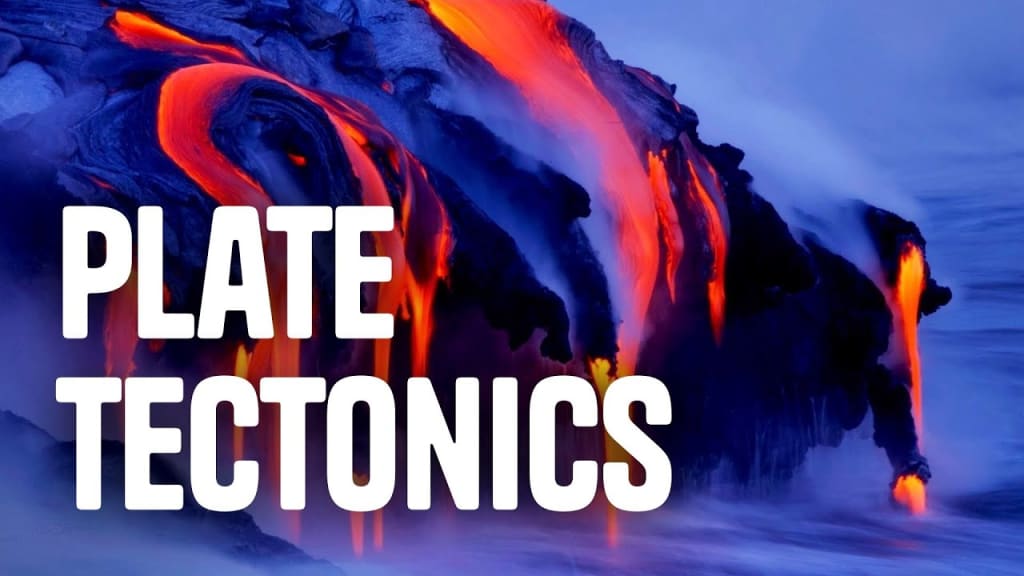
Volcanoes and earthquakes are the two most visible manifestations of plate tectonics. Volcanoes are formed at divergent and convergent plate boundaries, where magma rises to the surface and solidifies into new crust. The type of volcano that forms depends on the type of magma and the way it interacts with the surrounding rocks. Some volcanoes, such as those in Hawaii, are characterized by low-viscosity lava that flows easily and forms broad shield volcanoes. Other volcanoes, such as those in the Cascades and Andes, are characterized by more viscous lava that forms steep stratovolcanoes.
Earthquakes occur at all types of plate boundaries, but are particularly common at transform boundaries. When two plates are locked together and cannot move smoothly past each other, stress builds up until the rocks suddenly break, releasing energy in the form of seismic waves. The size and frequency of earthquakes depends on the amount of stress and the strength of the rocks involved. In general, earthquakes at subduction zones are larger and more destructive than those at transform boundaries.
Geological Features:
Plate tectonics is responsible for a wide variety of geological features, including mountain ranges, ocean basins, and volcanic islands. One of the most famous examples of a mountain range formed by plate tectonics is the Himalayas, which were created when the Indian plate collided with the Eurasian plate. The Andes, Rockies, and Alps are other examples of mountain ranges that were formed by plate collisions.
Ocean basins are created at divergent plate boundaries, where new crust is formed and spreads out from the ridge. The Atlantic Ocean, for example, is widening at a rate of about 2-3 centimeters per year as the North American and Eurasian plates move away from the mid-Atlantic ridge. Over time, the spreading of the ocean basin can lead to the formation of new continents, as evidenced by the creation of the Atlantic Ocean and the separation of Africa and South America.
Volcanic islands are formed at hotspots, which are areas of the mantle where magma rises to the surface independently of plate boundaries. Examples of hotspots include Hawaii, Iceland, and Yellowstone National Park. As the plate moves over the hotspot, a chain of volcanic islands is formed, with the oldest island being farthest from the hotspot and the youngest island being closest.
Impacts on Climate and Life:
Plate tectonics has had a profound impact on the Earth's climate and biota over the course of geologic history. One of the most significant effects has been the formation and breakup of supercontinents, which are large land masses composed of multiple continents. The most recent supercontinent, Pangaea, existed about 300 million years ago and was surrounded by a single, large ocean called Panthalassa. The breakup of Pangaea and the formation of the modern continents and oceans has had major implications for the Earth's climate, as the distribution of land masses affects ocean currents and atmospheric circulation.
Plate tectonics has also influenced the evolution of life by creating and destroying habitats. For example, the collision of the Indian and Eurasian plates about 50 million years ago created the Himalayas, which are now home to a diverse array of plant and animal species. Conversely, the formation of ocean basins has caused extinction events by separating populations and disrupting ocean currents. The movement of the plates also affects the distribution of nutrients and minerals in the Earth's crust, which can have implications for the growth and survival of plants and animals.
Conclusion:
Plate tectonics is a fundamental concept in geology that has revolutionized our understanding of the Earth's structure and history. By explaining the formation of mountains, oceans, and volcanic islands, plate tectonics has provided a framework for understanding a wide range of geological phenomena. Additionally, plate tectonics has had significant impacts on the Earth's climate and biota over millions of years, shaping the evolution of life on our planet. As our knowledge of plate tectonics continues to grow, we can expect to gain new insights into the workings of the Earth and the complex interactions between its various systems.
About the Creator
Keerthana Thirumalairaj
An Independent Solitude girl, who recently found the interests in writings and converts Facts and imaginations into writings.
Keep reading
More stories from Keerthana Thirumalairaj and writers in Earth and other communities.
The Fascinating Story of Earth
Introduction The geologic time scale is a framework that provides a way to measure the time that has passed since the formation of the Earth. It is a way of categorizing and understanding the major events that have occurred on Earth over the last 4.54 billion years. The geologic time scale is divided into several different time intervals, each of which is characterized by different geologic events and changes in the Earth's environment. In this essay, we will provide a detailed overview of the geologic time scale, including its history, structure, and major events.
By Keerthana Thirumalairaj3 years ago in Earth
Chinese Planetary Engineering: The Great Green Wall and the Reclamation of Climate
There are junctures in history where a civilization no longer chooses between comfort and progress, but between adaptation and extinction. At the dawn of the new millennium, China hit one of those silent thresholds where geography ceases to be a backdrop and becomes an adversary. The desert was advancing, not as a metaphor for decay, but as a physical, methodical, and relentless force. Sand was devouring the horizon, winds grew heavy with dust, and the soil lost its fertile memory, taking with it the promise of social stability.
By Laurenceau Porte5 days ago in Earth
US Warns Airlines About Military Activity in Parts of Latin America
Commercial aviation is built on predictability—clearly defined airspace, coordinated air traffic control, and shared international rules. When that predictability is disrupted, even subtly, the ripple effects can stretch far beyond the cockpit. That is exactly why a recent warning from the United States has caught the attention of airlines, governments, and travelers alike. In early 2026, US aviation authorities issued an advisory warning airlines about military activity in parts of Latin America, urging pilots to exercise heightened caution when flying over certain regions. While no immediate restrictions or flight bans were imposed, the message itself was clear: something in the skies has changed, and the risks—however limited—can no longer be ignored. This development is not just about aviation safety. It reflects a growing intersection between geopolitics, military operations, and civilian infrastructure in a region that has long balanced cooperation with tension. What Exactly Did the US Warn About? The advisory, released through official aviation safety channels, highlighted concerns over potential military activity affecting airspace across parts of Mexico, Central America, South America, and nearby oceanic regions. Airlines were advised to remain vigilant during all phases of flight, including cruising at high altitudes, takeoff, and landing. Unlike routine notices related to weather systems or airport congestion, this warning explicitly referenced security-related risks. These include the possibility of unexpected military movements, temporary airspace disruptions, and interference with navigation systems that modern aircraft rely on for safe operations. Importantly, the warning did not accuse any specific country of wrongdoing, nor did it suggest an immediate danger to passengers. Instead, it served as a precaution—one designed to ensure airlines adjust flight planning, monitoring, and communication protocols accordingly. Why Military Activity Matters to Civil Aviation To the average traveler, military exercises or operations may seem distant from the experience of flying on a commercial jet. In reality, the two worlds often share the same skies. Civilian aircraft depend heavily on satellite navigation, coordinated air traffic control, and stable airspace rules. Military operations—especially those involving fast-moving aircraft, surveillance systems, or electronic equipment—can introduce uncertainty into that environment. Some of the key risks aviation authorities monitor include: Unplanned military aircraft movements that may not follow civilian flight patterns Temporary airspace closures or restrictions that require last-minute rerouting Navigation signal disruptions, whether accidental or intentional Increased congestion in strategic corridors used by both civilian and military flights While these risks are typically managed through coordination and communication, heightened military activity raises the stakes. The FAA’s advisory suggests that such activity has reached a level where additional caution is warranted. The Geopolitical Context Behind the Warning The timing of the advisory is not accidental. Latin America has seen a noticeable rise in security operations and military coordination involving the United States over the past year. These efforts are largely focused on counter-narcotics missions, maritime security, and regional stability, particularly in areas with strategic shipping routes or ongoing political tension. At the same time, broader global dynamics—ranging from great-power competition to shifting alliances—have increased the strategic importance of air and sea routes across the Western Hemisphere. From Washington’s perspective, issuing an aviation warning is not about alarmism. It is about acknowledging that military and security activities in the region may temporarily affect civilian systems, including aviation. How Airlines Are Responding For airlines, advisories like this are not unusual—but they are taken seriously. Most major carriers already operate with layered safety systems that allow them to respond quickly to changing conditions. In practical terms, this warning may lead to: Slight route adjustments to avoid specific airspace Enhanced pilot briefings before flights Increased coordination with air traffic controllers Closer monitoring of navigation and communication systems So far, there have been no widespread flight cancellations or suspensions linked directly to the warning. That suggests airlines view the risk as manageable, provided proper precautions are followed. Reactions from Latin American Governments Some governments in the region have been quick to reassure the public. Officials have emphasized that their national airspace remains safe and fully operational, and that civilian flights continue without disruption. This response highlights an important tension: while the US warning is precautionary, it can still affect public perception. Tourism, business travel, and investor confidence are all sensitive to suggestions of instability—even when no immediate danger exists. As a result, many countries are walking a careful line between cooperating on aviation safety and defending their reputation for stability. What This Means for Passengers For travelers, the key takeaway is simple: commercial aviation remains safe. Warnings like this are designed to prevent incidents, not predict them. Passengers flying through or over affected regions may experience slightly longer flight times or minor schedule adjustments, but there is no indication of increased danger to civilian aircraft. In fact, the existence of such advisories demonstrates how seriously aviation authorities take even low-probability risks. A Sign of a More Complex World The US warning to airlines is a reminder that modern air travel does not exist in a vacuum. As military operations, security concerns, and geopolitical rivalries evolve, civilian systems—from shipping lanes to flight paths—are increasingly affected. This moment underscores a broader reality: the skies are becoming more crowded, more contested, and more interconnected with global politics. Managing that complexity will require continued transparency, cooperation, and vigilance from governments, regulators, and airlines alike. For now, planes continue to fly, passengers continue to travel, and the system continues to work. But behind the scenes, aviation authorities are quietly adjusting to a world where safety is shaped not just by weather and mechanics—but by geopolitics as well.
By Muhammad Hassana day ago in Earth
So You Decided To Become a Nurse Practitioner:
So you decided to become an "Advanced Practice" nurse. Congratulations!... is what I would say if this was a good idea. Grad school? In this economy? What were you thinking? Likely it was something along the lines of either 1) “I've seen these other chucklefucks do it— Why can't I?” or even 2) “I've got a nice career, I should shake it up. I miss feeling like I have no clue what I'm doing.”
By Sandor Szabo2 days ago in Fiction


Comments
There are no comments for this story
Be the first to respond and start the conversation.