
Chinese Planetary Engineering: The Great Green Wall and the Reclamation of Climate
.

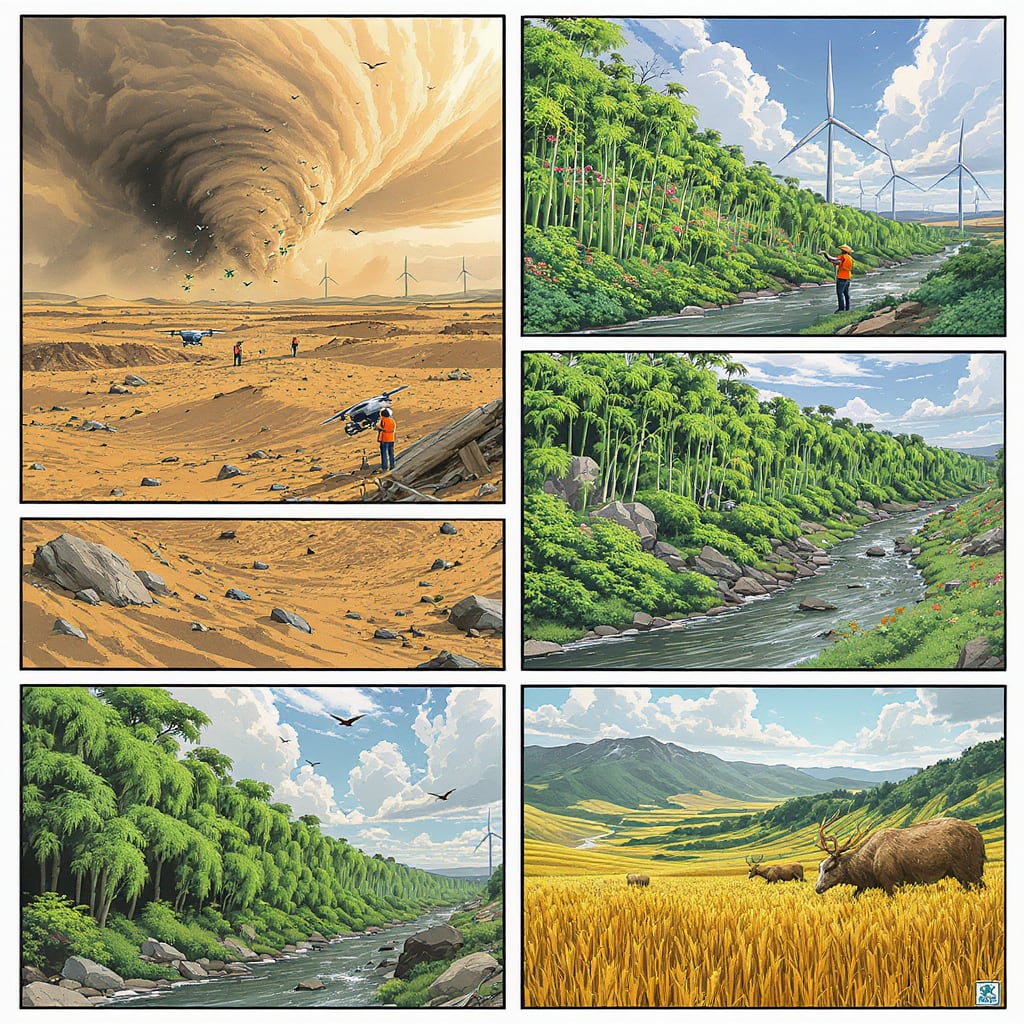
There are junctures in history where a civilization no longer chooses between comfort and progress, but between adaptation and extinction. At the dawn of the new millennium, China hit one of those silent thresholds where geography ceases to be a backdrop and becomes an adversary. The desert was advancing, not as a metaphor for decay, but as a physical, methodical, and relentless force. Sand was devouring the horizon, winds grew heavy with dust, and the soil lost its fertile memory, taking with it the promise of social stability.
There was nothing romantic about this encroaching wasteland. It was a mechanical process, fueled by decades of deforestation, intensive farming, and the bite of continental climate dynamics. The north of the country was becoming a gray zone, where the boundary between habitable space and hostile wilderness blurred. Dust storms were no longer seasonal quirks but constant reminders of the land's fragility.
In the face of this, the Chinese response was neither symbolic nor marginal. It did not take the form of a moral plea for nature nor a minor adjustment of existing habits. It was conceived as a profound restructuring of the relationship between man, soil, and atmosphere. What was born was not a mere environmental program, but a living infrastructure, built with the same logic as the great defensive works of history—except the enemy was neither human nor visible, but a diffuse, systemic climatic threat.
The forest, then, was deployed as a strategic weapon. Not the idealized forest of pastoral tales, but a forest envisioned as biological technology. A living matter capable of interacting with wind, heat, water, and earth. This vegetal architecture’s primary function was not aesthetic, but thermodynamic. The goal was to friction the air, trap the dust, and stabilize the earth's surface, turning an unstable environment into a resilient system.
This vision rested on a fundamental insight long sidelined by Western climate approaches: local climate is not just the product of distant atmospheric forces. It is the result of a permanent friction between the earth's surface and the air above it. To change the surface is to change the energy exchange. To alter the biomass is to redirect the flow of water and heat. In this light, the tree is no longer a scenic prop but a primary climatic actor.
When these trees take root, they do more than just occupy space. They pump water from the depths and release it into the atmosphere as vapor. Repeated on a massive scale, this process alters the air's humidity, its density, and its movement. Moist air behaves differently than dry air: it rises more easily, encourages condensation, and disrupts wind patterns. Where the desert once allowed fast, dehydrating air masses to slide by, the vegetation imposes resistance—a new kind of slowness.
The soil itself undergoes a metamorphosis. Roots shatter mineral density, creating invisible veins for water, turning violent rains into a gradual soaking. Erosion slows. Underground aquifers cease their freefall. The landscape, once subject to brutal swings between drought and destructive runoff, begins to find a sense of hydric continuity.
These transformations are neither immediate nor flashy. They belong to "deep time," operating on a logic of thresholds and feedback loops. They demand a rare political stamina, as their benefits far outlast typical media cycles or election terms. This is where the Chinese project stands apart: it embraces a temporality that exceeds the urgency of the moment. The State acts as a steward of ecological processes on a generational scale.
The beginnings, however, were far from flawless. The temptation of the "quick fix" led to oversimplified choices. Fast-growing species were planted en masse, resulting in biological fragility. Pests spread. Water demands sometimes outstripped local capacity. Some areas saw their water tables drop further instead of stabilizing. These failures were not anecdotal; they revealed a fundamental limit: nature cannot be reduced to a uniform industrial logic.
Yet, failure did not lead to surrender. It sparked a learning process. Gradually, the strategy evolved toward a finer, humbler technicality. Monoculture gave way to diversity. Local species regained their central role. Drought-resistant shrubs were prioritized where majestic trees could not survive. Planting densities were adjusted to the actual capacity of the environment, rather than ideological quotas.
Reforestation thus became a dialogue with ecological constraints. Technology did not disappear; on the contrary, it intensified. Observation tools multiplied. Soils were analyzed, monitored, and mapped. Satellites tracked plant health and water stress. Drones allowed intervention where humans could not go. Nature was assisted, not replaced.
This alliance between biology and engineering marks a major conceptual shift. It breaks the illusion of an autonomous nature, separate from human action. It also breaks the arrogance of total domination. It proposes a third way—uncomfortable but lucid—where humanity recognizes it has become a geological force, and as such, can no longer passively watch the disruptions it has triggered.
In this framework, the question is no longer whether to intervene in natural systems, but how to do so without repeating the imbalances of the past. The Great Green Wall does not claim to be a final answer. It acts as an open-air laboratory, a full-scale experimental space with its successes, errors, and constant recalibrations.
The social effects are tangible. Lands shielded by these green curtains become more productive. Local communities find new livelihoods in activities that were once impossible. The forest ceases to be a constraint and becomes a resource. A living economy emerges where sterility once reigned.
Still, the project must not be idealized. It raises profound ethical questions. How far can a society modify its environment before tumbling into a new form of vulnerability? What happens if these artificial balances become dependent on constant maintenance? Is the resulting resilience durable or conditional?
These questions are the philosophical heart of the experience. What is at stake here is a redefinition of humanity’s role in the Earth system. We are no longer mere inhabitants of a stable world; we are actors capable of altering the planet’s fundamental cycles. The Great Green Wall is not proof that we control the climate, but proof that we can no longer pretend to be outside of it.
China has chosen to assume this responsibility through action, at the risk of error. It has accepted that the biosphere is a fragile, modular system requiring a new kind of precision. This choice is neither comfortable nor universal, but it forces a question this century cannot dodge.
If humanity possesses the power to transform the planet by accident, can it morally refuse to learn how to transform it consciously to avoid collapse? The answer is not written in the trees planted nor the deserts slowed. It lies in how we accept—or reject—thinking about our power without either denying it or idolizing it.
The Great Green Wall does not mark the end of the ecological crisis. It marks the end of an even older illusion: that of a passive, eternal nature, independent of human history. That world is gone. What remains is to see if we can inhabit the one we have begun to shape.
JLP
About the Creator
Laurenceau Porte
Chroniqueur indépendant. J’écris sur l’actualité, la société, l’environnement et les angles oubliés. Des textes littéraires, engagés, sans dogme, pour comprendre plutôt que consommer l’information.
Keep reading
More stories from Laurenceau Porte and writers in Earth and other communities.
Return to the Moon: Fear of Decline Disguised as Conquest
Humanity hasn't set foot on the Moon for decades. This fact, seemingly trivial, is actually dizzying. Over half a century has passed, and here we are, gazing at this celestial body we've once trod upon, without daring to return. It's as if that giant leap closed a chapter rather than opening a new one. As if the feat was so monumental it couldn't be repeated without losing its magic. Or, more bluntly, as if we'd lost faith in a future that extends beyond our little blue planet.
By Laurenceau Porteabout a month ago in Earth
Microbiota, microbiome or microflora: how to speak correctly and why it is for health.
You've probably heard the phrase, "We are what we eat." But modern science says more precisely: we are also those who live in us. Until 2016, it was believed that there are many times more bacteria in our body than our own cells. The latest calculations by mathematicians show that we divide the body with our microorganisms by about 50/50: about 30 trillion of our cells versus 38 trillion bacterial ones.
By Yaroslav Gorohov3 days ago in Earth
Chinese EVs Closing In on America After Canadian Tariffs Deal
The electric vehicle race is no longer just about climate goals or consumer choice — it has become a geopolitical contest. And in early 2026, a subtle but powerful move by Canada may have tilted the board. By agreeing to sharply reduce tariffs on Chinese electric vehicles, Canada has opened a door that the United States has worked hard to keep shut. While Chinese EVs are still largely barred from the American market, they are now edging closer than ever — not by crossing the border directly, but by entering through Canada. This development raises a pressing question: Are Chinese EVs closing in on America, and what does that mean for the future of North American auto markets? The Deal That Changed the Game Canada’s new agreement with China allows up to 49,000 Chinese-made electric vehicles per year to enter the Canadian market at a tariff rate of just over 6%, a dramatic drop from the previous 100% tariff that effectively blocked them. On paper, the quota seems small. In reality, it carries enormous symbolic and strategic weight. For years, both Canada and the United States aligned closely on keeping Chinese EVs out, citing concerns over unfair subsidies, national security, and the protection of domestic auto industries. This new deal marks a clear shift — and a divergence from U.S. policy. Canada didn’t make the decision in isolation. The EV tariff reduction was part of a broader trade reset with China, tied to agricultural exports such as canola and efforts to stabilize a strained economic relationship. Why Chinese EVs Matter So Much China is the undisputed leader of the global electric vehicle industry. Its manufacturers produce EVs at scale, often at prices Western automakers struggle to match. Brands like BYD, Nio, and Xpeng have already expanded aggressively into Europe, Southeast Asia, and parts of the Middle East. North America has remained one of the final fortified markets — until now. Chinese EVs are appealing not just because they’re cheaper, but because they’ve rapidly improved in quality, range, and technology. For consumers priced out of North American and European EV models, Chinese vehicles offer something rare: affordability without sacrificing features. Canada’s decision gives Chinese automakers their first legitimate foothold in North America — and footholds tend to grow. Why the U.S. Is Nervous The United States still enforces a 100% tariff on Chinese EV imports, making them effectively unsellable in the American market. But Canada’s move has triggered concern in Washington. U.S. officials argue that Chinese EVs entering Canada could indirectly pressure American markets, influence supply chains, and weaken Washington’s leverage in future trade negotiations. There’s also a political dimension. Both major U.S. parties have framed Chinese dominance in EVs as a strategic threat — not just to auto jobs, but to technological leadership. Modern EVs collect vast amounts of data, and lawmakers have raised concerns about cybersecurity and foreign data access. While Chinese EVs aren’t rolling onto American roads yet, their presence just across the border changes the conversation. Canada’s Risk — and Opportunity Inside Canada, the reaction has been mixed. Automotive hubs like Ontario worry that opening the market could undermine domestic manufacturing and strain relations with the U.S., Canada’s largest trading partner. Some leaders have called the deal “lopsided,” warning it could cost jobs if American retaliation follows. Others see opportunity. A more competitive EV market could lower prices for Canadian consumers and accelerate EV adoption. It may also attract Chinese investment into Canada itself — including factories, battery plants, and supply chain partnerships. If Chinese automakers choose to build in Canada rather than simply export to it, the country could position itself as a bridge between Chinese EV innovation and North American demand. That balancing act — between economic opportunity and political risk — defines Canada’s strategy. Are Chinese EVs Really ‘Closing In’ on America? For now, the answer is: not directly — but strategically, yes. Chinese EVs sold in Canada won’t automatically flood the U.S. market. Regulations, trade rules, and tariffs still stand in the way. But proximity matters. Supply chains overlap. Consumer awareness spreads. Manufacturing footprints expand. There’s also the possibility of a workaround: Chinese companies could eventually build EVs in North America to bypass tariffs altogether. This idea has already been floated — but it faces fierce resistance from U.S. lawmakers and unions. Still, history shows that once a global industry leader gains regional access, momentum often follows. What This Means for Consumers For Canadian buyers, the impact could be immediate: more choice and lower prices in an EV market that has long been criticized for being expensive and limited. For American consumers, the effect will be indirect — at least at first. But increased competition could eventually pressure U.S. automakers to reduce prices, improve features, and accelerate innovation. The larger question is whether North America wants competition or insulation — and how long insulation can realistically last in a globalized EV economy. The Bigger Picture: A Global EV Power Shift Canada’s tariff deal reflects a broader reality: China’s dominance in electric vehicles is reshaping global trade, whether governments like it or not. Europe is already grappling with an influx of Chinese EVs. Emerging markets are embracing them. And now, North America has its first real crack in the wall. This isn’t just about cars. It’s about who controls the future of clean transportation, supply chains, and industrial policy. Final Thoughts Chinese EVs aren’t driving down American highways yet — but after Canada’s tariff deal, they’re closer than ever. This move doesn’t spell immediate disruption, but it does signal a shift. One country has decided that economic pragmatism outweighs political alignment. And in doing so, Canada may have opened the door to a new phase of EV competition in North America. Whether that door swings wider — or slams shut — will depend on how the U.S., automakers, and consumers respond. One thing is certain: the EV race just entered a new chapter.
By Muhammad Hassana day ago in Earth



Comments
There are no comments for this story
Be the first to respond and start the conversation.