
Types of rocks (igneous, sedimentary, metamorphic)
Rocks are Naturally occurring solid substances that form the Earth's crust.

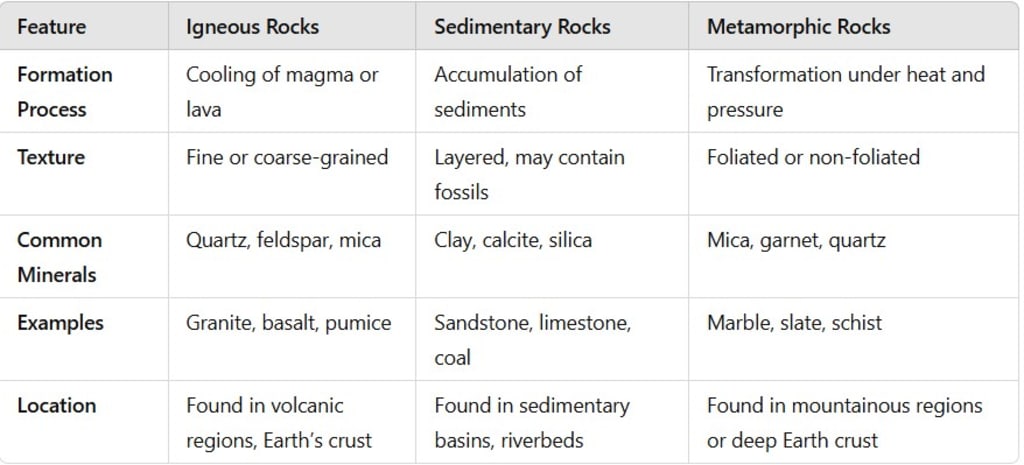
They are classified into three main types based on their formation processes: igneous, sedimentary, and metamorphic. Each type of rock tells a unique story of how it came to be, and their differences are crucial for understanding the Earth's geological history. Below is an overview of each rock type, their formation processes, characteristics, and examples.
1. Igneous Rocks
Formation: Igneous rocks are formed from the cooling and solidification of molten rock material. This material, called magma when beneath the Earth’s surface and lava when it erupts, cools and crystallizes to form solid rocks. The cooling process can happen either inside the Earth (intrusive or plutonic) or on the surface (extrusive or volcanic).
Intrusive Igneous Rocks: These form when magma cools slowly beneath the Earth’s surface. The slow cooling allows large crystals to form, resulting in a coarse-grained texture. An example of this is granite, which is often light-colored and made up mostly of quartz and feldspar.
Extrusive Igneous Rocks: These rocks form when lava cools quickly on the Earth's surface. Due to the rapid cooling, they tend to have a fine-grained texture with smaller crystals. Basalt is a common example, typically dark in color and rich in iron and magnesium.
Characteristics:
Texture: Can range from coarse-grained to fine-grained, depending on the rate of cooling.
Mineral Composition: Igneous rocks can be rich in minerals like quartz, feldspar, mica, and iron-bearing minerals.
Color: Igneous rocks can be light-colored (granite) or dark-colored (basalt) based on their mineral content.
Examples:
Granite (intrusive)
Basalt (extrusive)
Pumice (extrusive, volcanic glass with a porous texture)
2. Sedimentary Rocks
Formation: Sedimentary rocks are formed from the accumulation and compaction of sediments, which can be pieces of other rocks, minerals, or organic materials like plants and animals. These sediments are carried by water, wind, or ice and then deposited in layers. Over time, these layers are compressed and cemented together to form solid rock. Sedimentary rocks are often found in layers and may contain fossils.
Clastic Sedimentary Rocks: These are composed of fragments of other rocks that have been broken down into small particles. The most common example is sandstone, made from sand-sized particles that have been compacted and cemented.
Chemical Sedimentary Rocks: These form when dissolved minerals precipitate out of water, often due to evaporation. An example of this is limestone, which forms from the accumulation of calcium carbonate from shells and other marine organisms.
Organic Sedimentary Rocks: These are made from the accumulation of organic materials, such as plant debris or the remains of marine organisms. Coal is a example, formed from the remains of plants in swampy environments.
Characteristics:
- Stratification: Sedimentary rocks often form in distinct layers.
- Fossils: Fossils are commonly found in sedimentary rocks, providing insight into past life.
- Texture: Can range from coarse-grained (like conglomerate) to fine-grained (like shale).
Examples:
- Sandstone (clastic)
- Limestone (chemical)
- Coal (organic)
3. Metamorphic Rocks
- Formation: Metamorphic rocks are formed from the transformation of existing rocks (igneous, sedimentary, or other metamorphic rocks) under high pressure, high temperature, or chemically active fluids. This process, called metamorphism, alters the mineral composition and texture of the rock, creating new mineral structures. Metamorphic rocks can form deep within the Earth’s crust or at plate boundaries.
- Foliated Metamorphic Rocks: These have a layered or banded appearance due to the alignment of minerals under pressure. Schist and slate are examples of foliated rocks, where minerals like mica align to create a distinct pattern.
- Non-Foliated Metamorphic Rocks: These rocks do not show layering. Instead, they are typically more uniform in texture, formed from minerals that do not align under pressure. Marble, which forms from limestone, is a non-foliated metamorphic rock known for its smooth texture and is widely used in sculpture.
Characteristics:
- Texture: Can be foliated (layered) or non-foliated.
- Mineral Composition: Can contain a variety of minerals, depending on the parent rock and the conditions of metamorphism.
- Recrystallization: During metamorphism, minerals may recrystallize, changing the rock’s structure and appearance.
Examples:
- Schist (foliated)
- Marble (non-foliated)
- Slate (foliated)
About the Creator
Badhan Sen
Myself Badhan, I am a professional writer.I like to share some stories with my friends.
Keep reading
More stories from Badhan Sen and writers in Earth and other communities.
Plate tectonics and continental drift
While both theories are interconnected, they are distinct in their focus and history. The theory of continental drift was proposed first, followed by the more comprehensive theory of plate tectonics, which explains not only continental movement but also the dynamics of the Earth’s lithosphere.
By Badhan Senabout a year ago in Earth
US Government Partially Shuts Down Despite Last-Minute Funding Deal
The United States government has entered a partial shutdown, even after lawmakers announced a last-minute funding deal intended to avert disruption. The development highlights persistent political gridlock in Washington and underscores how narrow margins, internal party divisions, and procedural delays can still trigger government paralysis.
By Aarif Lashari7 days ago in Earth
Cabin Fever Because of Snow, Sleet, and Freezing Rain That Turned to Icy Roads
What Is Cabin Fever? The short answer is that cabin fever is restlessness from being in a confined area. Cabin fever is the distressing irritability or restlessness experienced when a person or group is stuck at an isolated location or in confined quarters for an extended time. Research shows that prolonged cold, gray skies, and being stuck indoors can trigger mood shifts similar to “winter blues.”
By Margaret Minnicks6 days ago in Humans



Comments
There are no comments for this story
Be the first to respond and start the conversation.