
Plate tectonics and continental drift
The concepts of plate tectonics and continental drift are fundamental to understanding the geological processes that shape the Earth's surface.

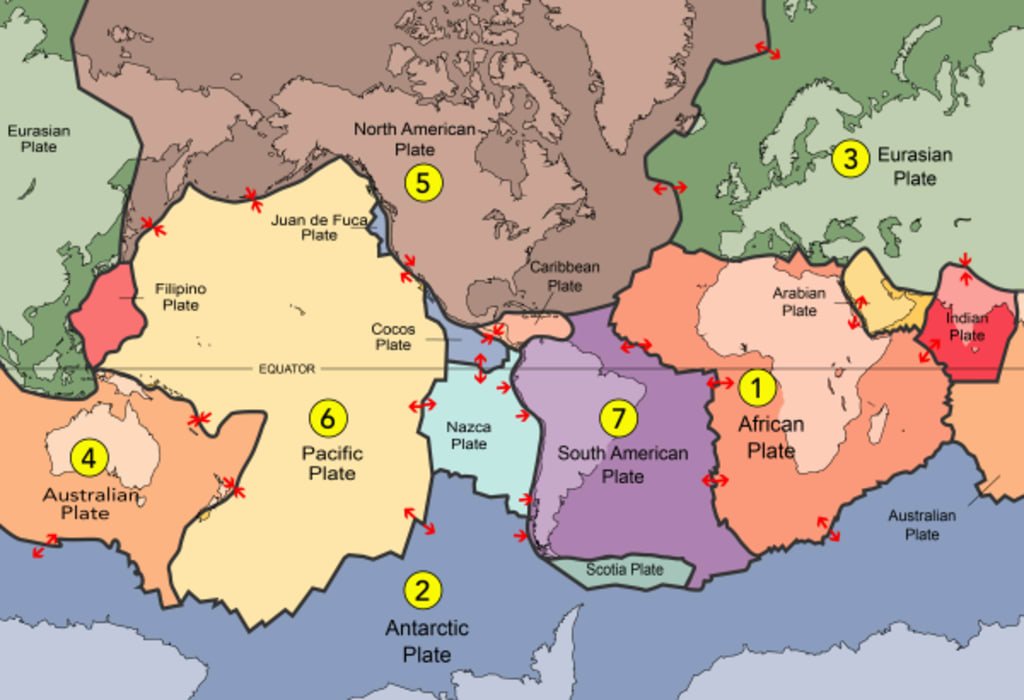
While both theories are interconnected, they are distinct in their focus and history. The theory of continental drift was proposed first, followed by the more comprehensive theory of plate tectonics, which explains not only continental movement but also the dynamics of the Earth’s lithosphere.
Continental Drift: The Beginning of a Revolutionary Idea
The theory of continental drift was first proposed in 1912 by German meteorologist and geophysicist Alfred Wegener. Wegener suggested that the continents were once joined together in a supercontinent he called Pangaea, meaning "all land" in Greek. According to him, Pangaea began breaking apart around 200 million years ago during the Mesozoic Era, leading to the continents we see today. Wegener’s idea was groundbreaking because it challenged the prevailing belief of the time that continents were stationary and unchanging.
Wegener’s evidence for continental drift came from several observations:
Fossil Evidence: Similar fossils of plants and animals were found on continents now separated by vast oceans, such as the fossil of the extinct reptile Mesosaurus, which was found in both South America and Africa. This suggested that these continents were once connected.
Geological Evidence: Mountain ranges and rock formations of similar age and type were found on continents separated by oceans. For example, the Appalachian Mountains in North America were found to have similar Geological features to those in Scotland and Scandinavia, indicating that these Regions were once part of the same landmass.
Paleoclimatic Evidence: Evidence of past climates, such as glacial deposits found in present-day tropical regions (e.g., in India and South America), suggested that these Regions were once located closer to the poles and had a cold, Glacial climate.
Despite these compelling observations, Wegener’s theory was met with skepticism, primarily because he could not explain the mechanism that would cause continents to drift apart. His suggestion of "centrifugal forces" from Earth’s rotation was not convincing to many geologists, and the theory of continental drift was largely dismissed until the mid-20th century.
The Emergence of Plate Tectonics
The theory of plate tectonics, developed in the 1960s, provided the missing piece of the puzzle that explained the movement of the continents. It integrated and expanded upon Wegener’s ideas by describing the Earth’s outer layer, the lithosphere, as being divided into several large and small pieces known as tectonic plates. These plates float on the semi-fluid asthenosphere, which lies beneath them, and they are constantly in motion due to the forces generated by heat within the Earth.
Plate tectonics was supported by a wide range of new evidence, including the discovery of sea-floor spreading and the identification of mid-ocean ridges. The key components of plate tectonics are as follows:
The Earth’s Layers: The Earth is made up of several layers. The outermost layer, the crust, is broken into large and small pieces called tectonic plates. Beneath the crust lies the mantle, a semi-solid layer that flows very slowly, enabling the plates to move. The rigid lithosphere sits on top of the more flexible asthenosphere, and this difference in physical properties allows for plate motion.
Types of Plate Boundaries: The interaction between tectonic plates occurs along three main types of plate boundaries:
Divergent Boundaries: Plates move away from each other, and new crust is formed as magma rises from the mantle. An example is the Mid-Atlantic Ridge, where the Eurasian and North American plates are moving apart.
Convergent Boundaries: Plates move toward each other, often resulting in one plate being forced beneath another in a process called subduction. This can lead to the formation of mountain ranges, such as the Himalayas, where the Indian and Eurasian plates collide.
Transform Boundaries: Plates slide past each other horizontally. This type of boundary is characterized by strike-slip faults, such as the San Andreas Fault in California.
Sea-Floor Spreading: One of the key pieces of evidence for plate tectonics came from the discovery of sea-floor spreading, proposed by Harry Hess in the 1960s. As tectonic plates move apart at divergent boundaries, magma rises from the mantle to create new oceanic crust. This process continuously adds new material to the ocean floor, pushing older material away from the ridge and providing evidence of plate motion.
Subduction Zones and Earthquakes: When one tectonic plate is forced beneath another in a subduction zone, it can lead to powerful earthquakes and volcanic eruptions. The Ring of Fire around the Pacific Ocean is a prime example of a region with frequent seismic activity due to subduction zones.
The Connection Between Continental Drift and Plate Tectonics
Continental drift and plate tectonics are closely related, but plate tectonics offers a more complete and scientifically accepted explanation of how continents move. Wegener’s theory of continental drift suggested that the continents were once part of a supercontinent and have since moved apart. Plate tectonics expands on this by describing how the lithospheric plates interact with one another at their boundaries, how new oceanic crust is created, and how plates move due to convection currents in the mantle.
For instance, the continents of South America and Africa appear to fit together are pieces of a puzzle, providing strong evidence that they were once part of a single landmass. Plate tectonics explains how the plates carrying these continents have since drifted apart due to sea-floor spreading at the Mid-Atlantic Ridge.
IN THE END
The theory of plate tectonics has revolutionized our understanding of Earth's dynamic surface. By explaining how continents drift and how the Earth's lithosphere is constantly reshaped, plate tectonics has provided answers to a wide range of geological questions. From the formation of mountain ranges to the occurrence of earthquakes and volcanic activity, plate tectonics helps us understand the forces at work beneath our feet. The theory of continental drift, although initially controversial, laid the groundwork for the more comprehensive model of plate tectonics, ultimately changing the way we view our planet’s history and future.
About the Creator
Badhan Sen
Myself Badhan, I am a professional writer.I like to share some stories with my friends.
Keep reading
More stories from Badhan Sen and writers in Earth and other communities.
Layers of the Earth (crust, mantle, core)
These layers, starting from the outermost to the innermost, include the crust, mantle, and core. Each of these layers has unique properties, composition, and behavior that contribute to the Earth’s overall functioning. Understanding these layers is crucial to grasping how our planet behaves, from the generation of volcanic eruptions to the creation of Earth's magnetic field.
By Badhan Senabout a year ago in Earth


Comments
There are no comments for this story
Be the first to respond and start the conversation.