

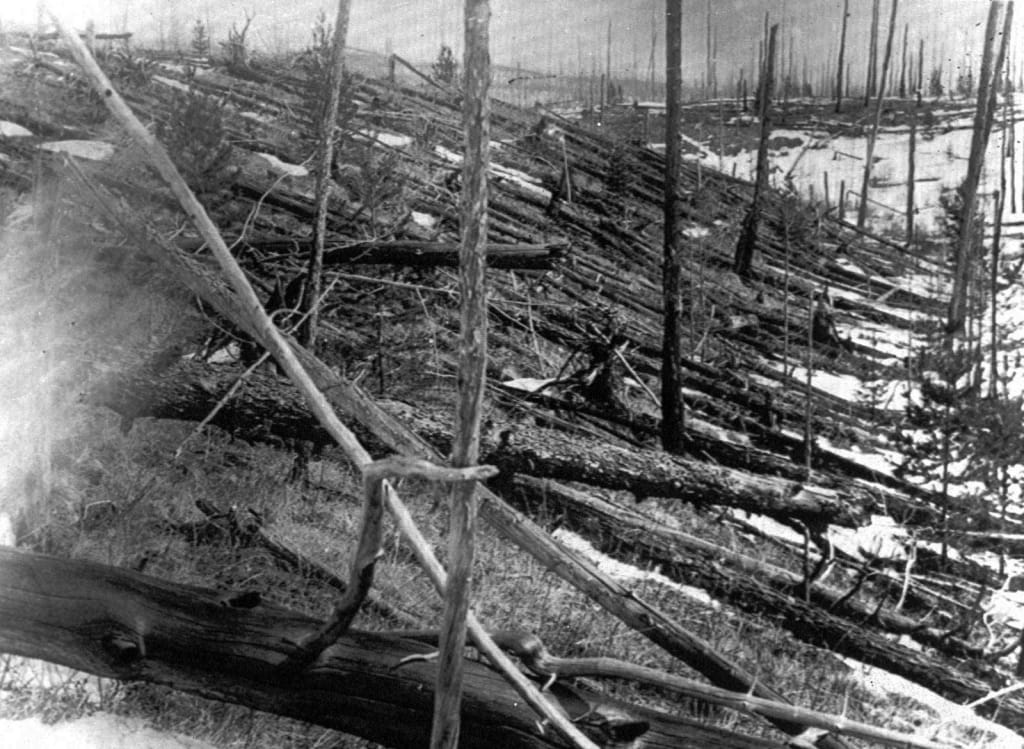
In 1908, a massive explosion occurred in the skies over Tunguska, a remote region in Siberia, Russia. The event was later dubbed the "Tunguska Event" and is widely believed to have been caused by the impact of a small asteroid or comet.
Eyewitness accounts of the event describe a bright fireball that lit up the sky, followed by a shockwave that knocked people off their feet and shattered windows up to hundreds of kilometers away. Some reports even suggest that the ground shook as if there had been an earthquake.
The impact is estimated to have been equivalent to 10-15 megatons of TNT, making it the most powerful impact event in recorded history. It is also estimated that the asteroid or comet responsible for the event was likely around 60 meters in diameter and traveling at a speed of about 60,000 km/h.
Despite the massive explosion, no crater was found at the site, leading some researchers to speculate that the object responsible for the Tunguska Event may have exploded in the air before making contact with the ground.
The Tunguska Event had significant environmental effects in the region. Trees were flattened over an area of around 2,000 square kilometers, and some estimates suggest that as many as 80 million trees may have been destroyed in the blast. The explosion also caused wildfires in the area, which burned for weeks.
The impact of the Tunguska Event on human life was relatively minimal, thanks to the remote location of the event. However, the incident did serve as a reminder of the potential danger posed by asteroids and comets, and sparked renewed interest in efforts to track and mitigate the risk of impact events.
Today, efforts to detect and track near-Earth objects continue, with organizations such as NASA's Near Earth Object Program working to identify potentially hazardous asteroids and comets and develop strategies to deflect or destroy them if they pose a threat to Earth.
The Tunguska Event also had significant scientific implications. The explosion generated a shockwave that traveled around the globe twice, and the resulting air pressure wave was detected by barometers as far away as England. The event also produced a large amount of dust and debris, which was deposited in the atmosphere and is thought to have caused unusual atmospheric phenomena in the years that followed, such as colorful sunsets and a cooling effect on the Earth's climate.
The Tunguska Event also sparked renewed interest in the study of impact events and the effects they can have on the Earth's environment. In the years since the event, scientists have studied impact craters and their associated features, such as shock metamorphism and tektites, to better understand the nature and effects of impact events. They have also used computer models and simulations to study the dynamics of asteroid impacts and develop strategies to mitigate their potential effects.
One of the most important lessons from the Tunguska Event is the need for continued efforts to track and identify potentially hazardous near-Earth objects. While events like Tunguska are rare, they do happen, and the potential consequences of a large impact on a populated area could be catastrophic. By identifying and tracking near-Earth objects, we can develop strategies to deflect or destroy them if they pose a threat to Earth.
Overall, the Tunguska Event of 1908 was a significant event in Earth's history. While it had minimal impact on human life, it had significant environmental and scientific implications and serves as a reminder of the potential danger posed by asteroids and comets. As we continue to study and understand impact events, we can work towards mitigating their potential effects and ensuring the safety of our planet.
In conclusion, the 1908 Tunguska Event remains one of the most significant impact events in Earth's history. While the impact had little impact on human life, it serves as a stark reminder of the potential danger posed by asteroids and comets, and underscores the importance of continued efforts to track and mitigate the risk of impact events.
Stay tuned for next event like this on 14 Feb 2046
Thank you for reading my post.
Please give me ❤️ and like and leave some comments for more post
About the Creator
Judith
I am a housewife with a passion for writing and a talent for creating interesting articles. With my talent for writing and my passion for sharing, I will sure to become one of your favorite article creators.



Comments
There are no comments for this story
Be the first to respond and start the conversation.