
Truffles: The Luxurious Cousin of Mushrooms
Why are Truffles So Expensive?
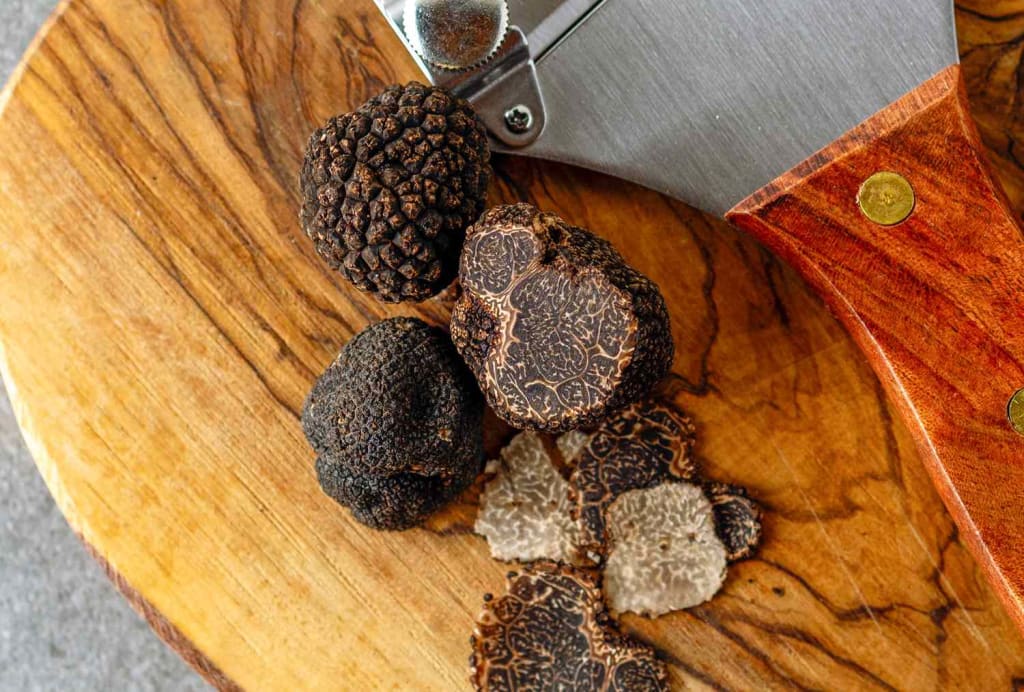
Truffles are a luxury food known around the world. But these delicious mushrooms are costly. In 2014, the world's largest white truffle was flown to New York, accompanied by a security guard, and sold at an auction for $61,000. Found in Italy, this giant mushroom weighed almost 2kg.
So what makes them so expensive?
There are many kinds of truffles. There are at least 40 species, many of which are inedible, and new ones were discovered in 2018. You may have seen luxurious truffle products in supermarkets or fancy restaurants, but the distinctive truffle flavour you know may not be a real truffle at all. Cheap truffle oil is often a far cry from real truffles. Many inexpensive truffle products use 2,4-dithiopentane, a synthetic compound that contains one of the main aromatic ingredients responsible for foot odour. The taste of "earth" is guaranteed, hints of a nutty flavour too. Real truffles are seasonal, expensive and have a short shelf life. They were originally tracked down with truffle pigs, but pigs are good at finding truffles, and they're good at eating them; dogs are more common now. Find your truffle partner! These mushrooms are found all over the world, But they all require a very specific climate to grow. While different strains may have slightly different requirements, one thing is for sure: There are no truffles without trees.
Truffles can always be found on trees, and they must be the correct species. Truffles only have fruiting bodies underground, the equivalent of apples. Many of these are so-called mycelium, tiny filaments that can grow up to 100 meters in a teaspoon of soil. That mycelium actually sticks to the root like the fingers of a glove stick to your hand. It kind of expands the range of the tree. It actually absorbs water and nutrients and passes them on to the tree, which in turn gives it sugar to help the fruit, the truffle, develop. Even if your conditions are just right, there's no guarantee you'll find truffles, and collecting them is a labour-intensive process. Once you know where to look, you have to sniff out and dig out each truffle by hand, and finding them can be difficult; but worth it.
The truffle season is also short, usually only a few months a year. Even if you can get them, they don't last long. Unripe truffles, unlike tomatoes that can be cut from the vine and ripen on your windowsill, the clock is ticking once the truffles come out of the ground. So it slowly deteriorates over time. Therefore, it must reach the customer quickly and easily.
After just five days out of the ground, that pungent truffle smell will have halved. You can farm many truffle varieties, besides the rare Italian whites.
Many people have been successful in setting up truffle orchards, but it's not easy. Trees need to be planted in the right soil conditions, inoculated with truffle fungus, and often irrigated constantly. It can take as long as six years before you get a good truffle harvest, and there's no guarantee that the fungi will grow at all.
So, after all that hard work, what does it actually taste like?
The aroma is quite strong. In contrast, the taste is delicate, with a mix of nutty. savoury and earthy freshness. In fact, it is very light and fragrant. Do not let the smell of damp socks hinder you from tasting something amazing. Truffles are also said to taste like mushrooms, but they have more of a meaty bite.
These days, farming is the primary source of truffles. Today, 70% of the world's truffles are cultivated, however, deforestation and climate change has caused the decline of wild truffles. Since the 19th century, production in France has dropped from more than 1,000 tons per season to just 30 tons. And climate change may cause truffles to disappear altogether in the future. Weather is very important, not only then, but throughout the season. Truffle harvesting is decreasing and the average size is getting smaller. Truffles are about 70% water. Rainfall is therefore necessary for truffles to grow. Some truffle scientists in the UK believe that the climate will move further north in traditional areas, and that the truffle industry will probably cease to exist within 50 years. While vacationers rejoice when dry summers arrive, I sometimes keep my fingers crossed for rain;)
This is why Truffles are so expensive!
About the Creator
Lav
Things to know! Including: Mystery , News , Facts, Physiology etc. Welcome to the world of info.
Keep reading
More stories from writers in Earth and other communities.
You and Me and Baby Makes Three
Albatrosses are known for their amazing wingspan and the partnership they form for life. After choosing a mate, when these seabirds are gliding over oceans and separated for long periods of time, they return to their chosen mate. Their courtship involves dancing and calls. Albatrosses are symbols of faithful companionship over time and distance.
By Rasma Raisters4 days ago in Earth



Comments
There are no comments for this story
Be the first to respond and start the conversation.