
Tornado Alley: Chasing America’s Most Violent Winds
The science, stories, and survival strategies behind the Midwest’s twisters

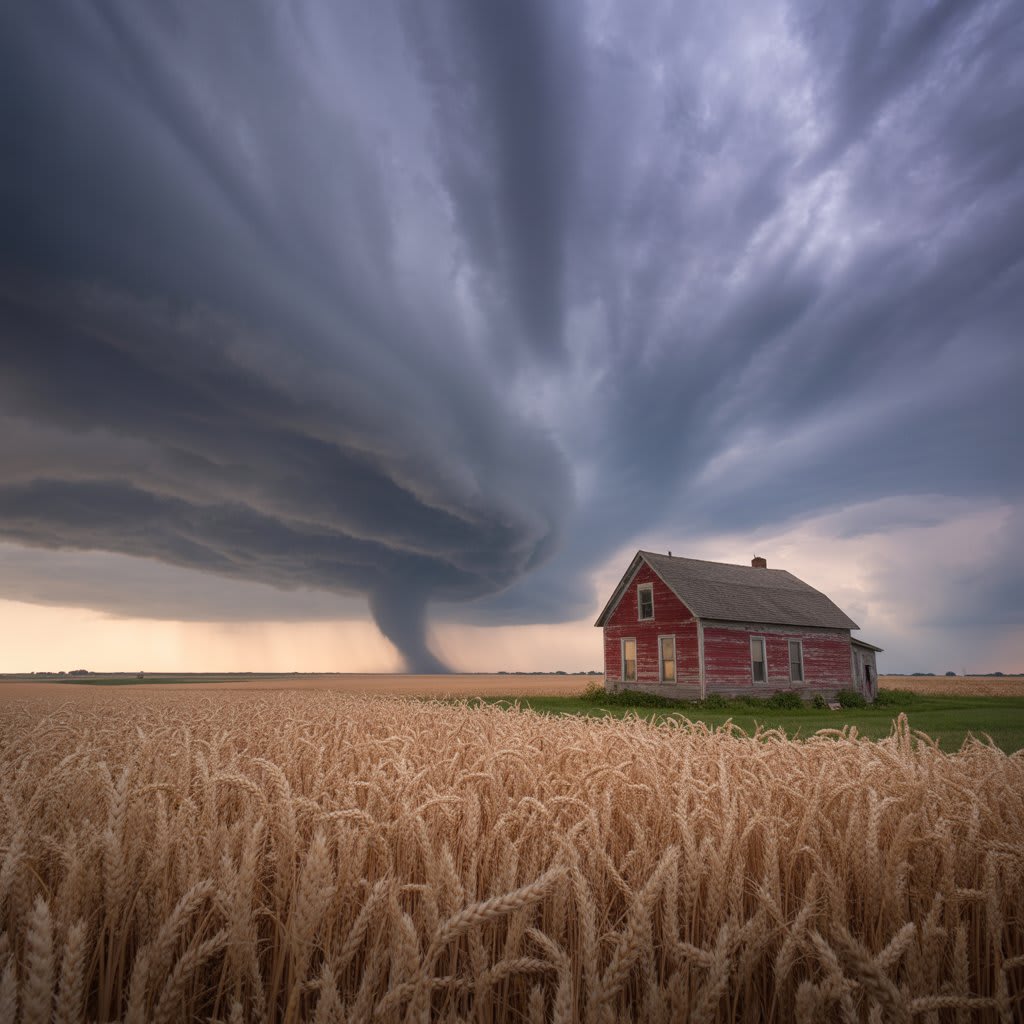
Few natural forces inspire both awe and terror quite like a tornado. These swirling giants of wind can flatten entire neighborhoods in minutes, leaving behind paths of destruction that stretch for miles. Nowhere are they more infamous than in the heart of the United States—a region nicknamed Tornado Alley.
Stretching across parts of Texas, Oklahoma, Kansas, Nebraska, South Dakota, and even reaching into Missouri and Iowa, Tornado Alley is the stage for some of the world’s most violent storms. But why does this area attract twisters year after year? And what can history, science, and survival teach us about living in nature’s most unpredictable neighborhood?
Why Tornado Alley Exists
The geography of Tornado Alley makes it a perfect breeding ground for severe weather. Warm, moist air drifts north from the Gulf of Mexico. At the same time, cold, dry air slides down from the Rocky Mountains and Canada. When these contrasting air masses collide over the Great Plains, the result is explosive—massive thunderstorms known as supercells.
Inside a supercell, wind shear (differences in wind speed and direction at different altitudes) can cause the storm to rotate. If conditions are just right, that rotation tightens and drops to the ground as a tornado. The flat landscape of the plains offers little resistance, allowing twisters to travel for miles.
This combination of geography and meteorology explains why the U.S. experiences more tornadoes than any other country—and why Tornado Alley is the heart of the storm.
The Human Side of Twisters
Behind every statistic is a human story. For generations, families in the Midwest have lived with tornadoes as a seasonal reality. Sirens, storm cellars, and weather radios are as familiar as baseball games and backyard barbecues.
Some tornadoes are relatively weak, causing minor damage. Others, classified as EF4 or EF5 on the Enhanced Fujita Scale, unleash winds exceeding 200 miles per hour. These storms can obliterate entire towns.
The 2011 Joplin, Missouri tornado killed 158 people and caused billions in damages. The 1999 Bridge Creek–Moore tornado in Oklahoma produced the strongest winds ever recorded on Earth—over 300 miles per hour. Such events remind us of both the fragility of human life and the resilience of communities that rebuild time and again.
The Science of Forecasting
Decades ago, tornadoes often struck with little or no warning. Today, thanks to advances in meteorology, warnings can arrive 15 to 30 minutes before a storm hits. Doppler radar systems track wind rotation inside thunderstorms, while satellite technology and computer models help forecasters predict severe weather days in advance.
Still, tornadoes remain notoriously difficult to forecast. Their small size compared to hurricanes and their sudden formation make them elusive. Meteorologists continue to study storm structure through field research projects like VORTEX, where scientists chase storms with radar trucks, drones, and instrument probes.
Each data point collected brings researchers closer to understanding what triggers a tornado to form—or fizzle.
Chasing the Storms
Storm chasing has become both a scientific pursuit and a cultural phenomenon. Researchers chase tornadoes for data; filmmakers and thrill-seekers chase them for the adrenaline and dramatic footage.
The 1996 film Twister introduced storm chasing to mainstream audiences, but real chasers emphasize that safety and science come first. A misplaced turn or a sudden shift in storm motion can turn a chase into a life-threatening situation.
Despite the risks, storm chasers have contributed valuable knowledge to tornado science. Mobile Doppler radars and video documentation have revealed how tornadoes form, evolve, and dissipate. This research has saved lives by improving warning systems.
Surviving Tornado Alley
For residents of Tornado Alley, preparedness is not optional—it’s essential. Survival strategies include:
Storm Shelters and Safe Rooms: Many homes and schools in tornado-prone areas are equipped with underground shelters or reinforced safe rooms designed to withstand high winds and flying debris.
Weather Awareness: Staying alert during severe weather season is critical. Families monitor weather radios, apps, and local news to track storm developments.
Emergency Kits: Stocked with flashlights, water, first aid, and important documents, these kits help families endure power outages or displacement after a storm.
Community Drills: Schools and towns often run tornado drills to ensure everyone knows where to go when sirens sound.
The lesson is clear: while no one can stop a tornado, preparation can mean the difference between life and death.
Nature’s Paradox: Destruction and Renewal
As destructive as tornadoes are, they are also part of nature’s rhythm. Some ecologists argue that tornadoes, like wildfires, play a role in reshaping ecosystems, clearing old growth, and allowing new plants to thrive.
For humans, the paradox lies in living with such danger while also finding beauty in it. Tornado Alley is not just about storms; it’s also about vast skies, fertile farmland, and communities bound by shared resilience.
Why Tornado Alley Captivates the World
The fascination with tornadoes goes beyond those who live in their path. Documentaries, storm-chasing videos, and weather research captivate global audiences. Perhaps it’s the mix of unpredictability and power—the way something invisible like wind can suddenly shape destiny.
Tornado Alley represents both the peril and promise of living close to nature’s rawest forces. It is a reminder that in a world of technological control, there are still elements beyond human power.
Conclusion
Tornado Alley is more than a stretch of land on a weather map—it’s a story of science, survival, and human spirit. It tells us that while nature can destroy, it also teaches resilience, unity, and respect for forces larger than ourselves.
In the end, the story of America’s violent winds is not just about storms. It’s about people who prepare, endure, and rebuild—again and again—under the wide skies of the Midwest.
About the Creator
Echoes of Life
I’m a storyteller and lifelong learner who writes about history, human experiences, animals, and motivational lessons that spark change. Through true stories, thoughtful advice, and reflections on life.
Keep reading
More stories from Echoes of Life and writers in Earth and other communities.
The Great Galveston Hurricane of 1900: Nature’s Deadliest Strike
On the night of September 8, 1900, the city of Galveston, Texas, was thriving. Known as the “Wall Street of the South,” Galveston was one of the busiest ports in the United States. Elegant homes lined the streets, commerce flowed through its harbors, and its future seemed limitless.
By Echoes of Life4 months ago in Earth
Microbiota, microbiome or microflora: how to speak correctly and why it is for health.
You've probably heard the phrase, "We are what we eat." But modern science says more precisely: we are also those who live in us. Until 2016, it was believed that there are many times more bacteria in our body than our own cells. The latest calculations by mathematicians show that we divide the body with our microorganisms by about 50/50: about 30 trillion of our cells versus 38 trillion bacterial ones.
By Yaroslav Gorohovabout 13 hours ago in Earth
A building's lifetime climate impact is mostly determined by its daily energy use.
The majority of a building's climate impact is not caused by its construction. As the heating, lighting, and ventilation systems continue to function year after year, it gradually accumulates.
By Francis Damiabout 16 hours ago in Earth



Comments
There are no comments for this story
Be the first to respond and start the conversation.