
Top 5 Animal Myths vs. Reality: What Science Says
Debunking 5 Popular Misconceptions About Animal Behavior and Biology


Blind bats, forgetful fish, and headless cockroaches — join us as we run through five of the most common animal facts that are actually myths. I'm Stu, this is Debunked, and we're here to sort the truth and the myths, and the facts from the misconceptions.
Number five: Goldfish have a three-second memory.
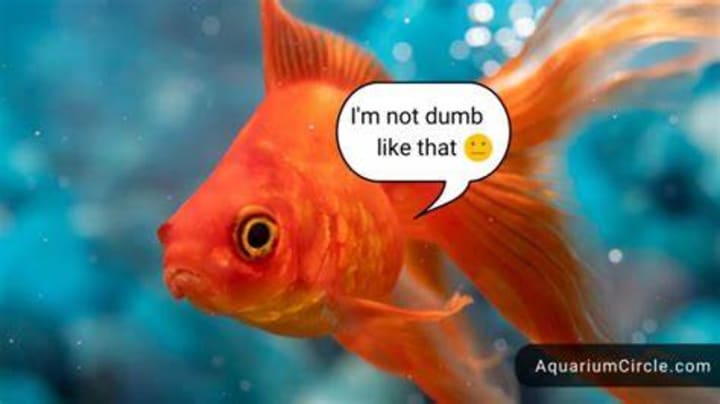
Luckily, thousands of studies have been conducted to investigate this very notion. One experiment showed that goldfish could remember which color pedal to push to receive a food reward, and which color pedal to avoid after no reward was offered.
This color preference even continued for months afterwards.
As well as remembering to operate the lever, goldfish have also shown they can remember which one-hour time slot will release the food reward within a 24-hour period.
Another study trained goldfish to distinguish between the classical compositions of Bach and Stravinsky.
But to top it off, studies have shown goldfish can solve mazes and even navigate a fish-operated vehicle on land.
So, how long is the memory of a goldfish? While there's no exact time limit, current studies suggest it spans three to five months, possibly longer.
Scientists believe this myth likely developed as a way for pet owners to feel better about confining them to their namesake goldfish bowl.
Number four: Bulls hate the color red.
Humans see color thanks to the cone cells in our retinas.
Most of us possess three types of cone cells — S for the blue end of the spectrum, M for the mid-spectrum colors, and L for the red end. Bulls, however, only have two — S and M/L cones.
Having only one type of cone to cover mid and long wavelength light means that, like colorblind humans, they likely struggle to differentiate between longer wavelength colors, one of which is red.
It's very unlikely, then, that red in particular would make a bull angry. So, why do they attack the red cloth in a bullfight? It's probably the flapping motion.
Stressed animals respond to perceived threats with either fight or flight, and in this bloodsport, escape is sadly not an option.
Should you pass a bull on your travels, then red is probably fine. If you leave him well alone, chances are he'll do the same.
Number three: Bats are blind
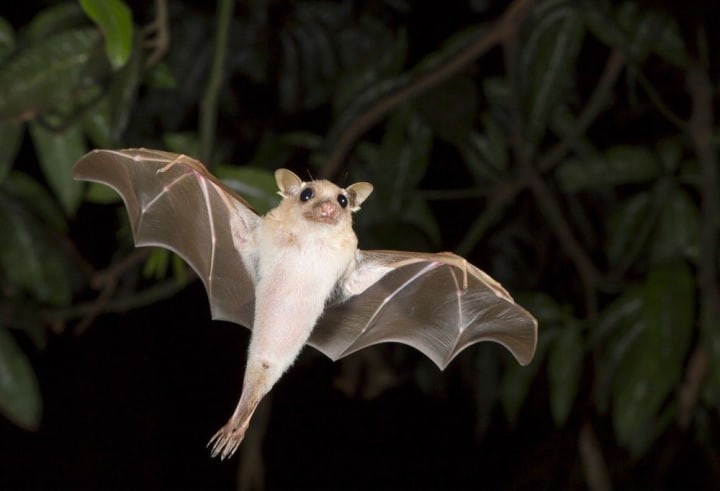
Bats are generally nocturnal and so hunt for food in the dark. To aid their nighttime movements, bats project clicking sounds that bounce off of surfaces and return as an echo to their highly tuned ears.
This is known as echolocation and allows them to judge distances and map out their surroundings. But this doesn't mean they're blind.
In fact, in low light conditions, their vision may be even better than ours.
Mammals like us have eyes that are made up of rods and cones. Cones are for daylight vision and color, and rods give you night vision. Studies have recently discovered that bats also have cones for reds and ultraviolet.
Reds help fruit bats find the ripest fruit, while ultraviolet helps microbats hunt at dusk and dawn.
It also helps nectar-feeding bats, who detect a flower's UV-reflecting nectar guide.
In areas that lack predators, several species of bat have even been recorded as daylight hunters, being active between 9 a.m. and 4 p.m.
Number two: You can sweat like a pig.
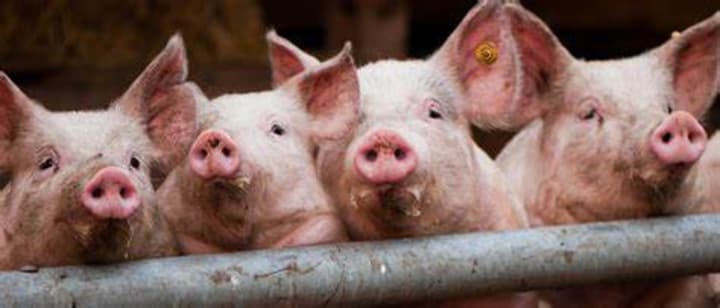
This may have evolved from an earlier expression, "bleed like a stuck pig," but the truth is pigs don't even sweat.
The few sweat glands they have don't function to cool the animal down.
Instead, they bathe and cover themselves in cool water to produce a similar sweating effect.
And if water is not available, then they roll themselves in mud. Hence, the expression, "happy as a pig in mud."
Experts also believe the suidae family use mud as a sort of sunscreen and insect repellent, and as a method for removing parasites once they rub the mud off.
The stereotype of a filthy pig is, in fact, the poor animal trying to keep on top of its hygiene.
But the term "sweat like a pig" may instead refer to pig iron, so called because the smelting system resembled a bunch of piglets suckling at their mother.
At the end, when the pig iron cools, beads of moisture form on its surface.
So, when the ingots or pigs sweat, it indicates that the metal is cool enough to handle safely.
Number one: Cockroaches can survive without a head.

Party as cockroaches are, is headlessness really survivable? Let's have a look at the possible outcomes of the chop.
Bleed out: Roaches don't have a closed, high-pressure circulatory system like ours.
Their organs are bathed directly in a nutrient-carrying fluid called hemolymph. After injury, the fluid congeals quickly, preventing excessive loss.
Suffocation: They breathe through spiracles — tiny tubes that are spread across their body segments. No head, no problem.
Brain loss: While they do have a brain in their heads, it's not the full-blown control center. Bundles of nerve cells called ganglia in their bodies allow their limbs to keep moving — head or not.
Dehydration or starvation: This is the killer. While their bodies can motor on for as long as a couple of weeks, without a mouth to eat or drink, they eventually run out of steam. The head, by contrast, lasts only a few hours. We'll call this one partly true.
Thanks for reading...............
About the Creator
Keep reading
More stories from Mohammed thanvir and writers in Earth and other communities.
Back from the Brink: The Bold Science of De-Extinction
Imagine a world where woolly mammoths and dinosaurs roam the earth once again, or pterosaurs fly through the skies. It sounds like something out of a science fiction movie, but could we actually bring these creatures back? Let's dive into the science of de-extinction and see what's possible.
By Mohammed thanvir9 months ago in Earth
Microbiota, microbiome or microflora: how to speak correctly and why it is for health.
You've probably heard the phrase, "We are what we eat." But modern science says more precisely: we are also those who live in us. Until 2016, it was believed that there are many times more bacteria in our body than our own cells. The latest calculations by mathematicians show that we divide the body with our microorganisms by about 50/50: about 30 trillion of our cells versus 38 trillion bacterial ones.
By Yaroslav Gorohova day ago in Earth
A building's lifetime climate impact is mostly determined by its daily energy use.
The majority of a building's climate impact is not caused by its construction. As the heating, lighting, and ventilation systems continue to function year after year, it gradually accumulates.
By Francis Dami2 days ago in Earth



Comments
There are no comments for this story
Be the first to respond and start the conversation.