
Back from the Brink: The Bold Science of De-Extinction
Can We Really Revive Woolly Mammoths and Other Lost Giants, or Are We Rewriting Nature’s Rules?


Imagine a world where woolly mammoths and dinosaurs roam the earth once again, or pterosaurs fly through the skies. It sounds like something out of a science fiction movie, but could we actually bring these creatures back? Let's dive into the science of de-extinction and see what's possible.
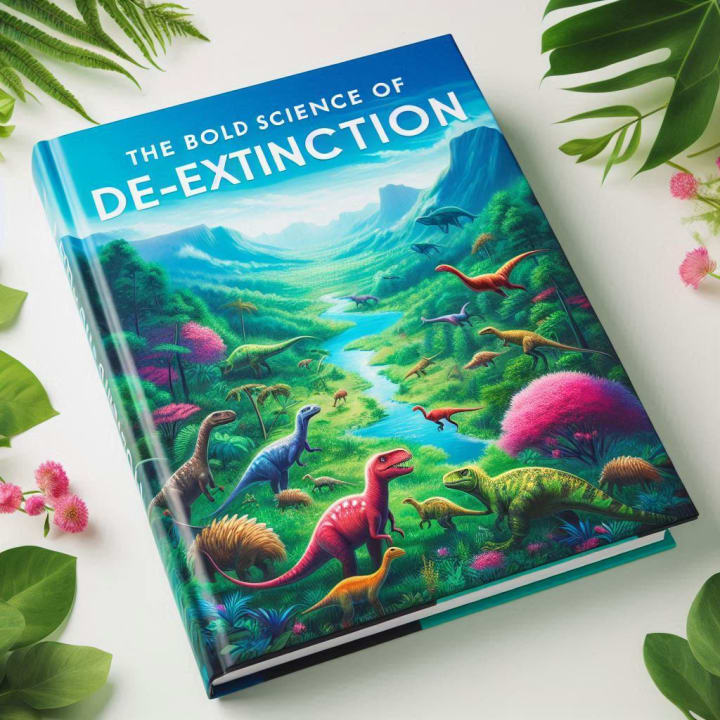
De-extinction, also known as resurrection biology, is the process of creating organisms that resemble extinct species. Scientists use advanced biotech tools like cloning, genome editing, and selective breeding to do this. De-extinction doesn't aim to create perfect replicas of extinct species. Instead, scientists focus on creating proxies — living organisms that are functionally equivalent to their extinct counterparts. These proxies often result from hybrids, where DNA from extinct species is combined with that of their closest living relatives.
De-Extinction Methods
Scientists are exploring several exciting methods to bring back extinct animals.
Let's start with the first one: cloning. Think of it as a biological time machine. Scientists take the nucleus — the cell's blueprint — from a preserved cell of an extinct species and insert it into an egg cell from a close living relative, after removing its own nucleus. The egg is then stimulated to develop into an embryo and implanted into a surrogate mother closely related to the extinct species.
The next: genome editing. Thanks to tools like CRISPR, researchers can now directly edit the DNA of living animals. By comparing the genome of an extinct species with that of its closest living relative, scientists can tweak the genes to restore lost traits. This method may eventually produce hybrids that behave much like their extinct ancestors.
The last method, back-breeding, involves selectively mating animals that still carry some traits of an extinct species. Through careful selection over several generations, these traits can gradually become more pronounced — ultimately leading to a living animal that looks and behaves much like the long-gone species. However, it won't be a perfect genetic match.
Together, these methods are paving the way for a new era in conservation, pushing the boundaries of what is possible in reviving lost species.
Let's get straight to the big question — can we actually revive extinct animals?
Can We Actually Bring Back?
Dinosaurs? It's nearly impossible. Their remains are over 65 million years old, and DNA has a half-life of only about 521 years, meaning it breaks down rapidly. In fact, after roughly 6.8 million years, no usable DNA would remain. Without intact DNA, there's no blueprint to work with, and no living relative can serve as a surrogate — so Jurassic Park stays as fiction.
But woolly mammoths are a different story. They disappeared only about 4,000 years ago, and well-preserved remains in Arctic permafrost provide us with usable DNA. Scientists can even use tools like CRISPR to edit the genome of the Asian and African elephant — the mammoth's closest living relative — to bring back key traits of the mammoth.
But rather than trying to create an exact replica, scientists are pursuing a hybrid approach. They aim to engineer a cold-resistant elephant with the key biological traits of the woolly mammoth — a creature often dubbed a "mam-moth." This hybrid would look and function much like a mammoth. So, there is real hope for seeing woolly mammoths return.
Current De-Extinction Projects
However, so far, no de-extinction project has successfully revived an extinct species to the point of reintroduction into the wild.
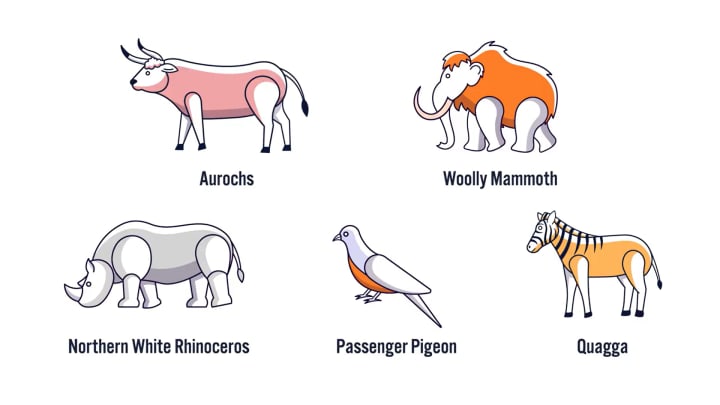
Several ambitious projects are making significant progress — like efforts to restore the aurochs, revive the woolly mammoth through genetic engineering, implant northern white rhinoceros embryos, and even revive the passenger pigeon and quagga.
These projects illustrate that while dinosaurs remain out of reach, the science of de-extinction is advancing rapidly. For some species, de-extinction isn't just about reviving the past — it's about pushing the boundaries of what nature can become.
Imagine a future where the echoes of extinct species become part of our world again. What role should humans play in reshaping nature? Could de-extinction help us undo some of the damage we've caused — or are we playing with forces we don't fully understand?
About the Creator
Keep reading
More stories from Mohammed thanvir and writers in Earth and other communities.
Mount Sinai, the World’s Oldest Monastery, and the Prophet’s Letter: Faith, History, and a Controversial Development Plan
At a sacred site revered by Muslims, Christians, and Jews alike, an ambitious modernization project has stirred debate after reports of graves being relocated—raising questions about heritage, memory, and the cost of progress.
By Irshad Abbasi 7 days ago in Earth


Comments
There are no comments for this story
Be the first to respond and start the conversation.