
The Sun: The Life-Giving Star of Our Solar System
A Comprehensive Exploration of the Sun’s Structure, Energy, and Role in Sustaining Life on Earth
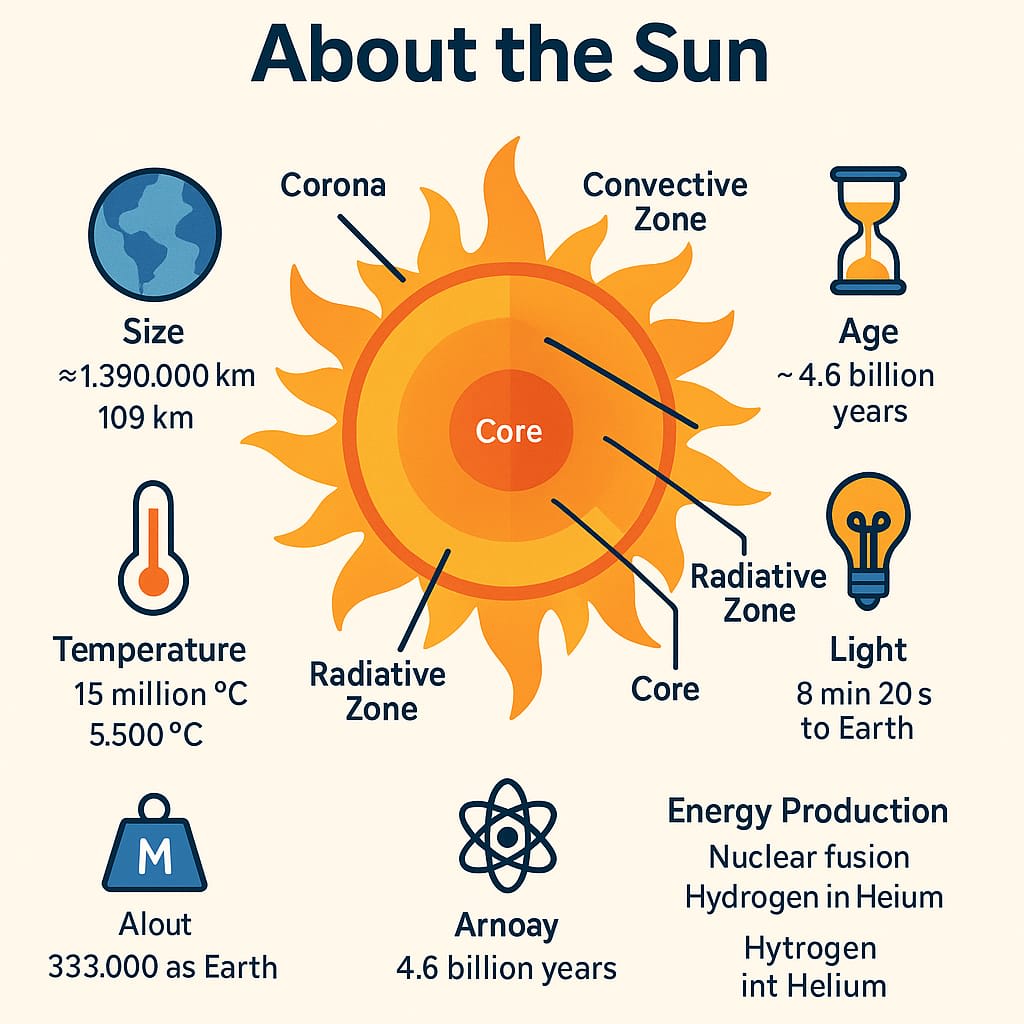
Details About the Sun
The Sun is the most essential and powerful star in our solar system. It is the primary source of light, heat, and energy for the Earth and all other planets. Without the Sun, life as we know it could not exist. From providing energy to driving weather patterns and enabling photosynthesis in plants, the Sun plays a crucial role in the stability and continuity of life on Earth. Below are detailed insights into the Sun's characteristics, structure, and influence.
---
1. Size of the Sun
The Sun is enormous compared to our planet. It has an approximate diameter of 1.39 million kilometers (1,390,000 km), making it about 109 times wider than Earth. When we consider its volume, it is so vast that over 1.3 million Earths could fit inside it. This immense size is one reason why it can produce and emit such an enormous amount of energy continuously.
---
2. Structure of the Sun
The Sun is composed of several distinct layers, each playing a specific role in energy production and transfer:
Core: This is the Sun’s innermost part and the powerhouse where nuclear fusion occurs. Here, hydrogen atoms fuse to form helium, releasing an immense amount of energy in the form of light and heat.
Radiative Zone: Energy generated in the core travels outward through this zone in the form of electromagnetic radiation.
Convective Zone: In this layer, energy moves via convection currents—hot plasma rises, cools down near the surface, and sinks back, creating loops that transfer energy to the outer layers.
Photosphere: This is the visible surface of the Sun. It emits the light we see and has a temperature of about 5,500°C. Sunspots, which are cooler, darker patches, can also be observed here.
Chromosphere: Located above the photosphere, this layer is harder to observe but becomes visible during solar eclipses as a reddish glow.
Corona: The outermost layer of the Sun's atmosphere, extending millions of kilometers into space. Despite being far from the core, it is incredibly hot—up to 1 to 3 million degrees Celsius—and is visible as a white halo during total solar eclipses.
---
3. Temperature of the Sun
The Sun’s temperatures vary dramatically across its layers:
Core Temperature: About 15 million degrees Celsius (15 million °C). This extreme heat drives the nuclear fusion reactions.
Photosphere Temperature: Approximately 5,500 degrees Celsius (5,500 °C). This is the temperature of the Sun’s surface from where light is emitted.
Corona Temperature: Between 1 to 3 million degrees Celsius, significantly hotter than the surface due to magnetic activities.
---
4. Mass and Weight of the Sun
The Sun’s mass is about 333,000 times that of Earth. It holds 99.86% of all the mass in our solar system, making it the dominant gravitational force that keeps all planets, asteroids, and comets in orbit. Its massive weight and gravitational pull govern the movement and structure of the entire solar system.
---
5. Sunlight and Radiation
Sunlight takes around 8 minutes and 20 seconds to reach Earth, traveling at the speed of light. This light contains various types of radiation:
Visible Light: The light we see.
Infrared Rays: Felt as heat.
Ultraviolet (UV) Rays: Invisible rays that can cause sunburn.
X-rays and Gamma rays: High-energy rays detected through scientific instruments.
Magnetic Waves: Responsible for solar storms and auroras on Earth.
These different rays serve various roles, from providing warmth and visibility to driving chemical reactions like photosynthesis and affecting weather and climate.
---
6. Source of Solar Energy
The Sun generates its energy through nuclear fusion, a process in which hydrogen nuclei fuse to form helium under extreme temperature and pressure conditions. This reaction releases a vast amount of energy, which travels through space in the form of electromagnetic radiation. A small fraction of this energy reaches Earth and sustains all life.
---
7. Rotation of the Sun
The Sun rotates on its axis, but unlike Earth, it doesn’t rotate uniformly:
The equatorial region completes a full rotation in about 25 days.
The polar regions take about 35 days to complete a rotation.
This differential rotation leads to complex magnetic field patterns and solar activities like sunspots, flares, and coronal mass ejections.
---
8. Impact of the Sun on Earth
The Sun influences almost every aspect of life on Earth:
Climate and Weather: Solar energy drives the water cycle and global wind patterns.
Photosynthesis: Plants use sunlight to create food, which supports the food chain.
Biological Rhythms: Day and night cycles affect human and animal behavior.
Technology: Solar radiation can affect satellite operations and radio communications during solar storms.
Without the Sun, Earth would be a frozen, lifeless rock drifting in space.
---
9. Age of the Sun
The Sun is approximately 4.6 billion years old, formed from a giant cloud of gas and dust. Scientists estimate that it is currently about halfway through its main sequence life stage. This means it has enough fuel (hydrogen) to continue burning for another 5 billion years or so.
---
10. Future of the Sun
As the Sun ages and exhausts its hydrogen fuel:
It will swell into a Red Giant, possibly engulfing Mercury, Venus, and even Earth.
After this phase, it will shed its outer layers and become a White Dwarf, a small, dense remnant.
Over billions of more years, it will gradually cool down and fade away.
This long evolutionary journey reflects the life cycle of medium-sized stars like our Sun.
---
11. Importance of the Sun
The Sun’s energy and light have a direct impact on agriculture, biology, and the overall climate system. Crops depend on sunlight for growth, animals and humans need it for warmth and survival, and weather systems are directly influenced by it. Without the Sun, Earth would be a cold, dark, and lifeless planet.
---
Conclusion
The Sun is not just a ball of hot gases in the sky—it is the central life-supporting force of our solar system. Understanding the Sun helps us appreciate the delicate balance of nature and the vast, interconnected systems that allow life to exist. Its incredible energy, structure, and lifecycle are reminders of the complexity and beauty of the universe. The more we learn about the Sun, the better we can understand our place in the cosmos and prepare for future changes it may bring.
About the Creator
Keep reading
More stories from Ikram Ullah and writers in Earth and other communities.
The Deepest Hole on Earth: A Journey into the Heart of Our Planet
How Deep Have Humans Drilled Into the Earth? When we look up at the night sky, we often marvel at how far humans have gone—reaching the Moon, sending probes to Mars, and even exploring the outer planets. But have you ever wondered how far we've gone downward, into our own planet? Surprisingly, despite all our technological advancements, our deepest journey into the Earth barely scratches the surface compared to its total depth.
By Ikram Ullah8 months ago in Earth
Greenland News
Greenland News Greenland has increasingly drawn global attention in recent years due to its political developments, environmental changes, and growing strategic importance. As the world looks more closely at the Arctic region, news from Greenland reflects a unique mix of local priorities and international interest. From climate-related challenges to economic opportunities and governance issues, Greenland continues to shape its own path while remaining closely connected to global affairs.
By America today about 3 hours ago in Earth
Chinese Planetary Engineering: The Great Green Wall and the Reclamation of Climate
There are junctures in history where a civilization no longer chooses between comfort and progress, but between adaptation and extinction. At the dawn of the new millennium, China hit one of those silent thresholds where geography ceases to be a backdrop and becomes an adversary. The desert was advancing, not as a metaphor for decay, but as a physical, methodical, and relentless force. Sand was devouring the horizon, winds grew heavy with dust, and the soil lost its fertile memory, taking with it the promise of social stability.
By Laurenceau Porte4 days ago in Earth



Comments (1)
The Sun's size is mind-blowing. That 1.3 million Earths fitting inside it? Crazy. And its structure is complex. The core's fusion is key. I wonder how long it'll keep producing energy like this. The different layers all working together to give us light and heat is pretty amazing. Do you think we'll ever fully understand all the processes happening in the Sun?