
The Structure and Layers of the Ocean Floor
Exploring the Composition and Topography of the Ocean Floor
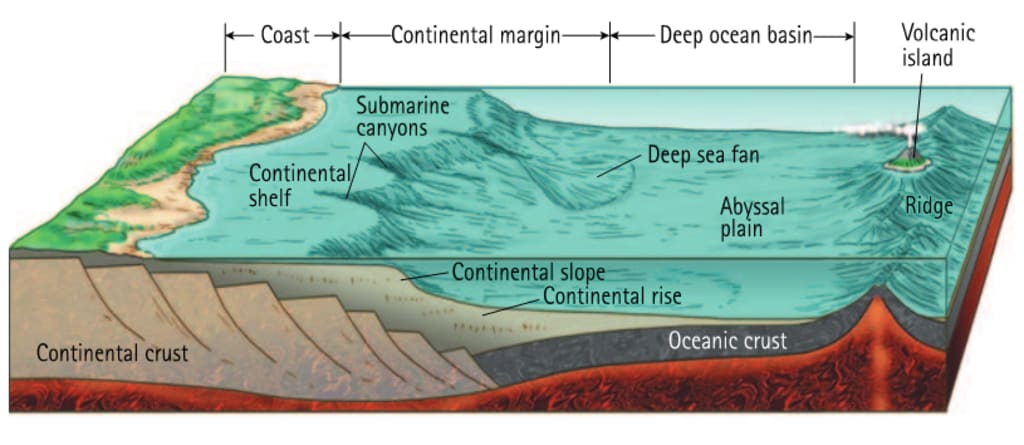
The ocean, covering over 70% of Earth’s surface, is a vast and mysterious realm. Beneath its surface lies the ocean floor—an intricate landscape that rivals the complexity of the continents. This underwater terrain is not flat or uniform, but composed of a variety of features shaped by geological processes over millions of years. Understanding the structure and layers of the ocean floor is crucial for marine science, geology, and environmental studies.
1. Introduction to the Ocean Floor
The ocean floor, or seabed, refers to the bottom of the ocean. Like the land we live on, it is part of the Earth’s crust, specifically the oceanic crust, which differs in composition and density from the continental crust. The oceanic crust is thinner and denser, primarily composed of basaltic rocks, whereas the continental crust is made up of granitic rocks.
The ocean floor is not a vast, flat expanse; it is a diverse and dynamic environment. From the shallow continental shelves to the deepest oceanic trenches, the seafloor consists of multiple structures and layers, each with its unique characteristics.
2. Major Features of the Ocean Floor
The ocean floor is composed of several key features:
a. Continental Shelf
The continental shelf is the extended perimeter of each continent, lying submerged under relatively shallow water. These shelves are biologically rich and are the locations of important fisheries. The slope is gentle and may extend hundreds of kilometers from the shore.
b. Continental Slope
Beyond the shelf lies the continental slope, a steeper incline that marks the boundary between continental and oceanic crust. This area often contains submarine canyons carved by underwater currents and sediment flows.
c. Continental Rise
At the base of the slope, the seafloor flattens out slightly in a region known as the continental rise. It consists of accumulated sediments that have cascaded down from the continental shelf and slope, forming thick layers over time.
d. Abyssal Plain
One of the flattest and smoothest regions on Earth, the abyssal plain lies beyond the continental rise. It is covered with fine-grained sediments and can reach depths of 3,000 to 6,000 meters. These plains make up the majority of the deep ocean floor.
e. Mid-Ocean Ridges
These underwater mountain ranges are created by tectonic activity where plates diverge, allowing magma to rise and form new crust. The Mid-Atlantic Ridge is one of the most well-known examples. These ridges often have central rift valleys and hydrothermal vents.
f. Ocean Trenches
Trenches are the deepest parts of the ocean, formed at subduction zones where one tectonic plate is forced beneath another. The Mariana Trench in the western Pacific is the deepest known part of the Earth's seabed, reaching over 11,000 meters.
g. Seamounts and Guyots
Seamounts are underwater volcanic mountains. If a seamount becomes eroded and flat-topped, it is called a guyot. These formations often serve as habitats for diverse marine species.
3. Geological Layers of the Ocean Floor
The structure of the ocean floor can be broken down into several geological layers, from top to bottom:
a. Sediment Layer
The uppermost layer consists of sediments that accumulate from various sources, including eroded land materials, dead marine organisms, volcanic ash, and cosmic dust. These sediments vary in thickness and composition depending on location. For example, sediments are thicker near continents and thinner at mid-ocean ridges.
b. Basaltic Crust
Beneath the sediment layer lies the oceanic crust, composed primarily of basalt—a dark, fine-grained volcanic rock. This layer is about 5-10 kilometers thick and is created at mid-ocean ridges through volcanic activity.
c. Upper Mantle
Below the oceanic crust is the upper mantle, made up of peridotite and other dense, solid rocks. This layer is part of the lithosphere, which includes the crust and the rigid uppermost portion of the mantle. The lithosphere is broken into tectonic plates that float on the more ductile asthenosphere beneath.
4. Plate Tectonics and Ocean Floor Formation
The concept of plate tectonics is vital to understanding the structure of the ocean floor. The Earth's lithosphere is divided into several plates that move relative to each other. At divergent boundaries, plates move apart, creating mid-ocean ridges where new oceanic crust is formed. At convergent boundaries, one plate subducts beneath another, forming trenches and volcanic arcs.
These tectonic movements are responsible for shaping the ocean floor’s topography. Over millions of years, plates spread, collide, and slide past each other, continually renewing and transforming the seafloor.
5. Marine Life and the Ocean Floor
The physical structure of the ocean floor significantly affects marine life. Shallow areas like continental shelves support a wide range of species due to ample sunlight and nutrient availability. In contrast, the deep-sea environment, such as abyssal plains and trenches, is home to organisms adapted to high pressure, low temperatures, and darkness.
Hydrothermal vents, found near mid-ocean ridges, are hotspots of biodiversity. They release mineral-rich fluids that support unique ecosystems, including chemosynthetic bacteria and exotic creatures like giant tube worms.
6. Human Exploration and Technology
Exploring the ocean floor is a challenging task due to its inaccessibility and extreme conditions. However, advancements in technology have enabled significant discoveries. Tools like sonar mapping, remotely operated vehicles (ROVs), and deep-sea submersibles help scientists map and study the ocean floor in detail.
Satellite altimetry is also used to measure slight variations in sea surface height, which can indicate the presence of underwater mountains or trenches. Despite these advances, much of the ocean floor remains unexplored, making it one of the last frontiers on Earth.
7. Importance of Studying the Ocean Floor
Studying the structure and layers of the ocean floor is vital for multiple reasons:
Scientific Research: Understanding plate tectonics, earthquake activity, and geological history.
Environmental Monitoring: Assessing climate change impacts, such as sediment composition and sea-level rise.
Resource Exploration: Locating underwater resources like oil, gas, and minerals.
Biodiversity Conservation: Protecting unique deep-sea ecosystems from human exploitation.
8. Conclusion
The ocean floor is a complex and dynamic environment shaped by geological processes and home to diverse ecosystems. From the shallow continental shelves to the mysterious deep-sea trenches, every feature tells a story of Earth's evolution. Although modern technology has shed light on many of its secrets, vast areas remain unexplored. Continued exploration and study are essential for understanding our planet’s past, managing its resources, and protecting its marine life for future generations.
About the Creator
Keep reading
More stories from Mubasshir Haque and writers in Earth and other communities.
Climate Collapse is Closer Than You Think – The Planet’s Final Warning
In recent years, the phrase “climate collapse” has evolved from a distant warning into an imminent threat. The latest findings from the Intergovernmental Panel on Climate Change (IPCC), NASA, and the World Meteorological Organization (WMO) all suggest that Earth is approaching critical tipping points. These thresholds, once crossed, could trigger irreversible damage to the planet’s ecosystems and human civilization. This report explores the causes, consequences, and urgent actions needed to address the looming climate collapse.
By Mubasshir Haque 8 months ago in Earth
Facing Political Pressure, Trump Seeks Answer to Rising Housing Costs
As Americans continue to grapple with soaring home prices and rising rents, former President Donald Trump is once again thrust into the national spotlight — this time on a topic that affects millions of households: housing affordability. Facing mounting political pressure, Trump is reportedly exploring ways to address the rising cost of housing, a move that could influence policy debates, the real estate market, and his political narrative in the lead-up to upcoming elections. The Housing Cost Crisis Housing costs in the United States have been climbing steadily over the past several years. According to recent data: Home prices have risen faster than wages in many urban and suburban markets. Rental rates have increased sharply, particularly in high-demand cities like New York, Los Angeles, and Miami. Many Americans now spend 30–50% of their income on housing, leaving less for healthcare, education, and savings. The issue is not just economic — it is increasingly political, with voters citing housing affordability as a top concern. For a public figure like Trump, addressing this problem is both a strategic and symbolic imperative. Political Pressure Mounts Trump’s renewed attention to housing comes amid rising scrutiny from both political opponents and his own party. Democrats have criticized Republican-led efforts for failing to curb housing inflation, while some GOP voters are pressuring Trump to propose solutions that boost homeownership and reduce rent burdens. Policy analysts suggest that housing has become a litmus test for leadership, particularly as younger voters and working families express frustration over the lack of affordable options. This makes it a high-stakes issue for any political figure seeking influence or office. Trump’s Approach Reports indicate that Trump is focusing on several potential strategies to address rising housing costs: Regulatory Reform: Reviewing local and federal regulations that may restrict new construction, including zoning laws, environmental review processes, and permitting bottlenecks. Tax Incentives: Exploring measures to encourage developers to build more affordable housing units. Federal Support Programs: Considering expansion of federal programs for low-income families, including subsidies or down-payment assistance initiatives. Market-Based Solutions: Encouraging private sector investment in housing developments through incentives, partnerships, and streamlined approval processes. While the specifics of these proposals are still emerging, the focus is on expanding supply and easing financial barriers to homeownership and renting. Why Housing Costs Are Rising Understanding the challenge requires examining the factors behind rising housing costs: Supply Constraints: Many cities face shortages of available homes, particularly in areas with strong job growth. Labor and Material Costs: Construction costs have surged due to inflation, labor shortages, and higher material prices. Investor Activity: Institutional investors buying single-family homes as rental properties have reduced the supply available to individual buyers. Interest Rates: Elevated mortgage rates have increased monthly payments, further reducing affordability. These pressures are compounded in high-demand urban areas, making policy intervention both urgent and complex. Economic and Social Implications Rising housing costs have broad implications: Economic Strain: Families allocate more of their income to housing, leaving less for discretionary spending, healthcare, and education. Migration Patterns: High costs push residents to more affordable regions, reshaping local economies and labor markets. Political Discontent: Voters increasingly associate rising housing prices with government inaction, making it a politically sensitive issue. For Trump, addressing housing affordability is as much about economic outcomes as it is about political perception. Reactions from Industry Experts Housing analysts and economists have weighed in on Trump’s efforts: Some applaud the focus on regulatory reform, noting that local zoning and permitting hurdles are major barriers to new construction. Others caution that market-based incentives alone may not suffice and emphasize the need for targeted programs for low- and moderate-income households. Critics warn that overly aggressive deregulation could compromise environmental standards or neighborhood planning, creating long-term trade-offs. The debate reflects the complexity of housing policy in a country where supply, demand, and regulation intersect. Political Strategy and Messaging For Trump, addressing housing costs is not just policy — it is also political messaging. Analysts suggest that: Highlighting efforts to reduce housing costs allows him to appeal to working-class voters who feel squeezed by inflation. Framing housing as a regulatory and market problem aligns with broader Republican priorities of limiting government overreach. Demonstrating concrete solutions could strengthen his position as a problem-solver in the eyes of the electorate. In short, housing affordability represents both a policy challenge and an opportunity to shape the political narrative. Looking Ahead Trump’s proposals are still taking shape, but the broader housing crisis will remain a central issue in American politics: Policymakers at federal, state, and local levels will face pressure to balance supply, affordability, and environmental considerations. Real estate markets will continue to respond to interest rates, investor activity, and regulatory changes. Political figures will be judged by their ability to provide practical solutions that alleviate the financial burdens of everyday Americans. As the debate unfolds, one thing is clear: housing costs are not just numbers on a chart; they impact families, communities, and the broader economy. Conclusion Facing rising political pressure, Trump’s focus on the housing affordability crisis reflects both a policy challenge and a political imperative. With Americans struggling to pay rent and mortgage costs, any strategy that expands supply, reduces financial barriers, or incentivizes affordable development could have meaningful consequences. Whether his efforts will succeed in lowering costs or simply generate debate remains to be seen. What is undeniable, however, is that housing affordability is now a front-and-center issue in American politics, shaping public perception, economic policy, and the national discourse for years to come.Start writing...
By Muhammad Hassana day ago in Earth
Ghana Wheat Market Size & Forecast 2025–2033
Introduction Ghana’s wheat market is steadily emerging as an essential segment of the country’s food economy. Driven by rapid urbanization, changing dietary habits, and the expansion of bakeries, fast-food outlets, and packaged food manufacturing, wheat has become a key ingredient in everyday Ghanaian diets. According to Renub Research, the Ghana wheat market was valued at US$ 46.20 million in 2024 and is projected to reach US$ 79.89 million by 2033, growing at a compound annual growth rate (CAGR) of 6.27% during 2025–2033.
By Marthan Sirabout 13 hours ago in Earth


Comments
There are no comments for this story
Be the first to respond and start the conversation.