
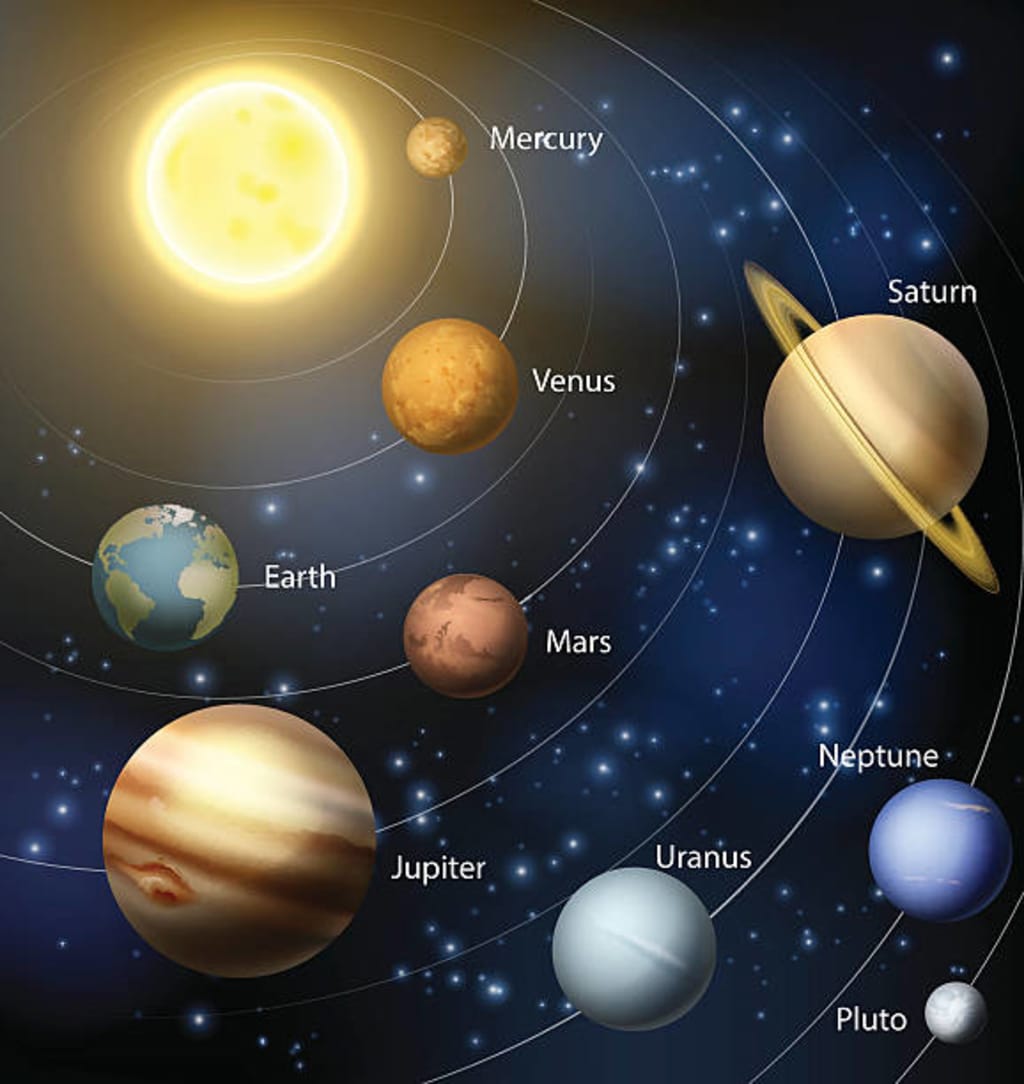
Exploring the Planets of Our Solar System
Today, we embark on an incredible journey through our solar system. Sit back, relax, and enjoy as we explore each planet, from the scorching Mercury to the distant ice giant Neptune.
We begin with Mercury, the planet closest to the Sun. Mercury is a terrestrial, or rocky, planet orbiting just under 58 million kilometers (36 million miles) from the Sun. Despite being the smallest planet in the solar system, with a diameter of only 4,879 km (3,031 mi), Mercury is slightly larger than Earth’s Moon, and the two even share a similar appearance. Surprisingly, Mercury is the second most dense planet in the solar system.
Mercury completes a full orbit around the Sun in just 88 days, but a single day on Mercury lasts about 58 Earth days. Temperatures on its surface are extreme: during the day, they can soar to 430°C (800°F), yet without a thick atmosphere to retain heat, nighttime temperatures can plummet to -180°C (-290°F). Gravity on Mercury is just 38% of Earth’s, meaning someone weighing 220 lbs on Earth would weigh only 84 lbs on Mercury. Its cratered surface tells the story of countless impacts over billions of years.
Next, we move to Venus, another rocky planet, orbiting approximately 107 million kilometers (67 million miles) from the Sun. Venus has a diameter of 12,103 km (7,520 mi) and is the hottest planet in our solar system. Surface temperatures reach nearly 465°C (900°F), thanks to its thick carbon dioxide atmosphere and clouds of sulfuric acid. Its dense cloud layer filters sunlight, giving the surface a fiery orange glow. Venus is dotted with thousands of volcanoes, mountains, and valleys, including Maxwell Montes, comparable in size to Mount Everest.
Venus completes an orbit around the Sun in 225 days, but a single day lasts almost 243 Earth days—making its day longer than its year. Gravity on Venus is roughly 90% of Earth’s, so a 220 lb person on Earth would weigh about 198 lbs on Venus. Scientists believe Venus may once have had oceans and a more Earth-like environment, but a runaway greenhouse effect transformed it into the scorching world we see today—a powerful reminder of what could happen on Earth under similar conditions.
Now, we arrive at our home, Earth, the third planet from the Sun. Earth is a terrestrial planet orbiting 149.6 million kilometers (92.9 million miles) from the Sun, at a distance ideal for supporting life. It is the densest planet in the solar system, with a diameter of 12,742 km (7,917 mi). Temperatures vary widely depending on location and season. The highest recorded temperature was 56.7°C (134.1°F) in Death Valley, California, in 1913, while the coldest was -89°C (-128°F) in Antarctica in 1983.
Earth completes one orbit around the Sun every 365 days, with each day lasting 24 hours. Its surface is diverse, ranging from icy tundras and molten lava fields to lush forests, wetlands, and deserts. This diversity supports the vast array of life that thrives here. Our challenge is to understand and preserve our planet, living sustainably rather than depleting its resources.
Next, we visit Mars, the famous Red Planet. Mars orbits the Sun at an average distance of 228 million kilometers (142 million miles) and takes 687 Earth days to complete a revolution. A day on Mars lasts about 24.6 hours. With a diameter of 6,779 km (4,212 mi), Mars is roughly half the size of Earth. Its surface is cold and dusty, with average temperatures around -60°C (-80°F), although near the equator, temperatures can reach 20°C (70°F). Gravity on Mars is only 38% of Earth’s, so a 220 lb person would weigh just 83 lbs.
Mars shares some similarities with Earth, sparking curiosity about the potential for human colonization. Could humans one day live on Mars? Share your thoughts in the comments.
Moving outward, we encounter Jupiter, the largest planet in the solar system. This gas giant has a diameter of 139,820 km (86,880 mi) and orbits the Sun at an average distance of 778 million kilometers (484 million miles), taking 12 Earth years to complete a revolution. A day on Jupiter is only 10 hours long.
Jupiter has no solid surface, but deep within its clouds lies a swirling ocean of liquid metallic hydrogen, kept in a liquid state by immense pressure. Temperatures range from -145°C (-234°F) in the clouds to a scorching 24,000°C (43,000°F) near its core—hotter than the Sun’s surface. Gravity atop the clouds is 2.4 times stronger than Earth’s, making a 100 lb person feel like 240 lbs. Jupiter is also home to the Great Red Spot, a massive hurricane-like storm twice the size of Earth, with winds reaching 423 km/h (270 mph).
Saturn, the sixth planet from the Sun, is famous for its magnificent rings. A gas giant with a diameter of 116,460 km (72,364 mi), Saturn orbits the Sun at 1.4 billion kilometers (886 million miles) and takes about 29 Earth years to complete one revolution. Its day lasts just under 11 Earth hours. Saturn’s layered clouds feature ammonia ice in the upper layers (-173°C to -113°C, or -280°F to -270°F), frozen water beneath (-88°C to -3°C, or -127°F to -26°F), and temperatures as high as 57°C (134°F) in lower layers. Gravity is 1.08 times that of Earth. Saturn’s composition is mainly hydrogen and helium, possibly with a solid core deep inside.
Next is Uranus, an ice giant orbiting 2.9 billion kilometers (1.8 billion miles) from the Sun. With a diameter of 50,724 km (31,518 mi), it takes 84 Earth years to complete one orbit. A day lasts 17 Earth hours. Despite its frigid temperatures (-213°C / -353°F), Uranus has a dense, hot interior composed of water, methane, and ammonia. Its gravity is 86% of Earth’s, and methane in its atmosphere gives the planet its signature blue hue.
Finally, we reach Neptune, the farthest confirmed planet from the Sun. Neptune orbits at 4.5 billion kilometers (2.8 billion miles) and takes 165 Earth years to complete a single revolution. Each day lasts 16 Earth hours. As the coldest planet, Neptune’s temperatures range from -218°C to -200°C (-360°F to -328°F). Similar to Uranus, Neptune has a dense, icy interior and an atmosphere dominated by hydrogen, helium, and methane. Its gravity is 1.14 times Earth’s, meaning a 100 lb person would weigh 114 lbs here. Intense storms, some lasting weeks, create fast-moving dark vortex clouds as large as Earth itself.
Exploring our solar system offers a humbling perspective on Earth’s place in the cosmos. The harsh conditions on other planets highlight the extraordinary balance that makes life possible here. While life elsewhere is yet to be discovered, the possibilities remain thrilling. Who knows what incredible forms of life might exist in distant solar systems?
Be well, and keep looking up.
About the Creator
Keep reading
More stories from Blessing Ngozi and writers in Earth and other communities.
The stromgest material in the universe
When most people are asked to name the strongest material in existence, the common answers are usually titanium or diamond. These substances are famous for their remarkable durability—titanium for its resilience and lightweight strength, and diamond for its unmatched hardness on Earth. Yet, as impressive as they are, they are nowhere near the true champion of strength in the cosmos.
By Blessing Ngozi5 months ago in Earth
Severe Geomagnetic Storm Could Bring Northern Lights Across Much of the U.S.
On Monday evening, skywatchers from the Pacific Northwest to the Midwest got ready for something out of the ordinary: a celestial display that typically occurs at high northern latitudes. Americans who provide forecasts as a powerful cloud of charged particles from the sun accelerates toward the Earth's magnetic field, the National Oceanic and Atmospheric Administration (NOAA) has issued a "G4 (Severe) geomagnetic storm watch."
By Raviha Imranabout 6 hours ago in Earth
Greenland News
Greenland News Greenland has increasingly drawn global attention in recent years due to its political developments, environmental changes, and growing strategic importance. As the world looks more closely at the Arctic region, news from Greenland reflects a unique mix of local priorities and international interest. From climate-related challenges to economic opportunities and governance issues, Greenland continues to shape its own path while remaining closely connected to global affairs.
By America today 2 days ago in Earth


Comments
There are no comments for this story
Be the first to respond and start the conversation.