
Severe Geomagnetic Storm Could Bring Northern Lights Across Much of the U.S.
NOAA issues a rare G4 storm watch as aurora borealis may be visible from the Pacific Northwest to the Midwest Monday night.
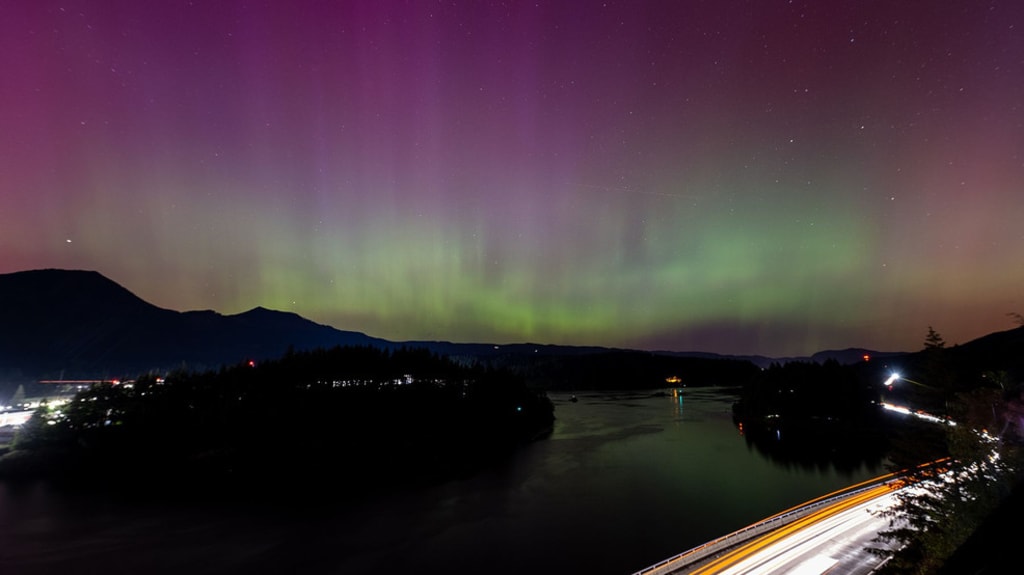
On Monday evening, skywatchers from the Pacific Northwest to the Midwest got ready for something out of the ordinary: a celestial display that typically occurs at high northern latitudes. Americans who provide forecasts as a powerful cloud of charged particles from the sun accelerates toward the Earth's magnetic field, the National Oceanic and Atmospheric Administration (NOAA) has issued a "G4 (Severe) geomagnetic storm watch."
This solar event is rooted in an energetic burst on the sun’s surface: an X1.9-class solar flare that erupted on January 18, sending a massive coronal mass ejection (CME) outward into space. It is anticipated that that CME, which is essentially a cloud of superheated plasma, will strike Earth's magnetosphere as early as late Monday night or early Tuesday, thereby preparing the ground for increased geomagnetic activity.
When these solar particles interact with Earth's magnetic field, they cause geomagnetic storms that cause the colorful displays known as the "aurora borealis" or "Northern Lights" to appear. When a storm reaches higher levels on the NOAA scale, this auroral oval expands southward. Typically, these shimmering light curtains are restricted to Arctic regions, such as Alaska or Northern Canada. This week’s event could be one of those rare occasions.
The Space Weather Prediction Center of NOAA has noted the possibility of "severe G4 conditions," which means that skywatchers in a large portion of the northern and central United States may be able to observe auroras dancing on the horizon. Meteorologists say the most dramatic displays are expected overnight Monday into early Tuesday as the storm reaches its peak.
As charged particles interact with the atmosphere, eerie hues have already been reported in recent days, and as the main CME approaches, a new wave of activity may occur. People who love the night sky in states like Oregon, Idaho, Montana, Minnesota, Wisconsin, Michigan, New York, and Maine have a good chance of seeing the aurora, but if the geomagnetic activity stays strong, even places further south, like Illinois, Indiana, Ohio, and Pennsylvania, might see it. This spectacle may be enjoyed even in locations that are further away from the equator. The auroral display could reach as far south as "mid-latitude states" according to some forecasts, giving many people a once-in-a-lifetime chance to see one of nature's greatest light shows without going to the Arctic.
To see the stars glow, not everyone will need to travel far. Previous geomagnetic watches in the Pacific Northwest suggested that clouds could be a challenge, but clear breaks in the night sky could provide dramatic views of shifting green and red arcs. In Chicago and parts of Illinois, local meteorologists have also highlighted Monday night as a time when auroras might appear — a rare sight well south of their usual range.
Geomagnetic storms, however, are more than just pretty to look at. Modern technology can be affected by severe disturbances. NOAA notes that high levels of geomagnetic activity can sometimes interfere with high-frequency radio communications, navigation signals like GPS, and even satellites in low Earth orbit. Utility companies may also keep an eye out for induced currents that could cause problems with some parts of the electric grid during a big event, but widespread outages are not guaranteed.
If you want to see the aurora, you should look north after sunset, preferably from a dark, wide-open location away from the lights of the city. Between 10 p.m. and 2 a.m., when geomagnetic conditions are most active and the night is darkest, is typically the best time to view the stars. Real-time aurora forecasting tools — such as NOAA’s Aurora Dashboard or popular mobile apps — can help observers track shifting activity and find the best moment to step outside.
The Northern Lights can be a spectacular challenge for photographers. With patience, a steady tripod, and long exposure settings, you can turn fleeting auroral specks into memorable photographs. Smartphone users have also reported using Night Mode successfully, particularly when stationed at a dark, light-free location. Even though the CME's effects are expected to lessen the geomagnetic storm by Wednesday, skywatchers who venture out into the cold night may remember the aurora that illuminated the skies from the Pacific to the Midwest.
This geomagnetic storm, which occurs during a winter marked by unusual weather and celestial events, serves as a reminder to us that the Earth's connection to the sun extends in dazzling and erratic ways, painting the heavens at times far beyond where we anticipate them to be.
About the Creator
Keep reading
More stories from Raviha Imran and writers in Earth and other communities.
Rare Kona Low Brings Heavy Rain and Snow to Hawaii’s Volcano Summits
Just when many had packed away thoughts of winter weather, Hawaii offered a striking reminder that even the most tropical landscapes can face dramatic seasonal shifts. Beginning late last weekend, a robust weather system known as a Kona Low swept across the islands, soaking the state with heavy rain and unleashing snow and ice atop the volcanic summits of Mauna Kea and Mauna Loa — a scene that startled visitors and locals alike.
By Raviha Imran13 days ago in Earth
Chinese EVs Closing In on America After Canadian Tariffs Deal
The electric vehicle race is no longer just about climate goals or consumer choice — it has become a geopolitical contest. And in early 2026, a subtle but powerful move by Canada may have tilted the board. By agreeing to sharply reduce tariffs on Chinese electric vehicles, Canada has opened a door that the United States has worked hard to keep shut. While Chinese EVs are still largely barred from the American market, they are now edging closer than ever — not by crossing the border directly, but by entering through Canada. This development raises a pressing question: Are Chinese EVs closing in on America, and what does that mean for the future of North American auto markets? The Deal That Changed the Game Canada’s new agreement with China allows up to 49,000 Chinese-made electric vehicles per year to enter the Canadian market at a tariff rate of just over 6%, a dramatic drop from the previous 100% tariff that effectively blocked them. On paper, the quota seems small. In reality, it carries enormous symbolic and strategic weight. For years, both Canada and the United States aligned closely on keeping Chinese EVs out, citing concerns over unfair subsidies, national security, and the protection of domestic auto industries. This new deal marks a clear shift — and a divergence from U.S. policy. Canada didn’t make the decision in isolation. The EV tariff reduction was part of a broader trade reset with China, tied to agricultural exports such as canola and efforts to stabilize a strained economic relationship. Why Chinese EVs Matter So Much China is the undisputed leader of the global electric vehicle industry. Its manufacturers produce EVs at scale, often at prices Western automakers struggle to match. Brands like BYD, Nio, and Xpeng have already expanded aggressively into Europe, Southeast Asia, and parts of the Middle East. North America has remained one of the final fortified markets — until now. Chinese EVs are appealing not just because they’re cheaper, but because they’ve rapidly improved in quality, range, and technology. For consumers priced out of North American and European EV models, Chinese vehicles offer something rare: affordability without sacrificing features. Canada’s decision gives Chinese automakers their first legitimate foothold in North America — and footholds tend to grow. Why the U.S. Is Nervous The United States still enforces a 100% tariff on Chinese EV imports, making them effectively unsellable in the American market. But Canada’s move has triggered concern in Washington. U.S. officials argue that Chinese EVs entering Canada could indirectly pressure American markets, influence supply chains, and weaken Washington’s leverage in future trade negotiations. There’s also a political dimension. Both major U.S. parties have framed Chinese dominance in EVs as a strategic threat — not just to auto jobs, but to technological leadership. Modern EVs collect vast amounts of data, and lawmakers have raised concerns about cybersecurity and foreign data access. While Chinese EVs aren’t rolling onto American roads yet, their presence just across the border changes the conversation. Canada’s Risk — and Opportunity Inside Canada, the reaction has been mixed. Automotive hubs like Ontario worry that opening the market could undermine domestic manufacturing and strain relations with the U.S., Canada’s largest trading partner. Some leaders have called the deal “lopsided,” warning it could cost jobs if American retaliation follows. Others see opportunity. A more competitive EV market could lower prices for Canadian consumers and accelerate EV adoption. It may also attract Chinese investment into Canada itself — including factories, battery plants, and supply chain partnerships. If Chinese automakers choose to build in Canada rather than simply export to it, the country could position itself as a bridge between Chinese EV innovation and North American demand. That balancing act — between economic opportunity and political risk — defines Canada’s strategy. Are Chinese EVs Really ‘Closing In’ on America? For now, the answer is: not directly — but strategically, yes. Chinese EVs sold in Canada won’t automatically flood the U.S. market. Regulations, trade rules, and tariffs still stand in the way. But proximity matters. Supply chains overlap. Consumer awareness spreads. Manufacturing footprints expand. There’s also the possibility of a workaround: Chinese companies could eventually build EVs in North America to bypass tariffs altogether. This idea has already been floated — but it faces fierce resistance from U.S. lawmakers and unions. Still, history shows that once a global industry leader gains regional access, momentum often follows. What This Means for Consumers For Canadian buyers, the impact could be immediate: more choice and lower prices in an EV market that has long been criticized for being expensive and limited. For American consumers, the effect will be indirect — at least at first. But increased competition could eventually pressure U.S. automakers to reduce prices, improve features, and accelerate innovation. The larger question is whether North America wants competition or insulation — and how long insulation can realistically last in a globalized EV economy. The Bigger Picture: A Global EV Power Shift Canada’s tariff deal reflects a broader reality: China’s dominance in electric vehicles is reshaping global trade, whether governments like it or not. Europe is already grappling with an influx of Chinese EVs. Emerging markets are embracing them. And now, North America has its first real crack in the wall. This isn’t just about cars. It’s about who controls the future of clean transportation, supply chains, and industrial policy. Final Thoughts Chinese EVs aren’t driving down American highways yet — but after Canada’s tariff deal, they’re closer than ever. This move doesn’t spell immediate disruption, but it does signal a shift. One country has decided that economic pragmatism outweighs political alignment. And in doing so, Canada may have opened the door to a new phase of EV competition in North America. Whether that door swings wider — or slams shut — will depend on how the U.S., automakers, and consumers respond. One thing is certain: the EV race just entered a new chapter.
By Muhammad Hassan3 days ago in Earth
A building's lifetime climate impact is mostly determined by its daily energy use.
The majority of a building's climate impact is not caused by its construction. As the heating, lighting, and ventilation systems continue to function year after year, it gradually accumulates.
By Francis Dami5 days ago in Earth
Ludacris and Nelly draw backlash over bookings at MAGA-coded music festival
Ludacris and Nelly headlining a mostly right-wing event is good for them. It’s also great for the genre of hip hop. The two rap veterans have showcased their talents on other stages. Why can’t they perform for mostly MAGA folks and grab that bag?
By Skyler Saunders5 days ago in Beat



Comments
There are no comments for this story
Be the first to respond and start the conversation.