
The Richest Impact Craters on Earth: How Asteroids Created Geological Wealth
Asteroid impacts are often remembered for their destructive power, but over geological time, they have also been creators of wealth. When massive asteroids collided with Earth, the energy released reshaped the planet’s crust, triggered deep melting, and concentrated valuable minerals. These impacts formed craters that later became some of the richest mining regions on Earth. This article explores the most important impact craters, explaining how each crater was created, its geological importance, and its contribution to Earth’s mineral wealth.

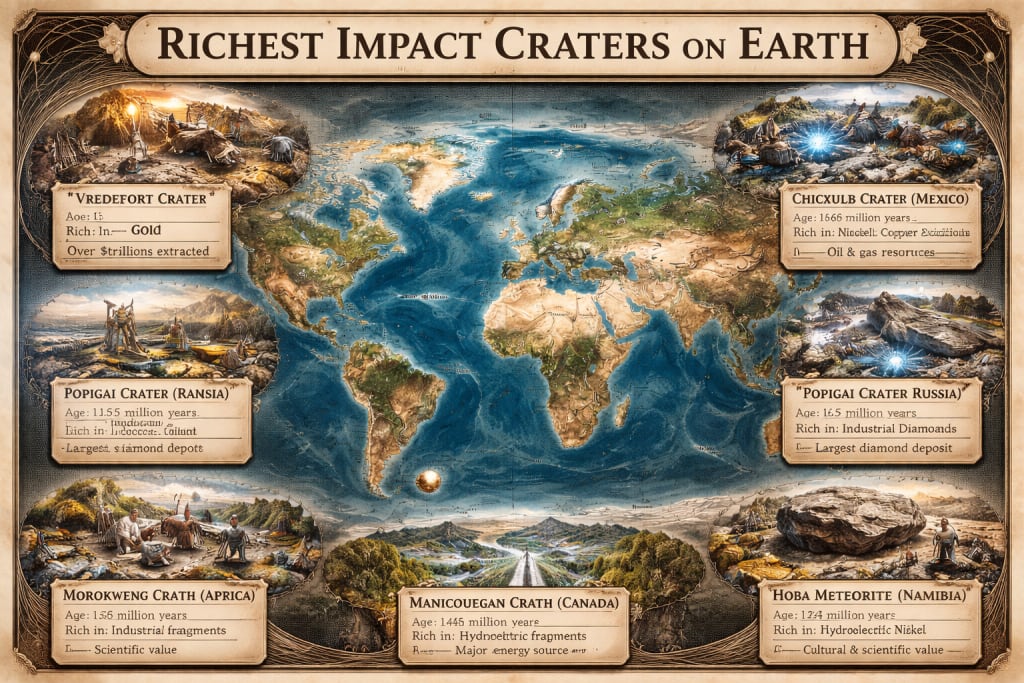
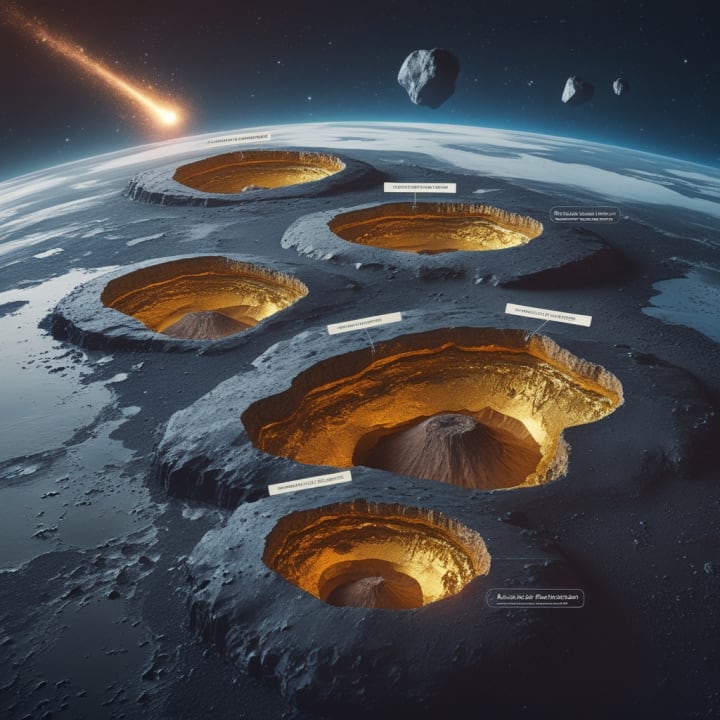
1. Vredefort Crater – South Africa
The Creator
The Vredefort Crater was created about 2 billion years ago by an asteroid estimated to be 10–15 kilometers wide. The collision released energy greater than billions of nuclear bombs.
Crater Formation
The impact fractured Earth’s crust deeply, causing extreme heat and pressure. This event altered rock layers across a vast region, redistributing minerals and creating pathways for gold-rich fluids.
Economic Importance
The crater is closely linked to the Witwatersrand Basin, the richest gold-producing region in human history.
Over 30% of all gold ever mined comes from this area
Estimated total gold value: trillions of dollars
While the asteroid did not directly “bring” gold, it played a major role in concentrating and preserving gold deposits, making Vredefort the most economically significant impact crater on Earth.
2. Sudbury Basin – Canada
The Creator
The Sudbury Basin was formed around 1.85 billion years ago by a massive asteroid impact. The asteroid is estimated to have been 10 km or larger.
Crater Formation
The impact melted vast quantities of rock, forming a magma sheet rich in metals. As the molten material cooled, heavy metals settled into concentrated layers.
Economic Importance
Sudbury is one of the world’s richest mining regions, containing:
Nickel
Copper
Platinum-group metals
The metals extracted from Sudbury have been essential for:
Stainless steel
Electronics
Aerospace industries
Estimated economic value of Sudbury’s metals exceeds hundreds of billions of dollars, with reserves still remaining underground.
3. Chicxulub Crater – Mexico
The Creator
The Chicxulub Crater was created 66 million years ago by an asteroid approximately 10–12 km wide.
Crater Formation
This impact caused:
Massive earthquakes
Global firestorms
A “nuclear winter” effect
It is famously linked to the extinction of the dinosaurs.
Economic and Geological Importance
Although not a major mining region, Chicxulub’s value lies in:
Scientific knowledge
Oil and gas trapping structures
Understanding mass extinctions
The crater helped form geological conditions that trap hydrocarbons in the Gulf of Mexico, indirectly contributing to billions of dollars in energy resources.
4. Popigai Crater – Russia
The Creator
Popigai Crater formed 35 million years ago in Siberia after a massive asteroid impact.
Crater Formation
The impact generated extreme pressure, transforming carbon into impact diamonds.
Economic Importance
Popigai is believed to contain the largest diamond deposit on Earth, far exceeding traditional diamond mines.
These diamonds are mostly industrial-grade
Extremely hard and valuable for cutting and drilling
If fully exploited, Popigai’s diamond resources could be worth hundreds of billions of dollars, though mining challenges and environmental concerns limit extraction.
5. Morokweng Crater – South Africa
The Creator
The Morokweng Crater was created around 145 million years ago by a large asteroid impact.
Crater Formation
The impact buried the crater deeply under sediments, preserving fragments of the asteroid itself.
Economic Importance
While not a major mining site, Morokweng is scientifically important because asteroid fragments were found embedded in Earth’s crust. These fragments help scientists understand asteroid composition and early solar system materials.
Its value is primarily scientific rather than commercial.
6. Manicouagan Crater – Canada
The Creator
Manicouagan Crater formed 214 million years ago after a massive asteroid strike.
Crater Formation
The impact created a large ring-shaped structure still visible today, often called the “Eye of Quebec.”
Economic and Environmental Value
Though not a major metal source, the crater hosts:
Hydroelectric power stations
Freshwater resources
The hydroelectric value generated over decades contributes billions of dollars in renewable energy.
7. Hoba Meteorite Site – Namibia (Honorable Mention)
The Creator
Unlike craters, the Hoba meteorite is a massive iron meteorite that landed intact around 80,000 years ago.
Economic Value
Contains iron and nickel
Estimated metal value: millions of dollars
However, its scientific and cultural value far exceeds its raw metal worth.
Why Impact Craters Become Wealth Centers
Asteroid impacts create wealth because they:
Fracture deep rock layers
Concentrate metals
Create heat-driven mineral flows
Preserve ancient deposits
Without these events, many of Earth’s richest mineral zones would not exist or would be inaccessible.
Estimated Combined Wealth of Impact Craters

When combining:
Gold from Vredefort
Metals from Sudbury
Diamonds from Popigai
Energy resources linked to Chicxulub
The total economic value influenced by asteroid-created craters reaches tens of trillions of dollars over human history.
Conclusion
Asteroids are not just agents of destruction—they are also creators of geological wealth. The craters they formed reshaped Earth’s crust, concentrated precious resources, and laid the foundation for some of humanity’s greatest mining regions. From gold in South Africa to nickel in Canada and diamonds in Siberia, asteroid impacts have silently supported global civilization for billions of years.
In this sense, much of Earth’s wealth has cosmic origins, delivered not by human effort, but by the violent and transformative forces of the universe itself.
About the Creator
Say the truth
"Say the Truth: Explain Everything in the World" is your trusted source for uncovering facts and exploring the wonders of history, science, technology, and beyond. We simplify complex ideas and reveal truths to inspire curiosity .
Keep reading
More stories from Say the truth and writers in Earth and other communities.
How Wind Energy Works: A Closer Look with Stanislav Kondrashov
As the world pushes further into the 21st century, the demand for sustainable and clean sources of energy has never been greater. At the heart of this shift is wind energy—a technology as old as the first sailboat, yet as modern as the towering turbines dotting coastlines and countrysides. Stanislav Kondrashov, an independent energy researcher and commentator, has long studied the mechanics and potential of wind power. His insights help demystify what’s often seen as a complex system driven by forces we can’t see.
By Stanislav Kondrashov 3 days ago in Earth
Amazon sailfin catfish found in Sindh waters, experts warn of invasive spread
Foreign aquarium species reaches Karachi Fish Harbour, threatening aquatic biodiversity KARACHI: An unusual fish brought from a dhund, or shallow pond, near Sukkur to the Karachi Fish Harbour on January 4, 2026, has been identified as an Amazon sailfin catfish, officials and experts said.
By Dena Falken Esq5 days ago in Earth



Comments
There are no comments for this story
Be the first to respond and start the conversation.