
The Price of Tradition
When routine turns deadly, and no one dares to question why

The village of Eldergrove was quiet, tucked between rolling hills and misty woods, seemingly untouched by time. Its people were kind, its streets clean, and its homes tidy. Outsiders who stumbled upon it would often say it felt like walking into a storybook. But what they didn’t know was that Eldergrove kept a secret, one hidden behind every smile, every handshake, and every warm loaf of bread passed over a neighbor’s fence.
Every year, on the first day of spring, the village gathered in the square for the Choosing. No one dared speak ill of it. It had always been done, long before the grandparents of the eldest villagers were even born. “It keeps the balance,” they’d say. “It ensures the land stays fertile, the harvests strong, and the sickness away.”
Children were told it was a celebration of nature’s return. They wore flower crowns and danced around maypoles while the adults set up a single wooden box on a pedestal in the center of the square.
The box was old, made of dark oak, its surface worn smooth by decades of hands placing slips of paper inside. No one knew who first built it, nor who started the tradition. But each spring, every adult over the age of eighteen drew a slip.
And one of those slips had a black mark.
Elena Hayes had just turned eighteen.
Her mother had braided her hair with violets that morning, her hands trembling as they worked. Her father gave her a tight hug, longer than usual, before leaving for the square.
She didn’t understand their silence.
“Why are you so nervous?” she asked, frowning.
Her mother glanced at her father, then forced a smile. “You’ll understand when you're older.”
“But I’m of age now,” Elena pressed. “Why won’t anyone tell me what this really is?”
Her father took her hands. “Elena, just draw your paper, and don’t ask questions.”
The square was crowded. The black box sat in its place, guarded by the Council. Every villager filed past, dipping a hand in and retrieving a single slip. No peeking, no trading. When everyone had drawn, the mayor stepped up.
“You may open your slips.”
A rustle of paper filled the air like the sound of dry leaves scattering.
Then silence.
And then, a scream.
Elena’s breath caught in her throat as the crowd parted to reveal Marcus Tye — a middle-aged carpenter — staring at the black mark on his slip. Tears streamed down his face, but he said nothing as the Council stepped forward.
He knew the rules.
They escorted him to the forest’s edge where a stone altar lay hidden beneath ivy and moss. Elena had always thought it was a monument, something symbolic. Now she saw its true purpose.
Marcus was tied down. An ancient blade was brought forward.
The villagers watched.
And no one stopped it.
Elena couldn’t sleep that night. The image of Marcus’s pleading eyes haunted her. The worst part wasn’t the death — it was the calm acceptance. The way everyone believed his sacrifice kept their lives safe.
The next morning, she stormed into her parents’ kitchen.
“You knew. You all knew. And you do nothing. You just let it happen?”
Her father didn’t raise his eyes. “We have no choice.”
“There’s always a choice,” she snapped. “What proof do you even have that this works? That it’s not just murder dressed as tradition?”
Her mother’s voice was hollow. “Because the year someone refused, the crops failed. A plague took the children. That year... it was chaos. We’ve never disobeyed again.”
Elena’s chest heaved. “Maybe it wasn’t the refusal. Maybe it was just a bad year. You’re killing people for a pattern you don't even understand!”
But no one would listen.
That spring, Elena took a stand.
She walked to the square with an empty box of her own — white and clean.
“This ends now,” she said, her voice ringing through the square. “Draw from this instead. No black mark. No death.”
People murmured. The mayor frowned. The Council whispered.
And then a voice rose: “We’ve done this for generations, girl. Who are you to question the old ways?”
“I’m someone who doesn’t want blood on my hands.”
The villagers looked at one another, unsure. Then slowly, one by one, a few brave souls stepped forward and took slips from Elena’s box.
They read them.
Blank.
No one screamed.
No one died.
The mayor’s face turned pale. “If something happens this year, it’ll be on your head.”
Elena met his eyes. “Then let it.”
Months passed.
The crops grew — even better than before. The rains came on time. No sickness spread. And for the first time in memory, there were no tears in spring.
People whispered Elena’s name with a mix of awe and guilt.
Tradition had not saved them. It had only blinded them.
Years later, the black box remained in the village museum — sealed, unused, a reminder of how fear can masquerade as faith.
And how courage can break any chain, even the ones forged in silence.
Moral of the Story:
"Blindly following tradition without questioning its purpose can lead to senseless harm. True courage lies in standing up against fear-driven customs and seeking truth, even when it means standing alone."
About the Creator
Keep reading
More stories from Muhammad Ibrar and writers in Earth and other communities.
Whispers Between Pages
In the quiet town of Everbrook, tucked between cobblestone streets and ivy-clad buildings, stood a forgotten little library — Wren’s Library. It smelled of old paper, coffee stains, and memories. Few visited now. The world outside had gotten faster, louder. But inside, the books still breathed, and the past whispered through the cracks in the wooden shelves.
By Muhammad Ibrar9 months ago in Fiction
We Outpaced the Soil
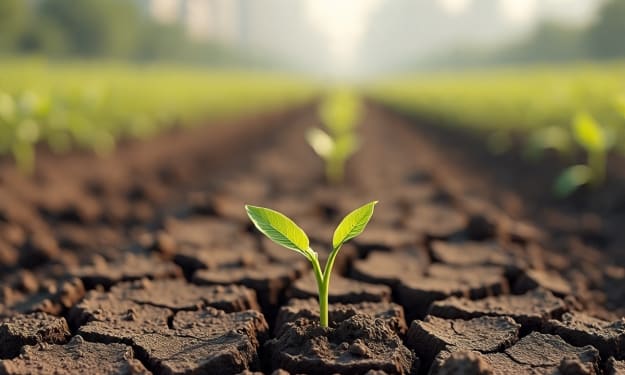
We learned how to move faster than the ground beneath us. At first, it felt like progress. Roads unrolled like promises, machines hummed with the confidence of certainty, and cities rose as if the earth itself had agreed to carry our weight. We measured time in minutes saved, distances conquered, yields multiplied. We learned to outpace the seasons, to outsmart rain, to hurry seeds into obedience. We learned to treat the soil like a resource instead of a relationship.
By Jhon smith3 days ago in Earth



Comments
There are no comments for this story
Be the first to respond and start the conversation.