
We Outpaced the Soil
A meditation on progress, patience, and the quiet cost of forgetting how to belong to the earth
We learned how to move faster than the ground beneath us.
At first, it felt like progress. Roads unrolled like promises, machines hummed with the confidence of certainty, and cities rose as if the earth itself had agreed to carry our weight. We measured time in minutes saved, distances conquered, yields multiplied. We learned to outpace the seasons, to outsmart rain, to hurry seeds into obedience. We learned to treat the soil like a resource instead of a relationship.
The soil never complained. It rarely does.
My grandfather used to kneel before planting. Not in prayer exactly, but in patience. He pressed the earth between his fingers, rubbed it like a secret, smelled it before he trusted it. “Good dirt talks,” he once said, “but only if you listen long enough.” I didn’t understand then. I thought listening was inefficient. I thought speed was proof of intelligence.
So we sped up.
We replaced hands with levers, levers with engines, engines with algorithms. We stopped asking the land what it needed and started telling it what to produce. Corn where forests had stood. Concrete where roots once braided stories underground. We paved over memory and called it development. The faster we moved, the quieter the soil became.
Still, it held us.
The irony is that we mistook silence for consent.
Fields turned brittle. Rivers forgot their curves. The soil thinned like an old book handled too roughly, its pages tearing one by one. We responded the only way we knew how—by accelerating. More fertilizer, more extraction, more urgency. When the ground tired, we blamed the weather. When harvests failed, we blamed the seed. We rarely blamed ourselves.
We outpaced the soil, but we didn’t escape it.
Because everything we build eventually circles back down. The dust in our lungs, the cracks in our foundations, the food that no longer nourishes the way it once did. The earth keeps receipts. It remembers every shortcut.
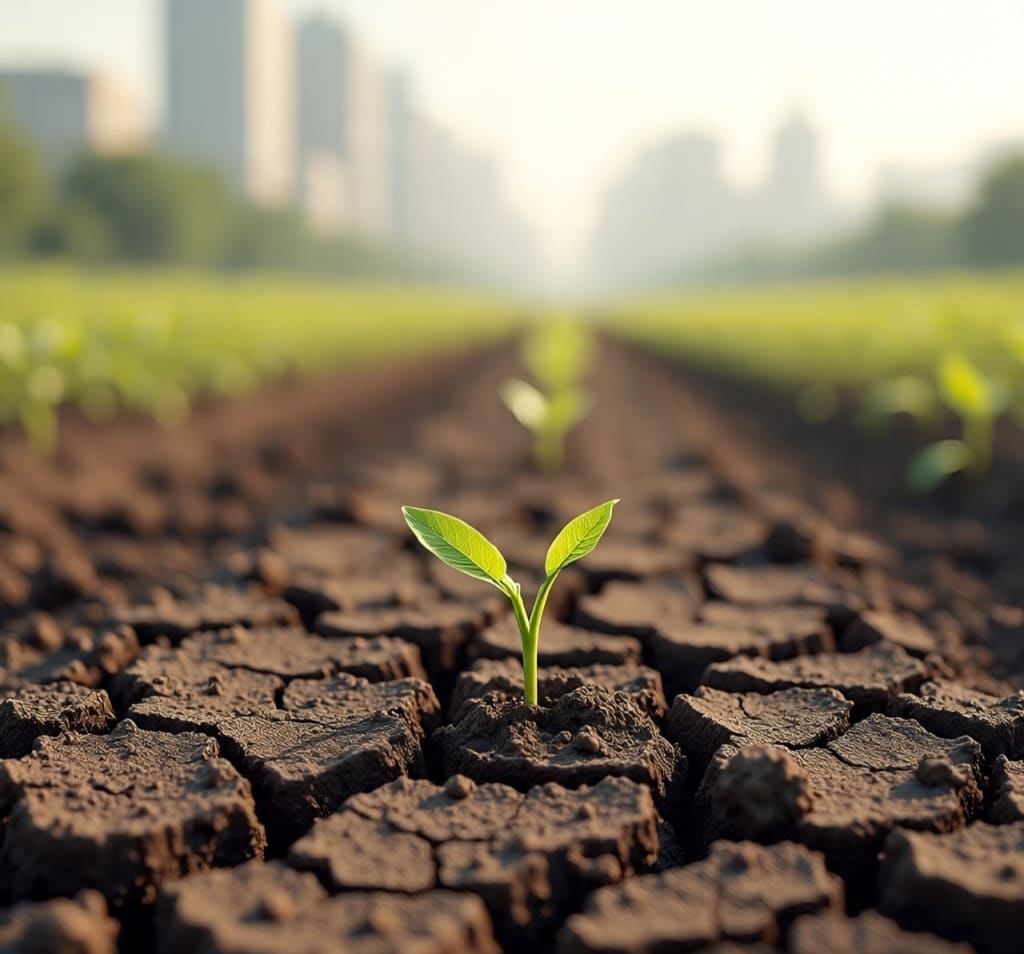
There was a year the rain didn’t come when it should have. The ground split open like a mouth that had been waiting too long to speak. I walked through a field that had once been generous, now sharp with stubble and regret. The silence felt heavier than noise. It wasn’t anger I felt from the land—it was exhaustion.
That’s when it struck me: the soil wasn’t failing us. It was mirroring us.
We had grown thin too. Emotionally eroded. Spiritually compacted. Always moving, rarely resting. Always extracting, rarely replenishing. We treated our own bodies the way we treated the land—fuel in, output out, no time for recovery. Burnout, like erosion, happens slowly enough to be ignored and suddenly enough to feel inevitable.
The soil teaches a different rhythm. It knows that nothing grows endlessly without pause. That decay is not failure but preparation. That rest is not laziness but strategy. We forgot these lessons because they took time. And time, we decided, was expensive.
But what has been more costly than forgetting how to belong?
There are people relearning how to listen. Farmers who plant cover crops not for profit, but for promise. Communities tearing up pavement to let gardens breathe again. Children with dirt under their nails, asking questions that don’t have quarterly returns. These acts are small. That’s the point. Soil work always is.
You can’t rush reconciliation.
If we slow down long enough, the ground begins to answer. Not in speeches, but in signs—worms returning, water soaking instead of running away, food that tastes like memory. The soil doesn’t demand perfection. It asks for patience. For humility. For hands willing to get dirty again.
We outpaced the soil, yes. But speed is reversible.
We can choose to walk. To kneel. To listen.
Because the earth has never asked us to be faster than it.
Only faithful.
About the Creator
Jhon smith
Welcome to my little corner of the internet, where words come alive
Keep reading
More stories from Jhon smith and writers in Earth and other communities.
We Are Our Ancestry
I grew up in a house filled with stories. Not the kind written on pages, but those whispered over dinner tables, hummed in lullabies, and carried in the creak of the old wooden floors. My grandmother would sit by the window, staring out at the trees, and begin in a soft voice: “Your great-grandfather once walked these lands, barefoot, with nothing but hope in his pocket.” I didn’t understand the weight of that hope then. I only knew it sounded important.
By Jhon smitha day ago in Writers
Things you don't know about Africa
Africa: What You Probably Didn’t Know Article No. 1671 Tuesday, 25 February 2020 By Wardah Baloch In terms of land area, Africa is the second-largest continent in the world. It covers nearly 22 percent of the world’s total landmass and about 6 percent of the Earth’s total surface area. Only Asia is larger than Africa in size.
By Sudais Zakwan5 days ago in Earth
USA vs Iran: A Military Mismatch in 2026
Comparing the U.S. and Iranian militaries is not about who would win a fair fight. It's about understanding two completely different ways of thinking about war. By 2026, the gap between their traditional strength will be wider than ever. The U.S. is a global superpower built to fight and win anywhere. Iran is a regional survivor, built to make an invasion so painful that no one would ever try.
By LegacyWords2 days ago in Earth



Comments
There are no comments for this story
Be the first to respond and start the conversation.