
The Own Nature's Force
Understanding and Surviving Dust Storms

Dust storms are a result of strong winds carrying loose sand particles in desert regions. They can cause damage to structures and cover outdoor items. Dust and sandstorms can have a significant impact on environments and ecosystems, leading to visibility issues, transportation disruptions, and harm to animals and plant life. Implementing preventative measures such as agricultural solutions, protective gear, and land preparation can help reduce the impact of dust storms. Lightning is an electrostatic discharge of energy that occurs when electrically charged regions equalize between the atmosphere and the ground. There are various types of lightning, including intra-cloud, cloud-to-cloud, and ground-to-cloud. Lightning can cause fire and injuries, but most people survive being struck by lightning.
Man-made structures like lightning rods help prevent dangerous accidents and are used to study lightning phenomena. Lightning also plays a role in the nitrogen cycle by releasing nitrates into the air, contributing to the growth of plants and organisms. Rain is the most common type of precipitation, released from clouds due to the water cycle and the process of evaporation and condensation. El Nino is a warm phase of the El Nino Southern Oscillation, characterized by warm ocean water in the Central and Eastern Pacific, accompanied by high air pressure in the west and low air pressure in the east, affecting nearby areas and regions. The term El Nino originates from the Spanish phrase for newborn Christ, alluding to Christmas. Its impacts encompass severe storms, intense droughts, and irregular weather patterns in different regions. El Nino affects weather conditions, ecosystems, and human health. It results in droughts, decreased rainfall, and alterations in fish migration patterns. Furthermore, it harms coral reefs, and sea habitats, and poses a threat to commercial fishing. Heat waves are defined differently across regions. The World Meteorological Organization characterizes heat waves as five or more consecutive days of temperatures 5°C higher than average.
In the US, it typically involves at least two days with temperatures exceeding 90°F. Australia's definition includes 5 consecutive days above 35°C or 95°F. Excessive heat can cause physical damage to roads and railways. Roads may melt, leading to asphalt damage, while railways can kink and buckle, elevating the risk of wildfires. Floods occur when water overflows onto land due to various factors, such as excessive precipitation from rain or melted snow. Human activities like construction and deforestation can also contribute to flooding. Mitigation strategies for floods are crucial. Prolonged flooding can result in infrastructure, building, road, and sewage system damage. It can also impact power and electricity supply, increasing the likelihood of waterborne diseases and drowning. Rainfall measurement plays a vital role in various sectors. Farmers depend on rainfall data for irrigation and crop management. Rainfall measurement is essential for water collection and weather prediction. Rainfall intensity classification and return period are important concepts to understand. Rainfall intensity is categorized based on precipitation rates, while the return period explains the frequency of rainfall events. Seasons are a result of the Earth's tilt and orbit. The Earth's axial tilt causes variations in light and heat exposure, resulting in warmer summers and cooler winters.
Additionally, the Earth's elliptical orbit leads to changes in distance from the Sun, impacting temperature fluctuations throughout the year. Autumn and winter bring about changes in nature and animal behavior, with plants shedding leaves and entering dormancy during autumn, and cold temperatures and snowfall occurring during winter. Water recycling and drought monitoring are essential for sustainable water use, while hurricane formation poses risks to various aspects of life, including shipping, property, health, and power supply. Mitigation measures such as forecasting, risk assessment, and preparedness are crucial for minimizing the impact of hurricanes. Thunderstorms can be destructive and require safety precautions due to hazards such as lightning, hail, tornadoes, flooding, and strong winds. Solar flares release immense energy and particles, affecting Earth's space weather and posing risks to spacecraft and astronauts.
Finally, rainbows are formed by sunlight refracted and dispersed by water droplets. Rainbows are formed by the refraction of light through water droplets and can also be seen near bodies of moving water such as waterfalls and geysers. The circular formation of rainbows is influenced by the viewer's angle, and they can be formed by various sources including geyser droplets. Hail is a type of solid precipitation characterized by irregular ice lumps, which form under specific conditions. Global warming refers to the increasing temperature of the earth's climate due to human activities and is caused by the greenhouse effect where CO2 traps heat in the Earth's atmosphere. The excessive production of CO2 from burning fossil fuels has led to a rise in temperature since the Industrial Revolution, impacting Earth's weather and causing phenomena such as rising sea levels, stronger storms, longer dry seasons, and flooding. Efforts to combat climate change include reducing carbon emissions and using alternative fuels. Weather prediction may not always be accurate due to its chaotic nature, with factors such as wind speed and temperature changes influencing accuracy.
Despite these challenges, weather forecasting remains highly valuable and beneficial. Typhoon Hayen caused widespread devastation and left millions homeless after making landfall in the Philippines and then Vietnam, causing damages estimated at $5.8 billion. The typhoon left as many as 6 million people without income and led to agricultural damage and environmental impact. Stay safe, dry, and warm until the next episode of Nature's Force.
About the Creator
Isaac Ekow Anyidoho
A calm person with a cascading mind filled with ideas of my own and know that; I can make a difference with the support of people like you. Thank you.
Keep reading
More stories from Isaac Ekow Anyidoho and writers in Earth and other communities.
History of the Black Death
The Bubonic plague, also known as the Black Death, had a profound impact on a global scale. It was the result of a combination of societal, environmental, and political factors that allowed for its rapid spread. The exact origins of the Black Death remain uncertain, but theories suggest that it may have originated in regions of Eurasia and the Gobi Desert. The expansion of trade, particularly due to the Pax Mongolica and the flourishing Silk Roads, played a significant role in the spread of the disease. The city of Kapha, strategically located for commerce, transformed into a bustling trade hub. The siege of the Genoese city of Tana by the Tartar Army and their Khan had unforeseen consequences, as the Genoese resistance led to the rapid overrun of their city. Reports of a strange disease began to spread westward, affecting regions in China and India before reaching the Genoese encampment. The Tartar Army's gruesome strategy, including catapulting decaying corpses into Genoa, facilitated the spread of the plague through rats and fleas. The Black rat, or Rattus rattus, which evolved in Asia, played a major role in transmitting the plague. The Bubonic plague is caused by the bacterium Yersinia pestis, which aggressively reproduces and invades the organs and lymphatic system once inside the human host.
By Isaac Ekow Anyidoho2 years ago in Earth
The Canals of Phoenix: How Waterways Made Life Possible in the Desert
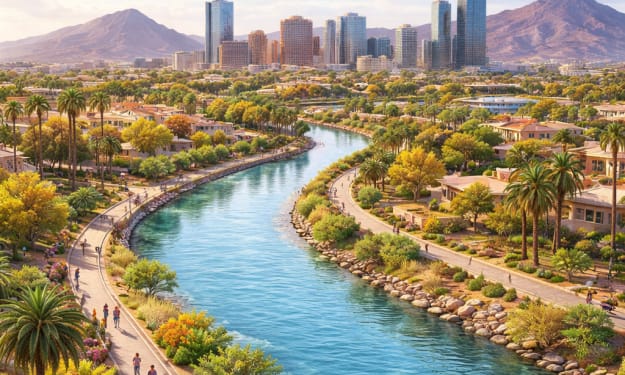
In the heart of the Sonoran Desert, where summer temperatures regularly climb above 110°F (43°C), the existence of a sprawling metropolitan city like Phoenix, Arizona, may seem almost impossible. Yet Phoenix thrives, home to millions of residents, vast suburbs, and a growing economy. The secret behind this unlikely success lies in a remarkable system of canals that carry life-giving water across the desert landscape.
By Irshad Abbasi about 14 hours ago in Earth



Comments
There are no comments for this story
Be the first to respond and start the conversation.