
The Outcome of Attaching One’s Heart to This World
The True Cost of Attaching Your Heart to the World


There is an undeniable truth that runs through every human experience: the world is temporary, fleeting, and ever-changing. "This is often the outcome of becoming attached to this world," captures this profound reality in a deeply poetic and spiritual way. It serves as a quiet warning — a gentle yet powerful reminder that attaching one’s heart too closely to the material world often leads to pain, disappointment, and disillusionment.
When we reflect on our lives, we notice how much time and energy we invest in worldly pursuits — wealth, status, relationships, possessions, beauty, and control. These things are not inherently bad; in fact, many are blessings and necessities. However, the issue arises when we allow our hearts to become overly attached to them — when we begin to see them not as temporary resources or tests, but as the very purpose of our existence.
The world, by its nature, is transient. Everything in it is bound to change, decay, or eventually come to an end. People grow distant. Wealth can disappear overnight. Health can fail. The most beautiful moments become memories, and time never stops moving forward. So when we attach our sense of identity, worth, or happiness to these impermanent things, we set ourselves up for heartbreak. We chase perfection in an imperfect world, and when reality fails to meet our expectations, we are left hurt, confused, and spiritually restless.
This is the result that the sentence speaks of — the silent sorrow that comes from loving a world that was never meant to be our final home. It is a sorrow born not from the things themselves, but from our illusion that they could give us lasting peace. The world can offer comfort, but not eternal contentment; pleasure, but not true purpose; connection, but not permanence.
Spiritual traditions, especially in Islam, emphasize this repeatedly. The Qur'an reminds us that this world is nothing but a temporary enjoyment — a deception for those who forget the hereafter. Prophet Muhammad (peace be upon him) advised his followers to live as if they were travelers in this world, never becoming too comfortable, and never losing sight of their true destination. These teachings don’t advocate abandonment of the world, but rather a healthy detachment — a heart that remains anchored in the Eternal while still navigating the temporary.
This detachment doesn’t mean we stop loving people, working hard, or enjoying life. Rather, it means we love with awareness — that everything and everyone we love is a gift, not a guarantee. We work with excellence, knowing that success is from God and that our efforts are means, not ends. We enjoy life’s moments, but we don’t let them define our existence. This shift in mindset allows us to live more freely, love more purely, and grieve with perspective.
Interestingly, this realization often comes not at the height of success, but during times of loss and hardship. When something we deeply cherished is taken away, we begin to understand the reality of the world. The pain itself becomes a teacher, showing us the limits of worldly attachment and inviting us to turn inward — toward the One who never leaves, never changes, and never disappoints.
Attaching our hearts to God, to truth, to meaning beyond the material, gives us a foundation that nothing in this world can shake. It gives us peace in uncertainty, hope in despair, and purpose even in pain. It transforms suffering into growth, and loss into closeness with the Divine.
So yes, the sentence rings true: “This is often the outcome of becoming attached to this world.” But within this truth lies a gentle invitation — to rise above worldly attachments and seek something greater. Not to reject the world, but to use it as a means, not an end. To walk through it with love, gratitude, and purpose, but to remember that our hearts belong to something — and Someone — far beyond its reach.
About the Creator
Israr khan
I write to bring attention to the voices and faces of the missing, the unheard, and the forgotten. , — raising awareness, sparking hope, and keeping the search alive. Every person has a story. Every story deserves to be told.
Keep reading
More stories from Israr khan and writers in Earth and other communities.
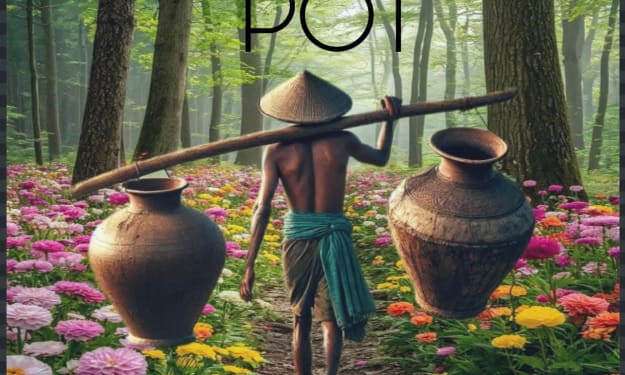
🌿 The Cracked Pot: A Story of Hidden Strength and Beauty 🌿
Once upon a time, in a quiet village nestled among rolling hills, there lived a humble water bearer. Every day, without fail, he carried two large pots on a wooden pole across his shoulders. His daily journey took him down to the river, where he filled both pots to the brim with fresh, clear water, and then back up the long, winding path to his master’s house.
By Israr khan7 months ago in Earth
A $170 Million Gemstone Discovery Shocks Myanmar’s Mining World
Myanmar, a country long known for its rich natural resources, has once again captured global attention after the discovery of an extraordinary gemstone estimated to be worth around $170 million. The remarkable find has stunned geologists, gem traders, and mining experts, reaffirming Myanmar’s reputation as one of the world’s most important sources of precious stones.
By Irshad Abbasi 6 days ago in Earth
Top tipple tricks
Been thinking a lot about drinking, lately. Not least because of a recent episode of over-indulgence and the inevitable after effects. Some readers may recall the earlier articles I wrote about beating the booze. Here I set out an experiment in techniques for cutting down on my alcohol intake. The experiment was successful, the techniques worked, and I have armed myself with an arsenal of weapons in the war against the demon drink. I have yet to fire the first round however. It's all a question of timing (perhaps procrastination).
By Raymond G. Taylor7 days ago in Psyche



Comments (1)
Love your description , a great use of words. Thankyou for sharing