

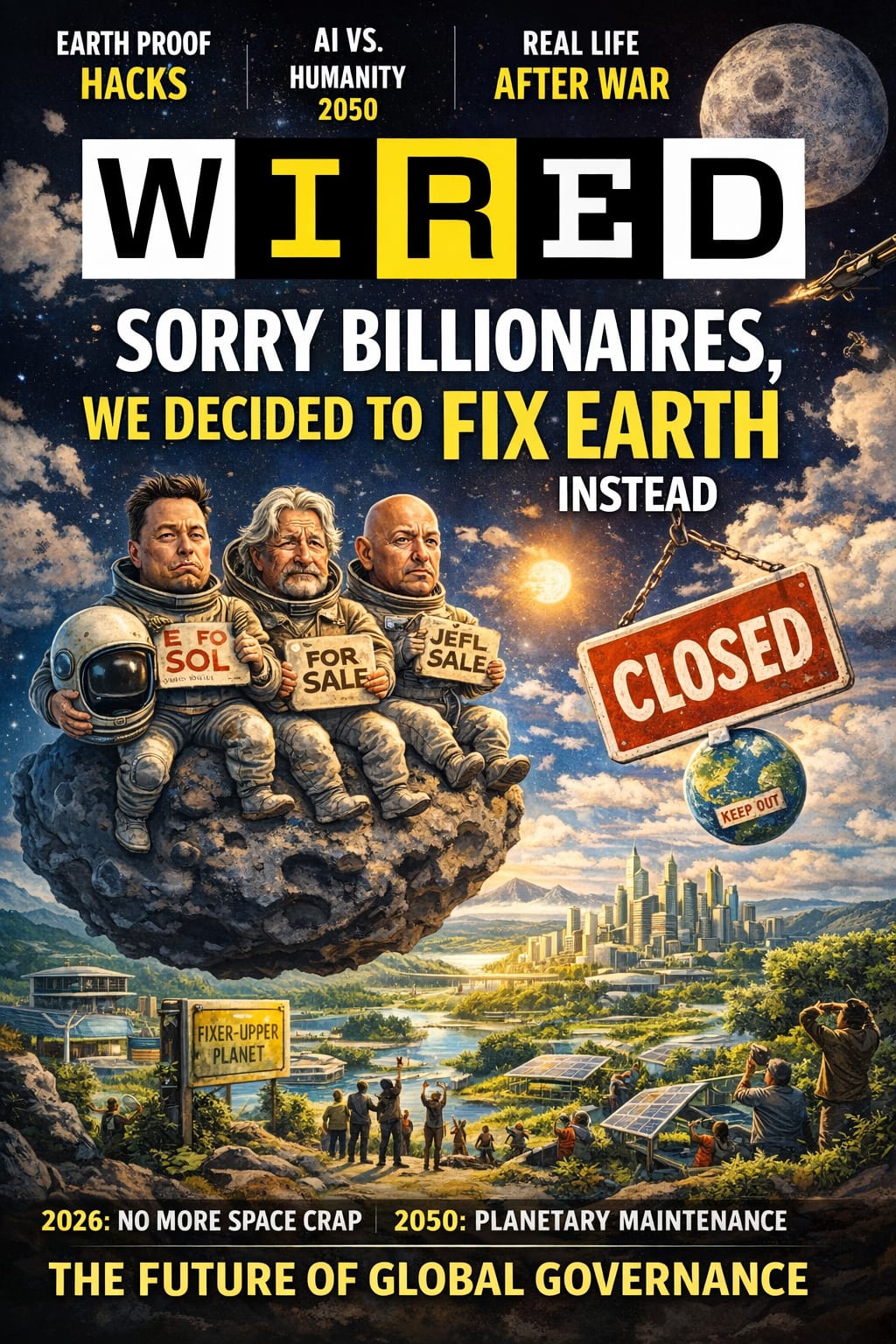
(This essay transforms the fragmented material into a single philosophical, future-oriented but non-naive vision. It treats humanity’s problems as one problem: governance understood as the art of living together over time, under shared responsibility, memory, and judgement. It avoids utopian innocence, and stages the solution historically: 2026, 2050, 2075, 2100.)
---
The One Problem: Living Together on a Finite Planet
All human problems reduce to one: how large groups of strangers live together in the same space, for a long time, with responsibility for their actions and with a memory that does not disappear when power changes hands. This is what has traditionally been called governance, but governance misunderstood as domination, coercion, or administration has repeatedly failed. The real problem is not evil, scarcity, or technology. It is coordination under conditions of scale, time, and consequence.
Humanity is no longer a collection of local societies separated by distance and ignorance. It is a single, tightly coupled system with shared risks, shared atmosphere, shared technologies, and shared futures. War, ecological collapse, mass alienation, and technological misuse are not separate crises; they are symptoms of outdated coordination mechanisms operating at planetary scale. The twenty-first century does not suffer from a lack of intelligence or resources, but from obsolete forms of collective decision-making.
The question is no longer whether humanity can solve its problems. The question is whether it can redesign how it governs itself before its inherited systems collapse under their own weight.
2026: The First Suspension
Imagine that in 2026 humanity performs a radical but temporary experiment. All wars stop. All arms production stops. Not forever, not as a moral miracle, but as a one-year suspension agreed upon by exhausted states, terrified markets, and increasingly ungovernable societies. This is not pacifism; it is accounting.
In one year, humanity saves roughly 2.7 trillion dollars in direct military expenditure. For the average human being, this is not an abstract number but the equivalent of several hundred dollars reclaimed from taxes that were previously converted into destruction. Energy consumption drops sharply. Military fuel use, logistics, and production chains slow. Carbon emissions fall measurably, not because individuals recycled better, but because the most energy-intensive institution in human history paused.
What matters most, however, is not money or emissions. What matters is precedent. For the first time, humanity demonstrates that war is not a natural law but an organisational choice. The suspension reveals something deeply destabilising to old power structures: violence is not inevitable, only profitable.
This single year does not end conflict. But it changes the grammar of politics. From this point forward, war must justify itself not as destiny, but as failure.
2050: Governance as Infrastructure
By 2050, the central insight of the suspension has matured: governance is infrastructure, not ideology. Just as roads, electricity, and sanitation had to be engineered for industrial societies, coordination, trust, and accountability must be engineered for planetary societies.
Global governance does not replace states, cultures, or traditions. It replaces opacity. Decisions that affect billions must leave traces. Collective memory becomes institutional rather than symbolic. Actions are recorded not to punish endlessly, but to prevent strategic amnesia.
Technology plays a role, but not as salvation. Artificial intelligence is not ruler or oracle; it is accountant, archivist, and referee. Its function is to remove informational asymmetries that historically allowed elites to externalise costs and privatise gains. Corruption becomes harder not because humans become better, but because systems become less forgetful.
Economically, the redirection of resources away from permanent militarisation produces a slow but compounding effect. Health, education, and ecological repair cease to be “social spending” and become stability investments. Poverty declines not through charity, but through predictable floors that prevent human potential from collapsing into survival mode.
The most important change by 2050 is psychological. The belief that order requires violence begins to erode. Governance is no longer imagined as force imposed from above, but as maintenance performed continuously.
2075: The Crisis After Success
By 2075, most traditional problems of governance are technically solved. Extreme poverty is rare. Large-scale war is obsolete, not because humans became angels, but because it became economically irrational and politically traceable. Energy systems are cleaner, slower, more circular. Products last longer. Cities resemble ecosystems more than machines.
And yet a new crisis appears, more subtle and more dangerous: the crisis of meaning after survival.
For millennia, human identity was forged against scarcity, enemies, and struggle. When those pressures recede, boredom, status anxiety, and existential drift emerge. Inequality no longer concentrates around money but around recognition, reputation, and symbolic power. Social conflict does not disappear; it mutates.
This is the moment where naive utopias fail. A society that guarantees survival but neglects purpose collapses inward. Governance must therefore evolve again, this time from distribution to orientation.
By 2075, education is no longer primarily vocational. It becomes civilisational. Humans are trained not only to work, but to contribute meaningfully to shared worlds: art, science, care, philosophy, and stewardship. Maintenance becomes a high-status activity. Caring for systems, ecosystems, and institutions replaces conquest as the primary source of prestige.
Justice also changes character. Perfect enforcement is rejected as inhuman. Memory exists, but so does forgiveness. Governance learns restraint, recognising that total optimisation produces brittle societies incapable of renewal.
2100: The End of Old Governance
By 2100, the old problems of governance are solved not because conflict vanished, but because humanity learned to absorb conflict without self-destruction. War, as organised mass killing between states, belongs to history. Not because it was banned, but because it became as irrational as burning libraries for heat.
Humanity understands itself as a single historical subject with internal plurality. Collective judgement exists, but it is slow, procedural, and accountable. Decisions are reversible. Errors are admitted. Power no longer depends on pretending infallibility.
New problems emerge, as they always will: demographic imbalances, cognitive enhancement debates, cultural fragmentation, the tension between stability and experimentation. But these are second-order problems. They occur within a system capable of remembering, correcting, and adapting.
The final lesson is neither moral nor technological. It is structural. Humanity did not need salvation, revolution, or transcendence. It needed governance adequate to its scale.
Living together was never impossible. It was simply attempted with tools designed for a smaller, poorer, forgetful world. Once those tools were replaced, not with perfection but with responsibility, the rest followed.
The future did not arrive as paradise. It arrived as maintenance.
About the Creator
Peter Ayolov
Peter Ayolov’s key contribution to media theory is the development of the "Propaganda 2.0" or the "manufacture of dissent" model, which he details in his 2024 book, The Economic Policy of Online Media: Manufacture of Dissent.
Keep reading
More stories from Peter Ayolov and writers in Earth and other communities.
The Obsolete Industry Dilemma
The Obsolete Industry Dilemma: What If the World Stopped Inertia-Production for One Year? Imagine not a technological breakthrough, not a green miracle, but a simple interruption. For one year, the world stops inertia-production: the endless manufacture of goods, services, movements, and institutions that persist not because they are needed, but because stopping them would expose how deeply human life has been reorganised around motion without purpose. This is not merely a pause in car production or construction or transport. It is a pause in the logic that turns people into components, societies into mechanisms, and the planet into an enormous clockwork Earth, rotating endlessly through repetition, habit, and systemic momentum.
By Peter Ayolov2 days ago in Humans
I Never Imagined This!’ How KPop Demon Hunters Could Make History at the Grammys and the Oscars
When KPop Demon Hunters was first announced, even its creators likely did not expect it to spark serious awards-season conversations. Blending high-energy K-pop music, supernatural action, animation, and global storytelling, the project initially seemed like a bold experiment aimed at younger audiences and niche fandoms. Today, however, it is being discussed as a potential history-maker—one that could break barriers at both the Grammys and the Academy Awards.
By Aarif Lashariabout 4 hours ago in Earth
Weather and Climate Understanding the Forces That Shape Our Daily Lives
Weather and Climate Understanding the Forces That Shape Our Daily Lives Weather and climate play a central role in how people live work travel and plan for the future. From daily temperature changes to long term climate patterns these natural systems influence agriculture health economies and even global stability. Understanding the difference between weather and climate and knowing how they affect human life has become more important than ever especially as the world experiences more extreme conditions.
By America today 7 days ago in Earth



Comments
There are no comments for this story
Be the first to respond and start the conversation.