
The oldest known stalagmite, which dates back 289 million years, was discovered in rocks in Oklahoma.
Are you able to distinguish between stalactites and stalagmites?

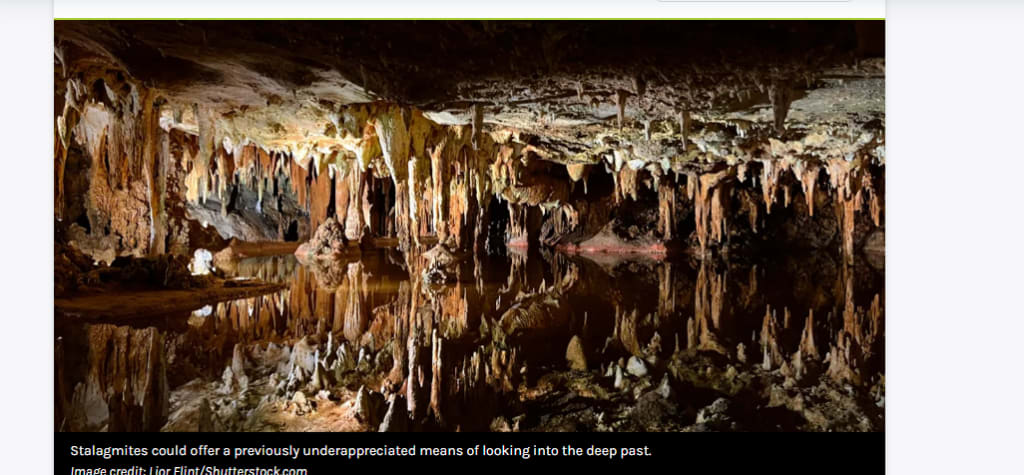
Did you know that troglobites are organisms that only inhabit caves? Although it's not the most attractive name in the world, it seems appropriate. evokes visions of damp, chilly, and shadowy spaces where unidentified liquids, some of which have been found to be the oldest water on Earth—and people drank it!—drip from the roof.
Although it may not sound appealing to a person who is afraid of fungal diseases, one benefit of cave conditions is that they encourage the development of massive structures that may be millions of years old. Yes, stalagmites are what I mean.
Comparing stalactite and stalagmite
A stalagmite is a type of cave formation that develops from the ground up as a result of drips falling on the cave floor. In contrast, a stalactite grows in the opposite direction and hangs from the ceiling like an icicle. To put it briefly, it's a stalactite if you could play hoopla with it and a stalagmite if you're afraid it would fall on your head and skewer you as in Final Destination.
They are both types of speleothems, which are structures created by mineral deposition in caves. They develop as water seeps from the earth above, collecting minerals as it passes through the rock. These minerals can then solidify when the water falls into underground caverns, creating massive, towering structures (or perfectly spherical balls; have you ever seen cave pearls?).
What is the maximum age of stalagmites?
Stalagmites have very slow growth rates. For only a few centimetres of growth, we're talking about thousands of years. As a result, they are frequently very, very old by the time they have grown considerably.
Some of the oldest stalagmites in the world are thought to be found in the Richards Spur, Oklahoma, fossil cave system. Because it was formerly filled with tar and petroleum, which prevented the fossils from decomposing, this limestone formation has produced some of the most varied and well-preserved Paleozoic fossils in the world.
As a result, it can boast of having the oldest amniote skin in the world and, guess what?, the oldest stalagmite ever discovered. A 2010 study that radiometrically dated a stalagmite and found it to be 289 million years old demonstrated the potential of stalagmites as deep-time climatic records. This makes it "by far the oldest speleothem to be directly dated by radiometric means," to use the scientists' own words.
As a result, it can boast of having the oldest amniote skin in the world and, guess what?, the oldest stalagmite ever discovered. A 2010 study that radiometrically dated a stalagmite and found it to be 289 million years old demonstrated the potential of stalagmites as deep-time climatic records. This makes it "by far the oldest speleothem to be directly dated by radiometric means," to use the scientists' own words.
Lehman Caves in Nevada are a great place to witness the oldest unbroken stalagmites because the dating was done on fragments discovered in rock rather than standing speleothems. Stalactites from 2.2 million years ago can be found in the state's longest cave system.
Even though it is shattered, the Richards Spur stalagmite is important because it shows that even though these speleothems are very weak, they can last for a very long time. In addition, it provides us with a new supply of data for studying past ecosystems, such as the variety of fossils discovered in Richards Spur.
In the context of the first absolute age and direct paleoclimate data for the Early Permian, one of the most important periods of vertebrate history, the samples we have begun to research here will enable us to re-examine the terrestrial vertebrate fauna at Richards Spur, the scientists stated. "It may be necessary to reevaluate currently accepted biostratigraphic ages for the majority of Early Permian fossil sites in Pangea, as this age is significantly older than traditional stratigraphic correlations would suggest."
"As we link the earliest phases of higher vertebrate evolution on land with precise age and climate determinations for the first time, our current perspectives on the timing and tempo of early reptilian and synapsid diversification are likely to change significantly."
About the Creator
Keep reading
More stories from Francis Dami and writers in Earth and other communities.
Europe Wheat Market Size and Forecast 2025–2033
Europe Wheat Market Overview The Europe Wheat Market is projected to grow from US$ 13.78 billion in 2024 to US$ 19.59 billion by 2033, expanding at a CAGR of 3.99% during 2025–2033, according to Renub Research. This steady growth is supported by rising food consumption, strong export demand, improved yields, government-backed agricultural policies, and the rapid adoption of modern farming technologies across the region.
By Aaina Oberoiabout 4 hours ago in Earth




Comments
There are no comments for this story
Be the first to respond and start the conversation.