
The Great American Eclipse of 2024 Caused Some Birds to Act Unexpectedly, But Not All Were Tricked
We finally have some information about how birds actually behave when the Moon blocks out the Sun thanks to an app and eager citizen scientists, after millennia of anecdotal stories.

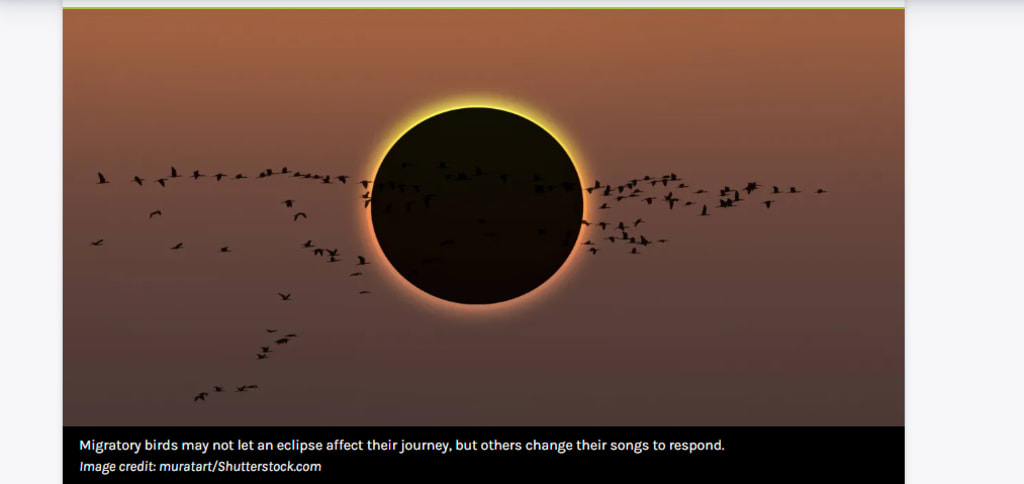
The 2024 total solar eclipse elicited a variety of responses from birds, as thousands of volunteers documented their behaviour.
Reports of animals reacting as though darkness had arrived early add to the enchantment of total solar eclipses for some people. Frogs started calling in 1932, and New England livestock were said to be making their way to their barns. As one frequent eclipse-chaser "The only animal I've seen responding oddly to an eclipse is humans." Other observers, however, contest this.
The "Great American Eclipse" in April 2024 was the ideal occasion for a group of scientists to gather extensive data in order to answer this question. After creating and distributing the app SolarBird, which describes how birds behaved during the eclipse, they received around 11,000 observations from 1,700 users. The app was used by people as far afield as California and Florida, but the majority were on the path of totality from mid-Mexico to eastern Canada.
In a statement, PhD candidate Liz Aguilar of Indiana University remarked, "Scientists can't be in a thousand places at once." The software circumvents this issue by using the general population as scientists. It also adds to the sky display by encouraging people to listen and glance around.
Users were instructed to locate a particular bird whose behaviour they could witness during totality and respond to ten checkbox questions concerning its actions. Along the eclipse's path, the authors also set up recording sites throughout Southern Indiana.
The eclipse was well-timed for bird research, the authors said, in addition to being long and travelling through some of North America's most populated regions. They observe that "many of which are preparing for their once-in-a-lifetime chance at reproduction," April is an intriguing period for birds in North America.
The team developed BirdNET, a machine learning algorithm, to identify the birds involved instead of depending on the participants, whose focus was naturally elsewhere. As the sky grew darker and the light returned, the crew was able to identify the songs of fifty-two different bird species thanks to the initiative.
According to the scientists, certain animals react as though their biological clocks had been reset to act as though they were starting over.
While 29 species displayed noticeable changes in their sounds, 23 species seemed to view the eclipse as just another day. These weren't all heading in the same direction, either. As the Sun was increasingly obscured, ten species sung more than normal, while just one sang noticeably less. In response to the Sun's apparent return, 19 then sang songs reminiscent of their pre-dawn tunes.
The odd behaviour was restricted to 12 species, evenly split between those that sang more and those that sang less, during the four-minute time in some areas of the eclipse's path when the Sun was completely hidden.
Dawn-singing robins made six times as many calls as usual during and after the eclipse's peak, while barred owls responded the strongest, making four times their normal calls that day.
Depending on the species present, the variety suggests that nearly all earlier reports of how birds react to eclipses could be true. But not everything went as planned for the writers. Only birds who are a member of a dawn chorus were found to be highly likely to alter their behaviour in reaction to the eclipse, contrary to their expectation that birds that sing at dawn and dusk would be most impacted.
Because solar eclipses occur so infrequently, there is no reason to believe that species would be under significant evolutionary pressure to adapt. However, this is not the only instance of near-darkness that animals experience throughout the day. Birds frequently experience the effects of heavy clouds, which can mimic a profound partial eclipse even though they do not block out as much light as totality. Maybe this explains why another study discovered that birds in regions where the Sun was less than 99 percent hidden altered their behaviour during the same eclipse.
Despite the romantic aspects of the piece, the eclipse's echoes had a more dramatic impact on one bird's behaviour in the movie Ladyhawke. Additionally, there is a troubling message.
According to the authors, "this natural experiment highlights the power of light in structuring animal behaviour: Even when "night" lasts only 4 minutes, robust behavioural changes ensue." Therefore, it should come as no surprise that artificial nighttime light has a longer-lasting effect on the behaviour of many birds.
“It’s crazy that you can turn off the Sun, even briefly, and birds’ physiology is so tuned to those changes that they act like it’s morning. Dr. Kimberly Rosvall stated, "This has significant ramifications for the effects of urbanisation or artificial light at night, which are far more pervasive."
About the Creator
Keep reading
More stories from Francis Dami and writers in Earth and other communities.
"Carter Catastrophe": The Math Formula That Foretells Human Demise
Humanity has been on a lengthy road to discover that we are not the centre of the universe, the galaxy, or even the Solar System since we evolved into a (semi) sentient species and began studying the cosmos.
By Francis Dami3 months ago in Earth
Europe Amniotic Membrane Market Size & Forecast 2025–2033
Europe Amniotic Membrane Market Outlook The Europe Amniotic Membrane Market is undergoing a significant transformation as regenerative medicine gains momentum across clinical disciplines. According to Renub Research, the market is projected to grow from US$ 788.42 million in 2024 to US$ 1,892.79 million by 2033, expanding at a CAGR of 10.22% during 2025–2033.
By jaiklin Fanandishabout 11 hours ago in Earth


Comments
There are no comments for this story
Be the first to respond and start the conversation.