
"The Natural Resource Titans: Countries with the Greatest Wealth Beneath Their Feet"
Natural resources have long been the foundation of national power and global influence. From Russia’s vast oil and gas reserves to the United States’ broad mineral wealth and agricultural riches, resource abundance has shaped the destiny of nations. In this article, we explore the countries with the highest estimated natural resource net worths, revealing the real giants beneath the surface of the Earth. We also discuss the challenges of managing these treasures and how they can either empower a nation—or become a curse.

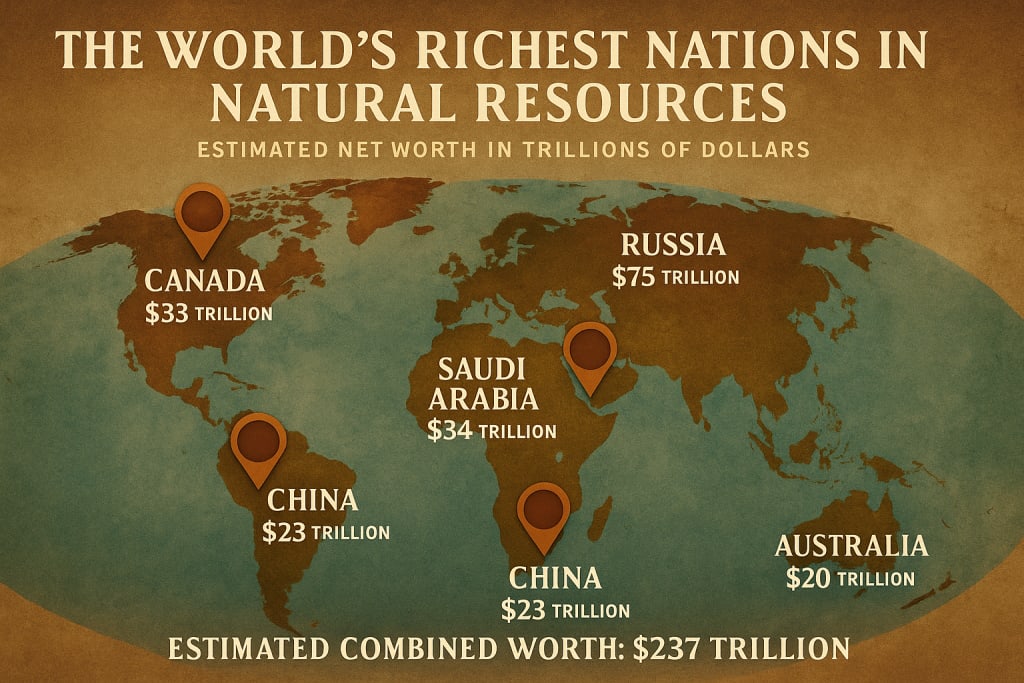
The World's Most Affluent Nations in Natural Resources: A Global Assessment
Natural resources serve as the concealed engines fueling a nation's prosperity, supplying the fundamental materials necessary for industry, energy, and economic development. From petroleum and gas to minerals, timber, and arable land, nations endowed with resources frequently exercise considerable global authority. But which countries genuinely occupy the pinnacle of the world's treasure trove? In this article, we investigate the nations with the greatest natural resource wealth, evaluate their estimated net worth, and analyze how they harness (or mishandle) their natural endowments.
1. Russia Estimated Net Worth: $75 Trillion
Russia is, by a considerable margin, one of the wealthiest countries regarding natural resources. It possesses extensive reserves of oil, natural gas, timber, coal, and a diverse array of minerals such as gold, nickel, and platinum.
Oil and Gas: Russia holds the largest natural gas reserves and ranks as a leading global exporter.
Forests: The Siberian taiga encompasses the largest continuous forest on the planet.
Minerals: Russia is a significant producer of diamonds, copper, iron ore, and coal.
Nevertheless, economic sanctions and political instability frequently hinder Russia from fully realizing the value of its natural riches.
2. United States Estimated Net Worth: $45 Trillion
The United States boasts an impressive array of resources, spanning energy reserves to agricultural abundance.
Energy: The U. S. ranks among the top producers of oil and natural gas.
Minerals: It possesses substantial deposits of coal, gold, copper, uranium, and rare earth elements.
Agriculture: Fertile land positions the U. S. as the foremost exporter of corn, soybeans, and wheat.
Robust infrastructure and technological advancement have enabled America to effectively leverage its resources, propelling it into the status of the world's largest economy.
3. Saudi Arabia Estimated Net Worth: $34 Trillion
Saudi Arabia's economy is intrinsically linked to oil. With the second-largest proven oil reserves after Venezuela, it stands as the globe’s leading oil exporter.
Oil Wealth: Oil constitutes approximately 90% of Saudi Arabia’s exports and around 42% of its GDP.
Minerals: Recent discoveries of gold, phosphate, and other minerals have expanded the resource portfolio.
Initiatives such as the "Vision 2030" plan aim to diversify the economy beyond oil, preparing for a future with decreased reliance on fossil fuels.
4. Canada Estimated Net Worth: $33 Trillion
Canada is endowed with a vast array of natural wealth.
Energy: Extensive reserves of oil (particularly in the oil sands of Alberta) and natural gas.
Minerals: A principal source of potash, uranium, gold, and nickel.
Forests and Water: Canada’s plentiful freshwater lakes and forests are invaluable resources.
A stable government and stringent environmental protections aid Canada in balancing resource extraction with sustainability.
5. China Estimated Net Worth: $23 Trillion
China, often recognized for its manufacturing prowess, is also significantly rich in natural resources.
Coal: China holds the largest coal reserves globally.
Rare Earth Elements: Dominates the global supply of these essential materials crucial for contemporary technologies.
Minerals: A leading producer of gold, tin, and aluminum.
Resource wealth, coupled with industrial expansion, has propelled China’s swift economic ascent over the last three decades.
6. Australia Estimated Net Worth: $20 Trillion
Australia’s affluence is embedded within its crimson soils.
Minerals: Premier global exporter of iron ore, bauxite, gold, and lithium.
Energy: Vast reserves of coal and natural gas.
Agriculture: Fertile land yields substantial agricultural exports such as wheat and wool.
With a comparatively modest population and robust governance, Australia proficiently exports its resources, particularly to burgeoning Asian economies.
7. Brazil Estimated Net Worth: $17 Trillion
Brazil is abundant in both mineral resources and biodiversity.
Minerals: Leading producer of iron ore, niobium, and bauxite.
Forests: The Amazon rainforest, the planet’s largest, serves as an immense reservoir of timber and carbon sequestration.
Agriculture: A dominant force in soybeans, coffee, and beef.
However, ecological challenges such as deforestation present significant threats to its long-term resource wealth.
How Resource Wealth Influences Nations
Resource abundance can yield both affluence and adversity:
Affluence: Countries like the United States and Canada have harnessed their resources to establish diversified, resilient economies.
Resource Curse: Conversely, others, like Venezuela and sections of Africa, have experienced resource wealth inciting corruption, disparity, and instabilitya phenomenon termed the "resource curse. "
The crucial factor is governance: administering wealth transparently, investing in infrastructure, education, and sustainability.
Conclusion
From the oil fields of Saudi Arabia to the mineral-rich territories of Australia, the world’s natural resources are unevenly allocated but universally vital. Estimates position Russia at the forefront, with an astounding $75 trillion in natural resources, followed by the U. S. and Saudi Arabia.
Yet possessing underground riches does not ensure prosperity above ground. The genuine treasure resides in how nations manage, preserve, and equitably allocate their natural inheritance for future generations. In an era of climate change and evolving energy demands, prudent stewardship will dictate which countries remain resource-rich not solely in value but in genuine affluence and sustainability.
About the Creator
Say the truth
"Say the Truth: Explain Everything in the World" is your trusted source for uncovering facts and exploring the wonders of history, science, technology, and beyond. We simplify complex ideas and reveal truths to inspire curiosity .
Keep reading
More stories from Say the truth and writers in Earth and other communities.
“India’s Hidden Wealth: A Deep Dive into the Net Worth of Its Natural Resources”
India’s Hidden Wealth: A Deep Dive into the Net Worth of Its Natural Resources India is not only a land of cultural and spiritual richness but also a nation blessed with an extraordinary bounty of natural resources. These natural endowments — including minerals, fuels, forests, water, and renewable energy sources — have powered India's civilization for millennia and continue to serve as the bedrock of its modern industrial and economic development.
By Say the truth 9 months ago in Earth
Top Australian Writers’ Festival Cancelled After Palestinian Author Barred
One of Australia’s most respected literary festivals has been cancelled following a fierce backlash over the decision to bar a Palestinian author from participating. What began as a programming dispute quickly escalated into a national debate about free speech, cultural inclusion, and political pressure in the arts. The cancellation has sent shockwaves through Australia’s literary community, raising urgent questions about whose voices are allowed on public platforms and at what cost.
By Aarif Lashari6 days ago in Earth
The Trans Youth Athletes in the US Fighting for Their Rights: ‘Playing Is an Act of Resistance’
Across the United States, sports have become an unexpected front line in the fight over transgender rights. For many trans youth athletes, simply stepping onto a field, track, or court is no longer just about competition—it is an act of resistance. As state legislatures debate and pass laws restricting transgender participation in school sports, young athletes are finding themselves at the center of a national culture war that reaches far beyond the locker room.
By Aarif Lashari6 days ago in Earth
How, Too
Many people wonder how, too. You are not alone, and I am an expert. I will teach you how, too! First, you need to remit a small application fee and fill out an application describing the nature of your financial situation and how often payments will be made, as this will have great bearing on how well I teach you how, too.
By Harper Lewis3 days ago in Fiction



Comments
There are no comments for this story
Be the first to respond and start the conversation.