
“India’s Hidden Wealth: A Deep Dive into the Net Worth of Its Natural Resources”
India, a land of vast landscapes and diverse geology, is home to some of the world’s richest reserves of natural resources. From its coal-dense states and iron-rich hills to the immense reserves of bauxite, natural gas, and renewable energy, India’s natural wealth underpins its growing economy. This article explores the history, strategic importance, and estimated net worth of India’s natural resources, shedding light on how these assets position India as a global powerhouse.

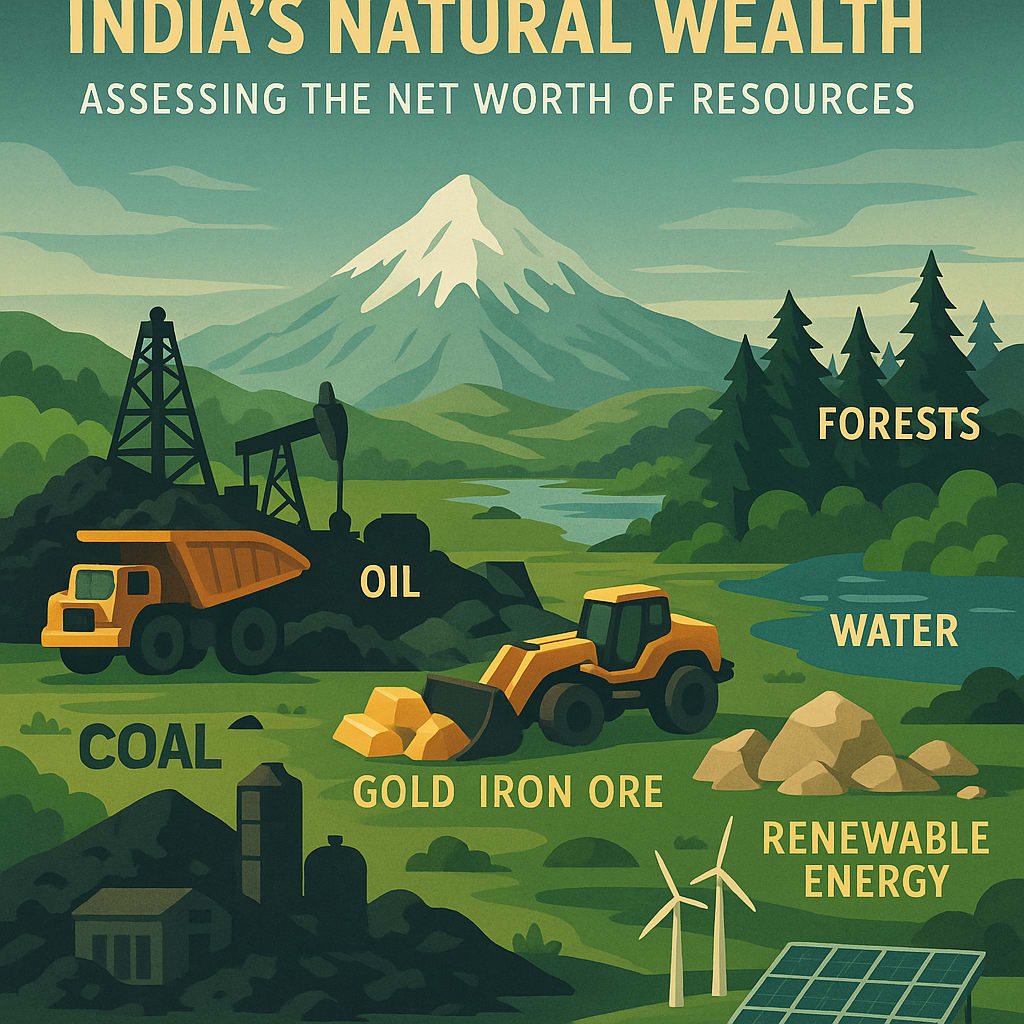
India’s Hidden Wealth: A Deep Dive into the Net Worth of Its Natural Resources
India is not only a land of cultural and spiritual richness but also a nation blessed with an extraordinary bounty of natural resources. These natural endowments — including minerals, fuels, forests, water, and renewable energy sources — have powered India's civilization for millennia and continue to serve as the bedrock of its modern industrial and economic development.
A Legacy Rooted in Nature
From the time of the Indus Valley Civilization, India's terrain has yielded everything from precious gems to vast timber forests. Historical texts, including those from travelers like Marco Polo and Ibn Battuta, speak of India as a land of gold, spices, and mineral treasures. The colonial powers, particularly the British Empire, exploited these resources extensively, laying down the groundwork for modern mining and industrial infrastructure.
After independence, India took aggressive steps to regulate and develop its resource-based sectors, creating national organizations such as the Oil and Natural Gas Corporation (ONGC), Coal India Limited, and Indian Bureau of Mines. These institutions have been instrumental in discovering and quantifying the country's natural wealth.
Mineral Wealth
India’s mineral reserves are among the largest in the world:
Coal: India holds the fifth-largest coal reserves globally, estimated at over 319 billion tonnes. These are primarily located in Jharkhand, Odisha, Chhattisgarh, and West Bengal. With energy demands on the rise, coal continues to be India's primary source of electricity.
Iron Ore: Rich deposits in states like Odisha and Karnataka make India one of the leading iron ore producers in the world. Annual production exceeds 200 million tonnes.
Bauxite and Manganese: India’s reserves of bauxite — the ore for aluminum — are among the top five in the world. These are located in Gujarat, Jharkhand, and Madhya Pradesh.
Gold: While not on the scale of Australia or South Africa, India’s Kolar Gold Fields and new discoveries in Uttar Pradesh are noteworthy.
Estimated mineral net worth: India’s known mineral wealth is estimated at around $10–12 trillion, with coal, iron, and bauxite forming the core.
Oil and Natural Gas
India’s oil and gas resources are significant, although still underdeveloped compared to Middle Eastern giants:
Oil Reserves: India has approximately 4.5 billion barrels of proven oil reserves, mainly located in the Western Offshore (Mumbai High), Assam, and Gujarat.
Natural Gas: The Krishna-Godavari basin is a major hub, along with the Cambay basin. India’s gas reserves are around 1.3 trillion cubic meters.
Estimated net worth: As of current global prices, the total value of India’s oil and gas reserves exceeds $1.5 trillion.
Forests and Biodiversity
India’s forests, covering roughly 24% of its total area, are home to valuable timber species like teak, sal, and sandalwood. Additionally, India is one of the most biodiverse countries in the world, with immense potential in medicinal plants and eco-tourism.
Estimated ecological resource value: Including ecosystem services and bio-resource value, the worth of India’s forests and biodiversity is estimated to be over $3 trillion.
Water Resources
India is endowed with major river systems — the Ganges, Brahmaputra, Godavari, and Krishna, to name a few. Water powers agriculture, which employs over 40% of the population, and is also essential for energy (hydropower) and drinking supplies.
Estimated value: In economic terms, India’s water resources contribute nearly $1 trillion to its GDP, factoring in agriculture, hydropower, and ecosystem services.
Renewable Energy Potential
India has immense potential in solar, wind, and hydroelectric power:
Solar Energy: With over 300 sunny days a year, India’s solar capacity is currently at 72 GW and growing rapidly.
Wind Power: Coastal states like Tamil Nadu and Gujarat offer high wind speeds ideal for turbine installation.
Hydropower: India ranks 5th in the world in hydropower generation.
Estimated value: The long-term potential of renewable energy development in India is projected to be $2 trillion by 2040.
Putting It All Together: India’s Natural Net Worth
Combining coal, oil, gas, minerals, forests, water, and renewables, the estimated total net worth of India’s natural resources surpasses $18–20 trillion. This figure could be higher with the discovery of new reserves and improvements in extraction technologies.
Strategic Importance
India’s natural resource wealth plays a crucial role in:
Energy security: Reducing dependence on oil imports.
Industrial growth: Supporting steel, aluminum, cement, and manufacturing sectors.
Economic independence: Potential for export-driven growth.
Geopolitical power: Ability to influence global markets and trade policies.
Conclusion
India’s natural resources are not just numbers on a ledger — they are the legacy of millions of years of geological evolution and centuries of civilization. The country’s strategic management of this wealth, combined with sustainable development practices, can elevate India into a global economic powerhouse. With innovation, policy reforms, and conservation, India can ensure that its natural treasures remain a source of prosperity for generations to come.
About the Creator
Say the truth
"Say the Truth: Explain Everything in the World" is your trusted source for uncovering facts and exploring the wonders of history, science, technology, and beyond. We simplify complex ideas and reveal truths to inspire curiosity .
Keep reading
More stories from Say the truth and writers in Earth and other communities.
"Vietnam's Wealth Uncovered: A Journey Through Economic Growth, Natural Riches, and National Prosperity"
Vietnam’s Wealth Uncovered: An Exploration of Its Economic Ascendancy and National Value From the remnants of conflict to the luminous skyline of Ho Chi Minh City, Vietnam has emerged as one of Southeast Asia’s most vibrant economies. This article investigates the economic evolution of Vietnam, examining its GDP, national assets, industries, and estimated value, while emphasizing the elements driving its extraordinary advancement.
By Say the truth 9 months ago in Earth
Understanding the Insurrection Act and the Role of Federal Officers in the United States
**Understanding the Insurrection Act and the Role of Federal Officers in the United States** The Insurrection Act is one of the most powerful and controversial laws in the United States, granting the president authority to deploy federal forces inside the country under specific circumstances. In recent years, public interest in this law has grown significantly, especially during periods of civil unrest, political tension, and nationwide protests. Questions about federal officers, presidential power, and constitutional limits have become central to public debate.
By America today 5 days ago in Earth
US Mortgage Rates Slide to One of Lowest Levels Since 2022
If you’ve been keeping an eye on the U.S. housing market, you’ve probably noticed some welcome news: mortgage rates have slid to one of their lowest levels since 2022. After years of steadily rising borrowing costs that pushed homeownership out of reach for many, this drop is providing a breath of fresh air for both prospective buyers and homeowners looking to refinance. But before you celebrate too quickly, it’s worth taking a closer look at what this actually means—and what it doesn’t. A Quick Look at the Numbers According to the Mortgage Bankers Association (MBA) and national rate surveys, the average 30‑year fixed mortgage rate has fallen to about 6.18%, marking the lowest reading in nearly two years. Adjustable-rate mortgages are down as well, with five-year ARMs hovering around 5.42%. At first glance, that might not seem like a huge change—but for anyone planning to buy a home, even a fraction of a percentage point can save hundreds of dollars each month. And over a 30-year loan term, those savings can easily add up to tens of thousands of dollars. For context, mortgage rates surged from pandemic-era lows below 3% to highs above 7% by 2023–2024. This recent dip is the first significant decline many buyers have seen in years. Why Are Rates Dropping? Mortgage rates aren’t set in a vacuum—they’re closely tied to economic indicators, including Treasury yields, Federal Reserve policy, and investor expectations about inflation and growth. Here are the main reasons for the recent drop: Falling Treasury Yields: Mortgage rates often track the 10-year Treasury yield. When investors flock to safer assets, demand for Treasuries rises and yields fall, which often translates to lower mortgage rates. Federal Reserve Policy: While the Fed doesn’t directly set mortgage rates, its stance influences market expectations. Hints at rate cuts or a slower pace of hikes can reduce borrowing costs over the long term. Government Support for Housing Finance: Programs and policies from Fannie Mae, Freddie Mac, and other federal initiatives help maintain liquidity in the mortgage market, which can also help push rates down. What This Means for Homebuyers For buyers, lower mortgage rates are essentially a ticket to increased affordability. Here’s how: More Buying Power: Lower rates mean smaller monthly payments for the same loan amount, letting buyers stretch their budgets or afford a larger home. Refinancing Opportunities: Homeowners with high-rate mortgages from recent years may finally find it worthwhile to refinance, cutting costs and freeing up money for other expenses. Encouragement for First-Time Buyers: After years of sky-high borrowing costs, first-time buyers may feel motivated to enter the market again. Still, it’s important to note that rates are just one piece of the puzzle. Housing prices, down payments, and availability remain critical factors for anyone looking to buy. Challenges Remain Even with rates dropping, the housing market isn’t without its hurdles: Tight Inventory: Many regions continue to face a shortage of homes for sale. Less supply means competition remains high, even if financing is cheaper. High Home Prices: Prices in many metro areas are still elevated, so lower rates only go so far in making homes affordable. Economic Uncertainty: Inflation, labor market fluctuations, and other economic factors could still influence mortgage rates and affordability in the months ahead. In short, the rate drop is a positive development—but it doesn’t solve all of the housing market’s challenges. Who Benefits Most? The recent decline in rates is particularly meaningful for: Prospective Homebuyers: They can lock in more affordable monthly payments and better long-term financing. Homeowners with High-Rate Mortgages: Those with older, higher-rate loans may save money through refinancing. Investors and Real Estate Professionals: Lower rates can increase demand and stimulate market activity, providing opportunities in sales, rentals, and property investments. Looking Ahead Analysts have mixed opinions about where rates will go next. Some predict rates could dip below 6% by the end of 2026, while others warn that inflationary pressures and economic uncertainty could keep them relatively stable. What seems clear, however, is that lower rates are likely to provide at least temporary relief for many Americans trying to navigate a challenging housing landscape. Takeaways for Buyers and Homeowners Act Wisely: If you’re in the market to buy or refinance, now may be a good time to explore your options—but don’t rush without considering other costs like property taxes, insurance, and fees. Keep an Eye on Prices: Even with lower rates, affordability depends on home prices and supply in your area. Plan for the Long Term: Use lower rates to strengthen your financial position, not just as a short-term fix. Conclusion The slide in U.S. mortgage rates to one of the lowest levels since 2022 is a rare and welcome reprieve for buyers and homeowners. It offers an opportunity to save money, improve financial flexibility, and, for some, finally step into homeownership after years of elevated costs. However, lower rates alone won’t fix the housing market. Tight inventory, high prices, and broader economic pressures remain hurdles for many Americans. That said, for those prepared to act strategically, this moment may represent a meaningful opportunity in an otherwise challenging landscape.
By Muhammad Hassan5 days ago in Earth



Comments
There are no comments for this story
Be the first to respond and start the conversation.