
The Multidimensional Universe
Exploring the Significance of Extra Dimensions and Their Implications for Physics and Cosmology


The idea of a multidimensional universe has fascinated scientists and philosophers for centuries. While we are familiar with the three spatial dimensions of length, width, and depth, there is a growing body of evidence to suggest that there may be additional dimensions beyond these. In this essay, we will explore the significance of extra dimensions and their implications for physics and cosmology.
First, let's define what we mean by dimensions. In physics, a dimension is a measurable property of a system, such as length, time, or mass. In the context of the universe, dimensions refer to the spatial and temporal coordinates that define its structure and evolution. The three dimensions of length, width, and depth, for example, determine the size and shape of objects in space, while time is the fourth dimension that governs the progression of events.
The notion of extra dimensions goes back to the work of German mathematician Theodor Kaluza and Swedish physicist Oskar Klein in the 1920s. They proposed that there may be additional spatial dimensions beyond the three we are familiar with, which could help unify the fundamental forces of nature. This idea was later developed in string theory, a theoretical framework that posits the existence of extra dimensions in order to reconcile general relativity and quantum mechanics.
So, what do we mean by extra dimensions? In physics, an extra dimension is a dimension beyond the three we experience in everyday life. It is a mathematical construct that allows us to describe phenomena that cannot be explained by the three dimensions alone. The idea of extra dimensions may seem strange at first, but it is actually a natural extension of our understanding of the universe.
One way to visualize extra dimensions is to consider a two-dimensional surface, such as a piece of paper. From our perspective, the paper has length and width, but no depth. However, if we were to fold the paper in half, we would create a third dimension of depth. Similarly, if we imagine the universe as a four-dimensional space-time, adding an extra dimension would be like folding it in on itself to create a fifth dimension.
The concept of extra dimensions has important implications for physics and cosmology. One of the most intriguing ideas is that extra dimensions may help explain why gravity is such a weak force compared to the other fundamental forces. In the standard model of particle physics, gravity is described by general relativity, which assumes that space-time is four-dimensional. However, this theory cannot be reconciled with quantum mechanics, which describes the behavior of particles on a subatomic level. String theory, which incorporates extra dimensions, offers a possible solution to this problem by proposing that gravity is diluted in the extra dimensions, making it appear weaker than the other forces.
Another potential consequence of extra dimensions is the possibility of parallel universes. In the theory of cosmic inflation, the universe underwent a rapid expansion in the moments after the Big Bang. During this expansion, some regions of space may have separated from others, creating bubble universes that exist alongside our own. These universes would occupy different dimensions, and would be inaccessible to us except perhaps through gravitational effects.
The idea of extra dimensions has also led to new insights into the nature of black holes. In the traditional model of a black hole, matter collapses to a singularity, a point of infinite density and zero volume. However, in string theory, extra dimensions may prevent the formation of a singularity by allowing matter to escape through the extra dimensions. This would change our understanding of what happens inside a black hole and could have profound implications for our understanding of the universe as a whole.
Furthermore, the concept of extra dimensions has also led to new ideas about the nature of dark matter, a mysterious substance that is believed to make up approximately 85% of the matter in the universe. In the standard model of particle physics, there is no explanation for dark matter, as it does not interact with light or any other known particle. However, in theories that incorporate extra dimensions, dark matter may be explained by the existence of "hidden" or "shadow" particles that interact with dark matter particles in extra dimensions. This would provide a new avenue for studying and understanding dark matter, which remains one of the biggest puzzles in modern astrophysics.
In conclusion, the idea of a multidimensional universe and the existence of extra dimensions beyond the three we experience in everyday life have important implications for physics and cosmology. From the possibility of explaining the weakness of gravity and the existence of parallel universes to new insights into black holes and the nature of dark matter, the concept of extra dimensions has opened up new avenues of research and understanding. As scientists continue to explore these ideas, we may gain a deeper insight into the nature of the universe and our place within it.
About the Creator
John memon
I Just like to write............
Keep reading
More stories from John memon and writers in Earth and other communities.
The Suspicious Suicide
Detective Lily Johnson had seen her fair share of murder cases in her career. But there was something about the death of businessman David Williams that made her suspicious. Williams had been found dead in his office, with a gunshot wound to the head. The police had ruled it a suicide, but Johnson couldn't shake the feeling that there was more to the story.
By John memon3 years ago in Criminal
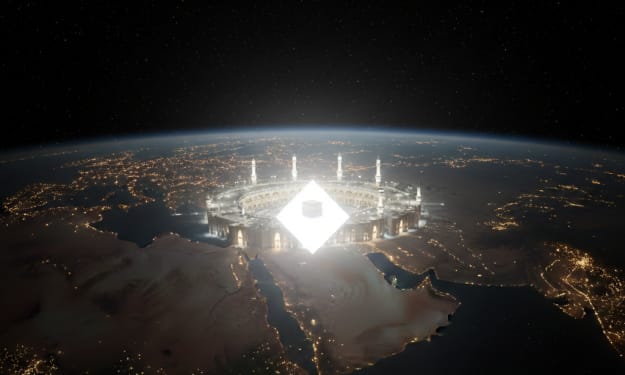
The Jewel of the Earth: How the Kaaba Shines Like a Diamond from Space
In the vast, silent expanse of the cosmos, where the Earth appears as a delicate blue marble against the infinite black of the universe, certain landmarks stand out with unexpected brilliance. Recently, a series of high-resolution images captured from the International Space Station (ISS) and advanced satellite arrays have left the global community in awe. The focal point? Masjid al-Haram in Mecca. From hundreds of miles above, the "House of Allah" does not just appear as a building; it radiates a piercing, crystalline glow, resembling a diamond set into the heart of the desert.
By Irshad Abbasi 3 days ago in Earth
Who is your "Person"?
It's important to recognize that you cannot go through life as easily on your own. My name is Elizabeth and I'm a survivor of child abuse and horrific trauma. Healing from trauma is not a quick fix and recognizing that it will take time, is part of the struggle.
By Elizabeth Woods3 days ago in Psyche



Comments
There are no comments for this story
Be the first to respond and start the conversation.