
The Most Mysterious Animal Migrations on Earth
From butterflies that vanish for generations to fish that swim thousands of miles — nature’s GPS is more accurate than you think.


Monarch Butterflies: A Journey They’ve Never Taken Before
Every year, millions of monarch butterflies travel over 4,000 km from Canada and the northern U.S. to Mexico, seeking warmer climates. But here's the twist — none of the butterflies that arrive in Mexico have ever been there before.
Monarchs take up to four generations to complete a full round trip. The butterflies that leave Mexico in spring will die before reaching Canada. Their great-grandchildren, who’ve never seen Mexico, somehow know how to return. Scientists still can’t fully explain how they navigate this vast journey — some think it’s based on the sun’s position or magnetic fields.
It’s one of the most mind-blowing inherited instincts in the insect world.

Arctic Terns: Masters of the Longest Migration on Earth
The Arctic tern holds the world record for the longest migration of any animal. These small birds travel from their breeding grounds in the Arctic all the way to Antarctica — and then fly back again. That's a round trip of around 70,000 km every year.
Imagine flying from the North Pole to the South Pole, then turning around and doing it again — and again, for decades. Arctic terns live up to 30 years, meaning one bird may travel more than 2 million kilometers in its lifetime. That’s like flying to the moon and back three times.
Yet, they do it for one simple reason: to follow summer. They spend their whole lives chasing sunlight and food.

Wildebeest: Earth’s Largest Land Migration
Every year, over 1.5 million wildebeest, along with zebras and gazelles, move across the Serengeti ecosystem in Tanzania and Kenya in search of fresh grass. This epic journey is called the Great Migration, and it’s often called one of the Seven Natural Wonders of Africa.
The animals face dangerous river crossings filled with crocodiles, treacherous terrain, and predators like lions and hyenas. What’s amazing is how they seem to know when and where to go, even though there are no maps, no leaders, and no guides — just instinct and survival.

Humpback Whales: Ocean Giants on a Cross-Planet Trip
Humpback whales migrate up to 16,000 km per year, swimming from cold polar waters where they feed, to warm tropical waters where they give birth. That’s like swimming halfway around the Earth.
These enormous creatures — up to 40 tons in weight — don’t eat during their migration. They rely entirely on the fat reserves they’ve built up in feeding grounds. They sing complex songs along the way, possibly to communicate with other whales during their long journey.
Even calves, born in warm water, know how to swim thousands of kilometers back to feeding grounds they’ve never seen. It’s a combination of memory, magnetism, and mystery.

Salmon: From the Ocean Back to Their Birthplace
Salmon are born in freshwater rivers, then swim out to sea, where they spend most of their lives. But when it’s time to reproduce, they return to the exact river where they were born, swimming upstream against powerful currents — sometimes jumping over waterfalls — just to spawn.
They do this using a remarkable sense of smell and possibly magnetic orientation. Some travel over 1,500 km upstream, and once they lay their eggs, they die — their entire life ends with this one mission.
What’s even more astonishing is that they don’t get lost. Even among thousands of similar rivers, each salmon finds its way back to its birthplace.

Caribou: A Migration Through Ice and Predators
In North America, caribou (reindeer) travel up to 5,000 km annually — the longest land migration of any mammal. Their herds, sometimes numbering in the hundreds of thousands, move through snowstorms, frozen lakes, and predator zones, all while avoiding wolves and harsh Arctic weather.
Calves are born during this journey, and within hours of being born, they must be ready to walk and migrate with the herd. The caribou’s survival depends on synchronization and stamina, and somehow, they manage to follow ancient routes passed down through generations.

Leatherback Sea Turtles: Navigating Oceans for 10,000 km
Leatherback sea turtles are the largest turtles on Earth, and their migrations are no small feat. Some travel over 10,000 km between nesting and feeding grounds. One recorded turtle swam from Indonesia to Oregon, USA — across the entire Pacific Ocean.
They follow ocean currents and use Earth’s magnetic fields as a natural compass. After laying eggs on the same beach where they were born, female turtles return to sea and repeat the cycle every few years. Scientists still don’t fully understand how they remember these exact locations.
It’s a story of ancient memory wrapped in a modern mystery.

Eels: A Mystery We Still Haven’t Solved
The European eel is one of the strangest cases in animal migration. Born in the Sargasso Sea (near the Caribbean), these eels drift across the Atlantic to Europe’s rivers, where they grow for years. Then, when it’s time to reproduce, they disappear back to the Sargasso — and no one has ever witnessed exactly how.
We know they return. But how? And what happens there? No scientist has ever found an eel egg in European waters. The Sargasso Sea seems to be their secret spawning ground, but it remains one of nature’s greatest mysteries.

Dragonflies: The Smallest Long-Distance Migrants
You might not expect an insect to travel far, but the globe skimmer dragonfly does something incredible: it crosses oceans. These tiny creatures fly from India to East Africa, and even across the Indian Ocean, covering up to 14,000 km in multi-generational journeys.
Scientists believe they ride high-altitude winds and time their migration with seasonal rains. Some of these dragonflies may even migrate further than monarch butterflies, but because they’re so small, much of their path remains unknown.
They’re proof that even the tiniest wings can take on the biggest skies.

Sardines: A Shimmering Wall of Movement
Off the coast of South Africa, millions of sardines gather and move northward in what’s called the Sardine Run — a marine migration so massive it can be seen from space. The sardines form dense shoals stretching over 7 km long and 30 meters deep, attracting dolphins, sharks, whales, and seabirds in a chaotic feeding frenzy.
No one knows exactly why the sardines do this. Some believe it’s a response to water temperatures or food sources. Whatever the reason, this shimmering wall of silver is one of the most spectacular ocean migrations on Earth.
Animal migrations aren’t just about movement — they’re about mystery, instinct, and survival. Some creatures travel halfway across the world without a map, compass, or any prior experience — just a deep, natural rhythm that tells them when it’s time to go.
It’s a journey written in their DNA, and we’re only just beginning to understand how they do it.
About the Creator
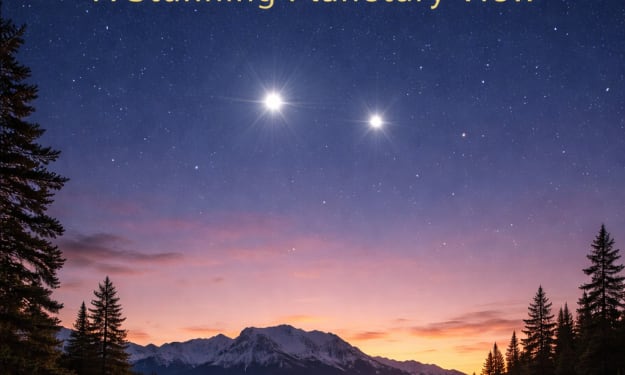
Venus and Jupiter Shine Together: A Stunning Planetary Display in Earth’s Sky
For skywatchers across the world, there are few sights more captivating than seeing bright planets glowing in the night sky. Among these celestial wonders, the close appearance of Venus and Jupiter from Earth is one of the most spectacular. When these two brilliant planets appear close together in the sky, they create a stunning astronomical event that fascinates both professional astronomers and casual stargazers alike.
By Irshad Abbasi 7 days ago in Earth



Comments
There are no comments for this story
Be the first to respond and start the conversation.