
The Last Selfie from Earth
In the final hours of Earth, silence echoed louder than bombs.
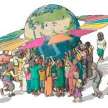

The skies were no longer blue. They bled in shades of orange and ash, thick with smoke from burning forests and decaying cities. Oceans had swallowed coastlines, once-bustling cities were now skeletal, and AI-driven machines roamed the streets — abandoned by their creators and left to wander without command. The planet had become a haunted graveyard of human ambition and arrogance.
Maya sat on a cracked rooftop in what was once Nairobi, staring at the evacuation ship that towered like a silver monument against the chaos. She held a phone — old, half-broken, its screen spider-webbed with cracks, but still functional. A relic from the past, like her.She was 17.
She had never seen snow. She had never felt real grass beneath her feet. Her education had been streamed through glitchy satellites. Her friends were avatars in virtual rooms. Her family—what was left—had died slowly, one by one: disease, famine, riots, or simply despair.
Maya had lived her entire life watching Earth die.
And now, she was one of the lucky few chosen to leave.
The Evacuation
The global evacuation had been decades in the making. As Earth collapsed, the wealthy and powerful built colonies on Mars. The "Red Renaissance," they called it — a new beginning. Tickets to the off-world settlements cost more than entire countries' GDPs. Only the elite were guaranteed a future.
But protests, revolutions, and eventually shame forced the Interplanetary Coalition to offer “Youth Exodus Scholarships” — free evacuations for young people with high cognitive scores, clean health, and a willingness to contribute to Martian society.
Maya didn’t believe she’d be chosen.
Yet, two days before the last ship departed, her name flashed on the approved list. No explanation. No goodbye. Just a number, a code, and a countdown.
The Selfie
She stood in line at the launch pad, clutching her bag and trying not to cry.
She looked around—others her age stood silently, eyes hollow, faces covered with masks not just for dust but for emotion. No one spoke. No one smiled.
Then, as they neared the boarding ramp, Maya stepped out of line.
Ignoring the guards' shouts, she climbed a nearby platform, turned toward the broken horizon, and raised her phone. Behind her, Earth burned—forests ablaze, buildings collapsing, drones falling from the skies.
She snapped the photo.
It was blurry. Raw. Unfiltered. Just a girl with tears in her eyes and flames behind her.
She opened the last global social network still online: EchoSphere.
She posted the photo with one line:
“This is what we did to our home. Don’t do the same to Mars.”
Then she turned off her phone and boarded the ship.
The Viral Message
By the time her ship reached orbit, her post had already gone viral.
It ricocheted through networks, spread across data satellites, bounced into MarsNet, and was translated into 96 languages within hours. The photo struck something primal. It wasn’t just about Earth. It was about guilt, loss, and the question no one wanted to ask:
What if we destroy the next world too?
Celebrities reposted it. Scientists quoted it. Politicians condemned it. And teenagers across Earth and Mars made it their banner.
Some even tattooed it on their arms.
It wasn’t the photo. It was the truth.
The Movement
They called themselves The Green Protocol — a youth-led initiative to ensure Mars would not repeat Earth's mistakes.
Their demands were simple:
Full environmental accountability from corporations building Martian infrastructure.
Equal access to technology, food, and education.
No weaponized AI.
Mandatory Earth history education in Martian schools.
And most important — every child to see Maya’s photo on their first day of school.
They weren’t activists.
They were survivors.
And they remembered what it felt like to be told, "There’s no more time."
Maya on Mars
Maya didn’t know any of this at first.
Her ship landed in Sector 9 — one of the newer, less developed colonies. She was assigned a recycled suit, a 2x2 meter room, and a maintenance job monitoring oxygen gardens.
Life was quiet.
She rarely spoke. She didn't post again. Her photo had become more than her — it had become a symbol. And she wasn’t sure if she could live up to that.
But then the letters came.
Thousands of messages sent to her ID: “You changed my life.” “Thank you.” “I started the first student union in my sector.” “We planted real trees.”
Maya sat one night under the bio-dome, staring at the artificial stars, holding her phone — now barely working.
She whispered, “I didn’t mean to be a hero.”
But maybe that was the point.
The world didn’t need perfect heroes. It needed honest ones.
Years Later
Ten years passed.
Maya became an environmental systems engineer, then a teacher. Her students knew her face before they knew her name. “The Selfie Girl,” they called her.
She hated the title — but loved what it represented.
Under her guidance, her students built Mars' first open-air biodome with breathable air and native Martian plants genetically engineered for the soil. They called it “Echo Garden” — a place for learning, healing, and remembering.
In its center stood a single sculpture: Maya’s selfie etched into stone, with her words engraved beneath.
Visitors cried when they saw it.
Parents brought their children.
Activists held rallies there.
And on the anniversary of Earth’s last evacuation, colonies around Mars held a moment of silence — not just for the past, but as a promise to the future.
The Forgotten Planet
Back on Earth, silence ruled.
No new posts. No growing trees. No rebuilding cities.
But satellites still orbited the dead planet. And sometimes, they caught strange signals — rogue broadcasts from AI-run systems still functioning in silence.One day, years after Maya’s garden bloomed, a signal came from Earth. It was a replay loop from a forgotten server in Nairobi.The loop?
Maya’s selfie.
Still broadcasting.
Still warning.
Still reminding the stars what happened when humans forget their roots.
Final Thought
Maya once said in an interview, decades later:
“I took tha
t photo because I didn’t want to forget. Not just what we lost—but why we lost it. We loved Earth too late. On Mars, we have a chance to love a world before we lose it.”
Today, her image is more than a selfie.
It’s a lesson.
It’s a vow.
And it all began with one girl, one broken phone, and one last look at a dying world.
About the Creator
Fawad Khan
I’m Fawad Khan a passionate speaker and researcher sharing journals, fiction, history, education, current affairs, and English literature. With deep research and clear voice, I bring knowledge to life. Learn,grow, and stay informed with me.
Keep reading
More stories from Fawad Khan and writers in Earth and other communities.
WWE – Is It Real or Fake?
Introduction World Wrestling Entertainment (WWE) has captivated millions around the globe with its blend of high-octane action, dramatic storytelling, and charismatic superstars. From childhood memories of legendary wrestlers like The Undertaker and Stone Cold Steve Austin to today’s icons like Roman Reigns and Seth Rollins, WWE has remained a cultural phenomenon. However, a persistent debate surrounds the sport: Is WWE real or fake?
By Fawad Khan7 months ago in Proof
Patio Covers Tacoma: A Practical Solution for Damp Weather
At first, I thought patios were mostly for sunny areas, not a place like Tacoma, where the sky is more often gray than not. However, after living through the seasons here, you quickly learn the issue isn't extreme weather; it's the constant dampness. Light rain, mist, cloudy afternoons, and that chilly moisture that lingers even when it’s not raining.
By Backlinks Cart3 days ago in Earth



Comments
There are no comments for this story
Be the first to respond and start the conversation.