
The Indian Golden Oriole
A Vibrant Jewel of the Indian Canopy
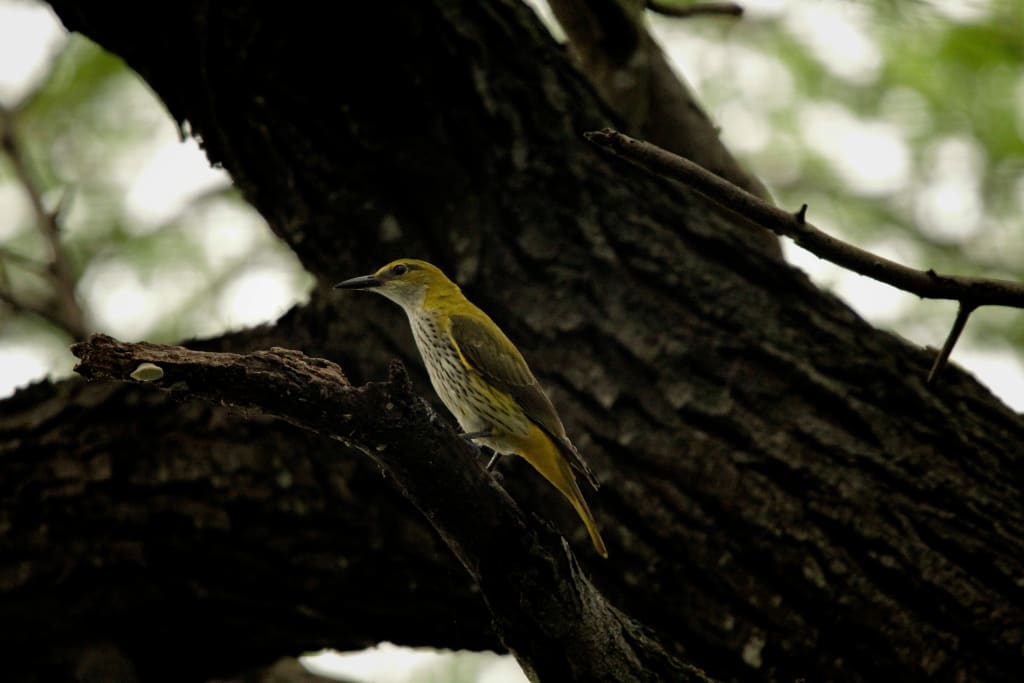
The Indian Golden Oriole :
The Indian Golden Oriole, known locally in Marathi as "Haldya," is a strikingly beautiful bird that graces the Indian subcontinent with its vibrant presence. With its brilliant yellow plumage and melodious call, the Haldya is not only a visual delight but also an integral part of India's avian biodiversity.
Taxonomy and Nomenclature :
- Scientific Name: Oriolus kundoo
- Family: Oriolidae
- Common Names: Indian Golden Oriole, Haldya (Marathi), Peelak (Hindi)
Originally considered a subspecies of the Eurasian Golden Oriole (Oriolus oriolus), the Indian Golden Oriole has been recognized as a distinct species based on differences in morphology and vocalizations.
Physical Characteristics :
The Indian Golden Oriole is a medium-sized passerine bird, measuring approximately 25 cm in length.
- Male: The adult male boasts a bright golden-yellow body contrasted by black wings and a black tail. A distinctive black stripe runs from the base of the beak through the eye, extending to the nape. The eyes are reddish, and the beak is pinkish and slightly curved.
- Female: Females are more subdued in coloration, with olive-green upperparts and yellowish underparts. They lack the prominent black eye-stripe seen in males, making them more camouflaged among foliage.
Habitat and Distribution :
The Indian Golden Oriole is widely distributed across the Indian subcontinent, including countries like India, Nepal, Bangladesh, and parts of Central Asia. In India, it is commonly found in various habitats such as:
- Deciduous and semi-evergreen forests
- Urban gardens and parks
- Orchards and agricultural lands
- Wooded areas and groves
In Maharashtra, particularly in regions like Konkan and Thane, the Haldya is a familiar sight, often spotted by bird enthusiasts.
Behavior and Diet :
The Indian Golden Oriole is primarily arboreal, spending most of its time in the tree canopy. It is known for its shy and elusive nature, often remaining hidden among dense foliage.
- Diet: The bird's diet mainly consists of:
- Fruits and berries
- Nectar from flowers
- Insects and caterpillars
By consuming fruits and subsequently dispersing seeds through its droppings, the Haldya plays a vital role in forest regeneration and ecosystem balance.
Breeding and Nesting :
The breeding season for the Indian Golden Oriole typically spans from April to August.
- Nest: The nest is a neat, cup-shaped structure woven from fine grasses, plant fibers, and spider webs. It is usually suspended from the fork of a horizontal tree branch, providing safety from predators.
- Eggs: The female lays 2 to 4 eggs, which are white with reddish-brown spots. Both parents share responsibilities in incubating the eggs and feeding the chicks once they hatch.
Vocalizations :
The Indian Golden Oriole is renowned for its melodious and flute-like calls. Its song is a series of rich, whistling notes that can be heard during the breeding season, serving both to attract mates and to establish territory.
Cultural Significance:
In Indian culture, the Haldya holds a special place. Its appearance and calls are often associated with the onset of summer. In Marathi tradition, the sighting of the Haldya building its nest is considered an indicator of the Chaitra month, marking the beginning of the traditional Hindu calendar.
Conservation Status :
The Indian Golden Oriole is currently listed as a species of "Least Concern" by the International Union for Conservation of Nature (IUCN). However, habitat loss due to deforestation and urbanization poses potential threats to its population. Conservation efforts focusing on preserving natural habitats are essential to ensure the continued survival of this species.
Observing the Haldya :
For bird watchers and nature enthusiasts, spotting the Indian Golden Oriole can be a rewarding experience. Early mornings during the breeding season offer the best chances to hear and see this elusive bird. Listening for its distinctive calls near fruiting trees like banyan, peepal, and fig can lead to successful sightings.
Conclusion :
The Indian Golden Oriole, or Haldya, is more than just a visually stunning bird; it is an integral part of India's ecological and cultural fabric. Its presence in various habitats across the subcontinent underscores the importance of biodiversity and the need for conservation. By understanding and appreciating such species, we take a step closer to preserving the natural heritage that enriches our lives.
About the Creator
Subhash C
As a naturalist, I am passionate about conservation and educating others about the importance of biodiversity and ecological balance. My work involves field research, wildlife observation, and environmental advocacy.


Comments
There are no comments for this story
Be the first to respond and start the conversation.