
The Ice Age Uncovered: Myths, Facts, and the Reality of Earth's Frozen Past
What Was the Ice Age Really Like? Breaking the myths of a frozen planet and uncovering the truth about Earth's icy history.


When we hear "Ice Age," many of us imagine a frozen planet in an eternal winter, where humans huddle in shelters, and mammoths and saber-tooth tigers roam vast icy landscapes. However, this idea isn't entirely accurate. Let’s dive into what the Ice Age really was, how long it lasted, and whether we might be heading for another one.
First, it's important to clarify that there wasn’t just one Ice Age. Earth has experienced at least five major ice ages. The first occurred between 2.4 and 2.1 billion years ago, while the most recent began 2.6 million years ago and lasted until about 11,500 years ago. Some scientists even argue that we’re still in an Ice Age. Why? Because Earth continues to experience warm and cold phases, and the planet hasn’t fully reverted to a non-glacial state.
An Ice Age consists of two main stages. The **glacial period**, or the colder phase, is when global temperatures drop, glaciers expand, and sea levels fall as water becomes locked in massive ice sheets. During the last glaciation, ice covered large parts of Canada, Greenland, Scandinavia, Eurasia, and even parts of South America. Despite this, not the entire planet froze. Even during the coldest periods, regions like Africa and the tropics remained relatively warm, though temperatures there were about 10°F cooler than today. For example, if modern-day Africa averages 77°F, it would have been closer to 67°F during the Ice Age—chilly but livable.
Humans were already around during the last Ice Age. Early Homo sapiens, along with other human species, lived primarily in Africa. Around 2 million years ago, some groups began migrating to colder climates, including Europe and Scandinavia. These regions could be harsh, with average annual temperatures in places like Germany dropping to 32°F, similar to modern-day Iceland. Yet humans not only survived—they thrived.
The colder climate encouraged innovation. Humans began sewing clothes to keep warm, developing tools for hunting, and building shelters. Hunting required strategic thinking, which spurred the development of intelligence. Survival became a mental exercise, and this necessity likely accelerated human advancement.
During the Ice Age, humans hunted animals that were well-adapted to the cold. Mammoths, for instance, were covered in thick fur, providing excellent material for clothing. Their bones were used for construction, and their meat was a vital food source. Mammoths survived harsh conditions thanks to stored fat reserves that sustained them during times of scarcity. Other animals included saber-tooth cats, which were fearsome predators, and giant ground sloths, towering up to 12 feet tall. Interestingly, many Ice Age animals were much larger than their modern counterparts, a phenomenon linked to evolutionary adaptations before the Ice Age.
The end of the Ice Age brought significant changes. As glaciers melted, water trapped in ice caps was released, causing sea levels to rise dramatically—by as much as 400 feet in some cases. Land that was once exposed became submerged. This transition marked the beginning of the **interglacial period**, a warmer phase that started around 11,500 years ago. Some scientists believe we’re still in this period today.
The interglacial phase follows a natural cycle triggered by solar radiation, which warms the Earth. Melting glaciers release carbon dioxide (CO2), further accelerating the warming process. While this cycle has occurred for millions of years, human activities in the last 150 years—such as industrialization and deforestation—have amplified the warming trend, leading to climate change concerns.
In conclusion, the Ice Age wasn’t a time of unrelenting cold and snowball Earth scenarios. Instead, it was a complex era with fluctuating temperatures, thriving human communities, and giant animals. As Earth continues to warm, we might be witnessing the final stages of the most recent Ice Age—a reminder of the planet's ever-changing climate.
About the Creator
Nora Ariana
Empowering through stories and sound igniting purpose, sparking growth, and awakening the power within.
Keep reading
More stories from Nora Ariana and writers in Earth and other communities.
A goal is a dream with a deadline
A goal is a dream with a deadline. This powerful quote reminds us that without action, dreams remain just that wishes floating in our imagination. But when we set a timeline and commit to achieving them, they evolve into goals, bringing clarity, direction, and purpose. Many people go through life holding on to dreams, hoping they will come true someday. But someday is not a day on the calendar. Dreams without structure often fade with time or get buried under the weight of daily responsibilities. Turning a dream into a goal is what separates those who achieve from those who continue to wish.
By Nora ArianaExclusive • 9 months ago
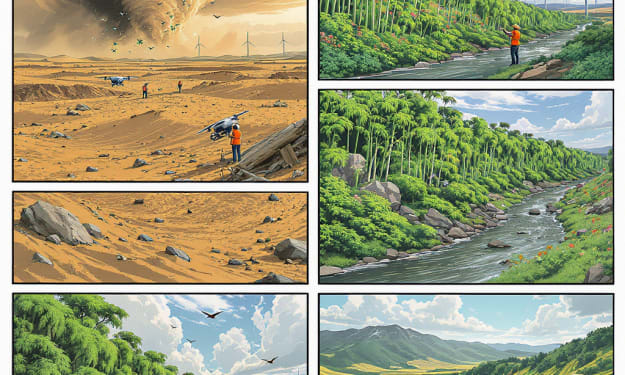
Chinese Planetary Engineering: The Great Green Wall and the Reclamation of Climate
There are junctures in history where a civilization no longer chooses between comfort and progress, but between adaptation and extinction. At the dawn of the new millennium, China hit one of those silent thresholds where geography ceases to be a backdrop and becomes an adversary. The desert was advancing, not as a metaphor for decay, but as a physical, methodical, and relentless force. Sand was devouring the horizon, winds grew heavy with dust, and the soil lost its fertile memory, taking with it the promise of social stability.
By Laurenceau Porte6 days ago in Earth
US Warns Airlines About Military Activity in Parts of Latin America
Commercial aviation is built on predictability—clearly defined airspace, coordinated air traffic control, and shared international rules. When that predictability is disrupted, even subtly, the ripple effects can stretch far beyond the cockpit. That is exactly why a recent warning from the United States has caught the attention of airlines, governments, and travelers alike. In early 2026, US aviation authorities issued an advisory warning airlines about military activity in parts of Latin America, urging pilots to exercise heightened caution when flying over certain regions. While no immediate restrictions or flight bans were imposed, the message itself was clear: something in the skies has changed, and the risks—however limited—can no longer be ignored. This development is not just about aviation safety. It reflects a growing intersection between geopolitics, military operations, and civilian infrastructure in a region that has long balanced cooperation with tension. What Exactly Did the US Warn About? The advisory, released through official aviation safety channels, highlighted concerns over potential military activity affecting airspace across parts of Mexico, Central America, South America, and nearby oceanic regions. Airlines were advised to remain vigilant during all phases of flight, including cruising at high altitudes, takeoff, and landing. Unlike routine notices related to weather systems or airport congestion, this warning explicitly referenced security-related risks. These include the possibility of unexpected military movements, temporary airspace disruptions, and interference with navigation systems that modern aircraft rely on for safe operations. Importantly, the warning did not accuse any specific country of wrongdoing, nor did it suggest an immediate danger to passengers. Instead, it served as a precaution—one designed to ensure airlines adjust flight planning, monitoring, and communication protocols accordingly. Why Military Activity Matters to Civil Aviation To the average traveler, military exercises or operations may seem distant from the experience of flying on a commercial jet. In reality, the two worlds often share the same skies. Civilian aircraft depend heavily on satellite navigation, coordinated air traffic control, and stable airspace rules. Military operations—especially those involving fast-moving aircraft, surveillance systems, or electronic equipment—can introduce uncertainty into that environment. Some of the key risks aviation authorities monitor include: Unplanned military aircraft movements that may not follow civilian flight patterns Temporary airspace closures or restrictions that require last-minute rerouting Navigation signal disruptions, whether accidental or intentional Increased congestion in strategic corridors used by both civilian and military flights While these risks are typically managed through coordination and communication, heightened military activity raises the stakes. The FAA’s advisory suggests that such activity has reached a level where additional caution is warranted. The Geopolitical Context Behind the Warning The timing of the advisory is not accidental. Latin America has seen a noticeable rise in security operations and military coordination involving the United States over the past year. These efforts are largely focused on counter-narcotics missions, maritime security, and regional stability, particularly in areas with strategic shipping routes or ongoing political tension. At the same time, broader global dynamics—ranging from great-power competition to shifting alliances—have increased the strategic importance of air and sea routes across the Western Hemisphere. From Washington’s perspective, issuing an aviation warning is not about alarmism. It is about acknowledging that military and security activities in the region may temporarily affect civilian systems, including aviation. How Airlines Are Responding For airlines, advisories like this are not unusual—but they are taken seriously. Most major carriers already operate with layered safety systems that allow them to respond quickly to changing conditions. In practical terms, this warning may lead to: Slight route adjustments to avoid specific airspace Enhanced pilot briefings before flights Increased coordination with air traffic controllers Closer monitoring of navigation and communication systems So far, there have been no widespread flight cancellations or suspensions linked directly to the warning. That suggests airlines view the risk as manageable, provided proper precautions are followed. Reactions from Latin American Governments Some governments in the region have been quick to reassure the public. Officials have emphasized that their national airspace remains safe and fully operational, and that civilian flights continue without disruption. This response highlights an important tension: while the US warning is precautionary, it can still affect public perception. Tourism, business travel, and investor confidence are all sensitive to suggestions of instability—even when no immediate danger exists. As a result, many countries are walking a careful line between cooperating on aviation safety and defending their reputation for stability. What This Means for Passengers For travelers, the key takeaway is simple: commercial aviation remains safe. Warnings like this are designed to prevent incidents, not predict them. Passengers flying through or over affected regions may experience slightly longer flight times or minor schedule adjustments, but there is no indication of increased danger to civilian aircraft. In fact, the existence of such advisories demonstrates how seriously aviation authorities take even low-probability risks. A Sign of a More Complex World The US warning to airlines is a reminder that modern air travel does not exist in a vacuum. As military operations, security concerns, and geopolitical rivalries evolve, civilian systems—from shipping lanes to flight paths—are increasingly affected. This moment underscores a broader reality: the skies are becoming more crowded, more contested, and more interconnected with global politics. Managing that complexity will require continued transparency, cooperation, and vigilance from governments, regulators, and airlines alike. For now, planes continue to fly, passengers continue to travel, and the system continues to work. But behind the scenes, aviation authorities are quietly adjusting to a world where safety is shaped not just by weather and mechanics—but by geopolitics as well.
By Muhammad Hassan3 days ago in Earth
So You Decided To Become a Nurse Practitioner:
So you decided to become an "Advanced Practice" nurse. Congratulations!... is what I would say if this was a good idea. Grad school? In this economy? What were you thinking? Likely it was something along the lines of either 1) “I've seen these other chucklefucks do it— Why can't I?” or even 2) “I've got a nice career, I should shake it up. I miss feeling like I have no clue what I'm doing.”
By Sandor Szabo3 days ago in Fiction



Comments
There are no comments for this story
Be the first to respond and start the conversation.